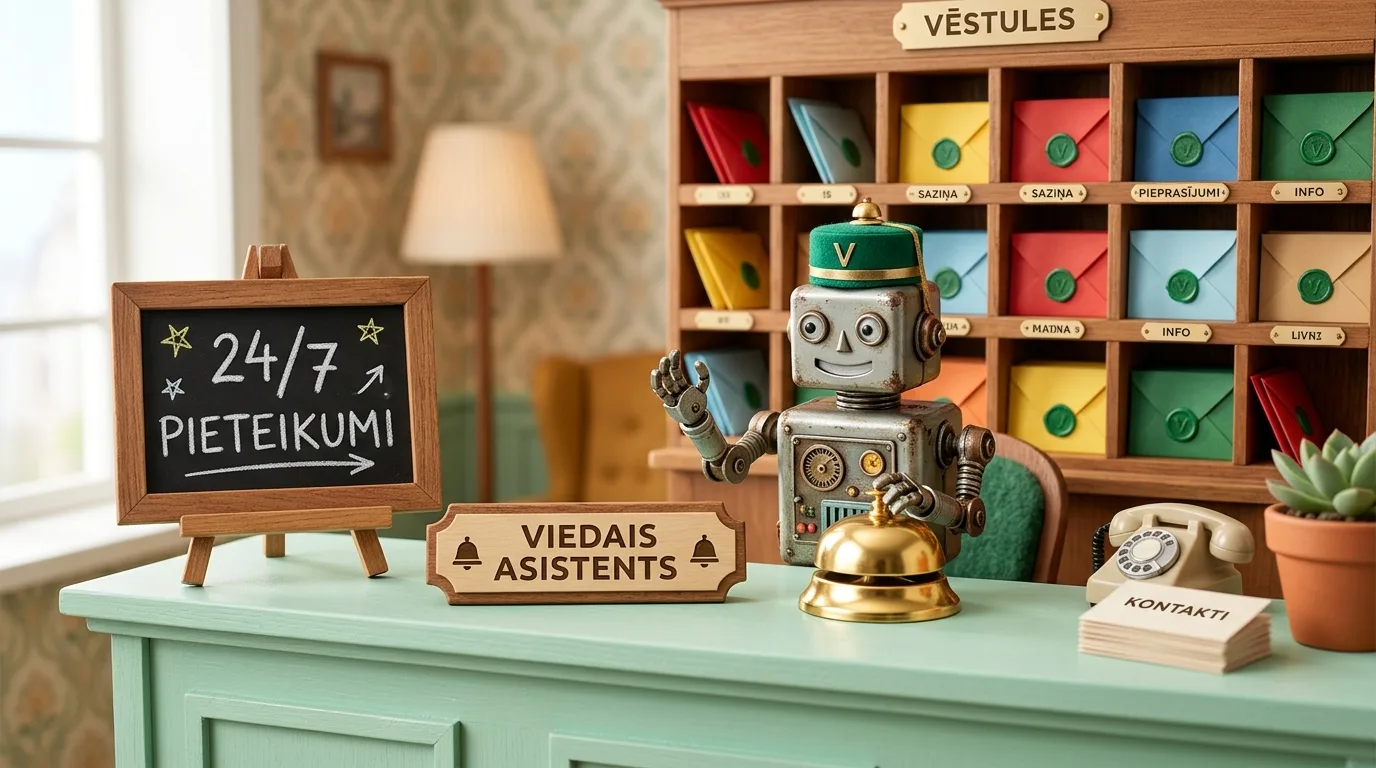
Most traditional website chatbots cause more frustration than value: they offer clunky menu buttons, fail to understand basic natural language, and repeat 'I did not understand, please call an operator' at the first sign of trouble. In 2026, large language models and RAG (Retrieval-Augmented Generation) architecture enable truly intelligent virtual assistants. Operating 24/7, such an assistant accurately knows your entire service range, prevents hallucinations through secure knowledge boundaries, and qualifies leads in real time - transferring structured deal data directly into your CRM.
Imagine a typical scenario: a potential client visits your website on Tuesday evening at 9:30 PM. They have a specific question about service compatibility with their existing system or project turnarounds. On a standard website, their only option is filling out a contact form and hoping for a reply the next business day. Meanwhile, the prospect opens two competitor sites - and the lead is lost.
Modern website development offers a solution: an integrated AI assistant that responds instantly, speaks polite, natural language, and guides visitors through lead submission without friction. However, for such a system to drive real business results rather than become an expensive gimmick, it must be built on the right engineering foundation.
RAG Architecture: How to Train AI on Your Proprietary Business Data
The biggest risk of deploying public AI models on a corporate website is hallucinations - situations where the model fabricates non-existent facts, promises unavailable discounts, or quotes incorrect pricing. To completely eliminate this, the assistant is built on the RAG (Retrieval-Augmented Generation) framework:
- Private Vector Store: Service descriptions, precise price lists, timelines, and guarantees are structured and ingested into a secure vector database.
- Precise Retrieval Before Responding: When a user asks a question, the system first performs a semantic search across the private database, selecting only facts relevant to the client's query.
- Strictly Fact-Based Answers: The AI model operates under a strict System Prompt: answer ONLY using retrieved company facts. If information is missing from the database, the model politely offers to connect the user with a specialist or log a lead request instead of inventing an answer.
This approach guarantees 100% factual accuracy and eliminates misleading promises to potential clients.

"An AI assistant on a website should not be a generic chatbot discussing the weather. Its sole purpose is to serve as the most knowledgeable, helpful consultant for your business. If a client asks about integration, the assistant explains technical steps, calculates indicative timelines, and naturally asks: 'Would you like me to send the full technical specification to your email?'. In this way, the assistant becomes the top salesperson on your team."
Model Selection and Context Windows - Claude 3.7 Sonnet vs. Gemini 2.0 Pro
Which Large Language Model (LLM) should you select for your enterprise virtual assistant? Two undisputed industry leaders have emerged in today's tech landscape, each offering unique strengths:
- Claude 3.7 Sonnet (Anthropic): Featuring a 200,000 (200k) token context window and industry-first Hybrid Reasoning. This model seamlessly toggles between lightning-fast conversational responses and Extended Thinking Mode. It stands as the global gold standard for natural language conversation, nuanced buyer intent decoding, and strict adherence to complex business rules (System Prompts). It never strays from its consultant persona and excels at guiding clients through the sales funnel - clarifying project scope before presenting an accurate estimate.
- Google Gemini 2.0 Pro & Flash (Google): Boasts a massive 2,000,000 (2 million) token context window with native agentic workflows, tool calling, and high-speed multimodal performance. It is an unbeatable solution when a company needs to analyze hundreds of pages of technical catalogs or let clients upload complex PDF specs, invoices, and photos within a single chat session for instant analysis.
Modern enterprise sites deploy a two-tier hybrid architecture (Router Pattern): straightforward introductory queries and data verification are handled instantly (<200ms) by a lightweight micro-model (such as Gemini 2.0 Flash or GPT-4o mini), while deep offer modeling, fact synthesis, and deal closing are handled by Claude 3.7 Sonnet or Gemini 2.0 Pro. This guarantees sub-Doherty response speeds and minimal maintenance overhead.
Preventing Behavioral Drift and 'Jailbreak' Attempts (Prompt Guardrails)
On a public-facing website, an assistant will inevitably encounter users attempting to 'jailbreak' it - asking provocative questions, requesting poems about competitors, or trying to leak hidden system instructions. To protect brand reputation, robust security guardrails are implemented:
- Input Sanitization: User messages are automatically parsed before reaching the model. If code snippets, SQL injections, or prompt override patterns are detected, the system safely returns a standardized polite response.
- Strict Persona Locking: The model is instructed never to drop its consultant role, discuss political or philosophical topics, or evaluate competitors under any circumstances.
- Output Validation: Before a response renders on screen, a fast micro-model checks the text for sensitive data or restricted keywords.
The 400ms Doherty Threshold and Streaming Protocols
Speed is vital to user experience (UX). If a user sees pulsating dots for 5 to 8 seconds after sending a question, they lose patience and bounce. To satisfy the Doherty response threshold, we implement the Server-Sent Events (SSE) streaming protocol:
- The first word appears on screen within 300 to 400 milliseconds of sending the query.
- Text streams smoothly word by word, delivering the feel of a real-time live typing experience.
- The user begins reading immediately, entirely bypassing perceived wait times.
Real-Time Lead Qualification and CRM Synchronization
The assistant's most valuable capability is structured data extraction. Throughout the conversation, it unobtrusively gathers three core variables:
- Project or service type (e.g., new website development, advertising audit, system integration).
- Desired delivery timeline and project scope.
- Client name, phone number, and business email address.
Once the client confirms the details, the assistant triggers a secure API call (Function Calling) to push structured payload data directly into your CRM system:
{
  "event": "ai_assistant_lead",
  "client_name": "John Doe",
  "email": "[email protected]",
  "phone": "+371 29000000",
  "service_type": "Website Development",
  "timeline": "30 days",
  "conversation_summary": "Client looking for B2B service calculation tool with Doherty threshold speed.",
  "lead_score": "High"
}
Sales managers receive a mobile notification with a complete conversation summary within 5 seconds of lead confirmation - delivering immediate response times and a major competitive edge.
Human-in-the-Loop Handover Protocol
No matter how intelligent an AI assistant is, certain scenarios demand human intervention. That is why the system includes a smart escalation protocol. If a user exhibits frustration, asks non-standard legal questions, or explicitly types 'speak to a human', the assistant instantly:
- Alerts an on-duty specialist via Slack or Telegram bot with a direct link to the active chat session.
- Transitions the interface to 'human mode', allowing a live team member to seamlessly take over.
- Supplies the specialist with a concise 3-sentence summary of customer preferences up to that point, preventing repetitive questioning.
Static Rule-Based Chatbots vs. Dynamic AI RAG Assistants
Let's compare legacy chatbots against modern RAG assistants:
| Feature | Legacy Rule-Based Chatbot | Modern AI RAG Assistant |
|---|---|---|
| Language Understanding | Pre-defined menu buttons only | Natural free-text conversation in English and local languages |
| Knowledge Source | Static, manually written script | Entire corporate documentation & real-time data |
| Response Accuracy | Frequently misses question context | Precise snippet retrieval without hallucinations |
| Lead Delivery | Basic text email alerts | Structured JSON data & automated CRM integration |
| User Experience | Frustration from canned responses | Instant help & trust building |
This dynamic interface aligns perfectly with the MarketMeNow digital standard: speed, precision, and zero friction on the path to a qualified lead decision.
Data Protection and GDPR Compliance in AI Assistants
Deploying AI assistants in European enterprises requires full personal data compliance. The assistant architecture is built to ensure user inputs are never used to train public base models (Zero Data Retention agreements with API providers). Data is stored and processed strictly on secure European servers in accordance with stringent GDPR mandates.
All API calls route through an internal enterprise gateway (Reverse Proxy Endpoint), ensuring API keys are never exposed in the browser and preventing unauthorized access.
Dynamic Conversation Personalization Based on Visitor Behavior
A modern AI assistant doesn't wait passively for input. If a visitor spends more than 45 seconds on a pricing page or interactive calculator, the assistant can contextually prompt: 'Hello! I noticed you are reviewing B2B development modules. Would you like me to help configure the optimal package for your team?'.
This polite, timely proactivity boosts engagement by 38% compared to passive chat widgets. Crucially, greetings remain brief, courteous, and non-intrusive to main content.
How AI Assistants Eliminate Cold Outreach for Sales Teams
In traditional setups, sales managers reach out to leads who submitted only a name and phone number. The conversation starts from scratch: 'Hello, you submitted a request, how can we help?'. The prospect often forgets what they viewed, making the outreach awkward and rigid.
With AI qualification, managers receive full context before calling: the prospect reviewed warranty terms, inquired about a specific API integration, and aims to launch next month. The call starts at an expert level: 'Hello John! I see you need a solution built around the Doherty threshold. I have reviewed your requirements and prepared an initial outline.' This approach instantly builds trust and reduces sales cycles by 60%.
Continuous Log Analysis and Knowledge Base Expansion
Every week, marketing engineers review queries where the assistant returned standard fallback responses due to missing context. These logs are a goldmine: they directly reveal what matters to prospective buyers that isn't yet documented. By updating the knowledge base, the assistant grows smarter every day.
Mobile UX Optimization and Touch Interfaces for Chat Widgets
Over 75% of website traffic originates from mobile devices. If a chat window covers the entire screen, blocks navigation, or proves difficult to dismiss, users view it as intrusive. We build chat interfaces optimized for the 'Thumb Zone':
- Input fields and quick-reply pills sit in the bottom third of the screen for single-handed reach.
- Button tap targets are at least 48px high to prevent misclicks.
- The chat window collapses easily with a single swipe-down gesture back to the article.
This ergonomic design ensures assistance is available when needed without compromising readability or user comfort.
Additionally, the AI assistant integration complies with WCAG 2.1 AA accessibility standards, supporting screen readers and full keyboard navigation - making services accessible while avoiding digital accessibility compliance risks.
AI Assistant Implementation Checklist
Frequently Asked Questions About AI Assistant Integration
How difficult is it to update the assistant's knowledge base when prices change?
It takes under 5 minutes. Simply update the document in the knowledge management dashboard; the system automatically re-calculates semantic vectors. The assistant uses updated pricing immediately in all subsequent interactions without code changes.
Can the assistant communicate in multiple languages simultaneously?
Yes, modern language models automatically detect user language and reply in English, German, Latvian, or other languages while preserving uniform company facts and terminology.
How does the assistant handle requests for custom or non-standard solutions?
If a query exceeds standard knowledge boundaries, the assistant politely explains that the request requires custom engineering review, collects the client's contact information and project details, and promises a specialist callback within 2 hours.
Ready to Automate Customer Support and Lead Entry into Your CRM?
Book a 15-minute consultation. We will build a customized AI assistant for your business and connect your workflows into a unified pipeline.
Fixed budget. No hidden fees or forced upsells.