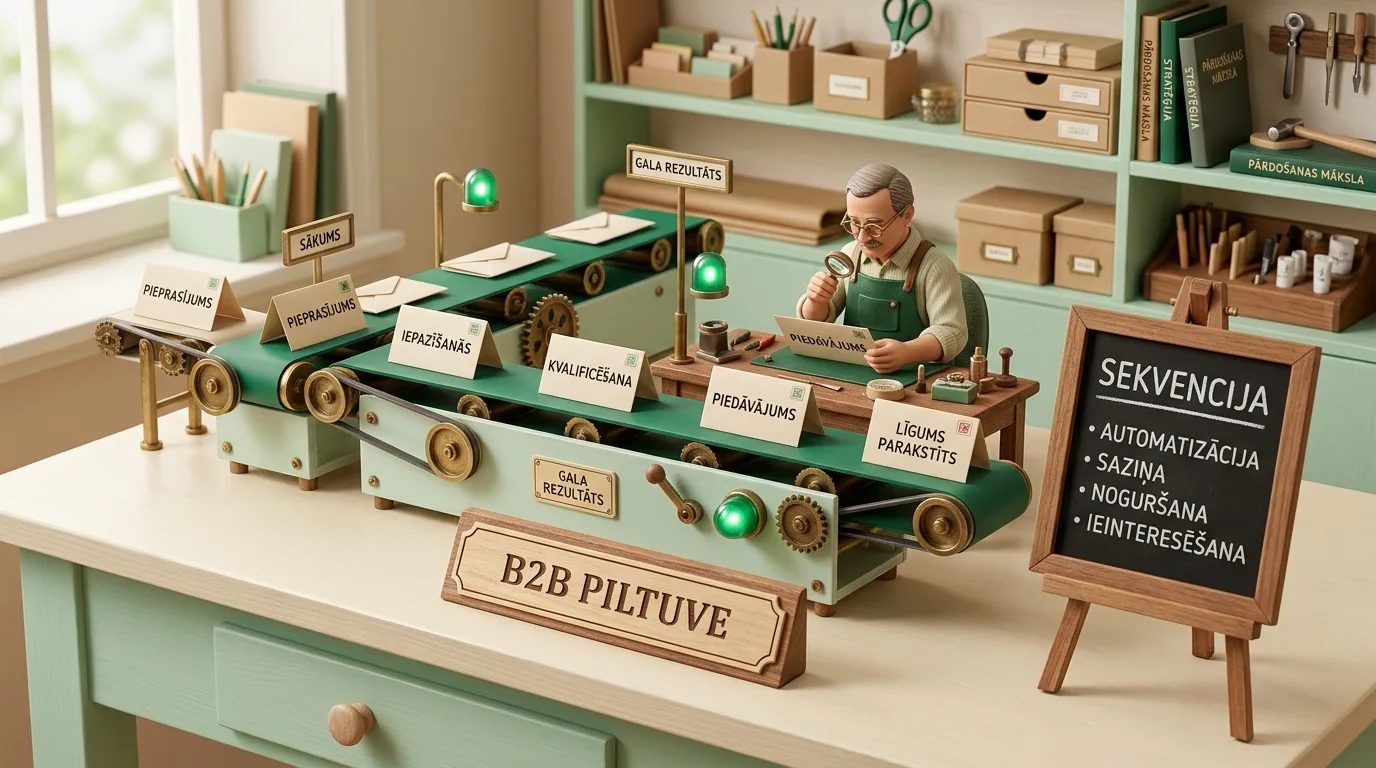
Most companies invest significant resources in digital advertising and SEO to drive traffic, yet they lose up to 80% of potential deals the moment a visitor submits an inquiry. In the B2B and high-value service market, decision-making is never impulsive - it requires building trust, evaluating risks, and aligning multiple stakeholders. Sales teams often call once or twice and, without an immediate response, write the lead off as 'cold'. Properly constructed automated email sequences take over this complex nurturing process, systematically breaking down customer doubts and ensuring a steady flow of paying clients without exhausting your sales managers.
Why manual lead processing loses 80% of B2B deals
In the B2B services and complex product sector, there is a universal truth: only 3% of your website visitors are ready to buy immediately. The remaining 97% are in the information-gathering, comparison, or problem-awareness stage. When a potential client fills out a form and downloads a quote calculator, they rarely want an immediate, aggressive sales call. They are looking for answers, comparing alternatives, and evaluating the supplier's competence.
If a company lacks a structured system, one of two extremes occurs: a sales manager calls immediately with direct sales pressure, which scares the client away, or the inquiry sits in an inbox and is processed only after 48 hours, by which time the wave of interest has already subsided. This is where strategic email automation and nurturing systems play a decisive role, responding automatically within seconds and keeping the contact warm for weeks.
A well-set funnel begins the moment a client opens the page, which is why it is critical that the site itself and the inquiry forms are built according to ergonomics and speed standards, ensured by purposeful conversion-optimized web development.

"The biggest sales mistake in the B2B sector is the assumption that an unanswered first call means an uninterested client. Research shows that an average business deal requires 7 to 12 meaningful touchpoints. No sales specialist can manually perform 10 individual follow-up calls for every prospect. An automated email sequence is your best sales assistant, delivering the right argument at exactly the right stage of the purchase journey without fatigue or bias."
B2B buyer psychology: from pain recognition to decision making
For an email series to deliver real results, it must follow the client's natural decision-making path. A classic mistake is repeating the same text in every email: 'Hello, did you have time to look at our offer?'. This approach provides no value and only annoys the recipient.
An effective sequence is built on the principle of value and trust steps:
1. First phase - immediate fulfillment of the promise: The client receives exactly what they asked for (quote file, audit summary, guide) without any sales pressure within minutes.
2. Second phase - education and uncovering invisible risks: Highlighting mistakes that industry companies usually make when choosing cheaper or unsuitable solutions.
3. Third phase - real evidence and numbers: Specific case studies on how a similar company solved the same problem and what measurable benefits it yielded.
4. Fourth phase - dispelling doubts and objections: Answers to unspoken questions about implementation timelines, guarantees, and integration with existing systems.
5. Fifth phase - low-stress call to dialogue: An invitation to have a short 15-minute strategic conversation or receive a specific system demonstration.
The five-step sequence structure step-by-step
Let's look at the precise timeline and message content that ensures the highest engagement in a service funnel:
Email 1 (sent at minute 0): 'Here are your requested materials'
The main task is immediate delivery. A link to the promised material, a short introduction on what to pay attention to in the first 3 minutes, and a reminder of who the company is. No price offers or intrusive call requests.
Email 2 (+24 hours): 'The most common mistake managers make at this stage'
Educational content that reveals an industry myth or hidden risk. For example, why cheap ready-made templates cause losses in the long run or why incorrect data tracking wastes advertising budget. This email positions your company as a thoughtful expert, not just a regular salesperson.
Email 3 (+72 hours): 'How [Client Industry Company] solved this challenge'
A story about a real situation. What the problem was, what was done, and what the result was. Concrete facts and a description of the process work better than any self-praising slogans.
Email 4 (+5 days): 'Frequently asked questions about implementation and timelines'
Preventive answering of internal fears: 'How much of our team's time will this take?', 'What are the guarantees?', 'What happens if requirements change?'. Doubts are removed before they are even voiced aloud.
Email 5 (+8 days): 'Would you like us to evaluate your situation?'
A friendly and specific invitation to the next step with a low stress level. A direct link to a calendar where the client can choose a convenient 15-minute time slot for a conversation.
Classic mass mailing vs. personalized behavioral sequences
Many companies still confuse regular marketing newsletters with targeted funnel sequences. Here are the fundamental differences:
| Criterion | Traditional Newsletter | Automated B2B Nurturing Sequence |
|---|---|---|
| Sending time | Fixed date and time for the entire database at once | Triggered by specific user actions and interest |
| Content | General company news, discounts, and greetings | Narrowly focused on solving a specific problem |
| Open Rate | Typically 15% to 22% | Average 45% to 68% due to high relevance |
| Click-Through Rate (CTR) | Low (1% to 3%) | High (8% to 18%) with one clear call to action |
| Design and format | Heavy HTML graphics with many buttons and banners | Clean, human text format that looks like a personal email |
| Business goal | Brand awareness | Converting a qualified lead into a closed contract |
Technical deliverability: SPF, DKIM, DMARC, and domain reputation
Even the most brilliant sales copy is worthless if the email ends up in the recipient's Spam folder or is silently blocked at the server level. In recent years, Google, Microsoft, and Yahoo have introduced ironclad rules for mass and commercial senders. For your emails to reach their destination, the technical infrastructure must be flawless:
1. SPF (Sender Policy Framework): A DNS record that precisely specifies which servers and services (e.g., MailerLite, ActiveCampaign, or HubSpot) are authorized to send emails on behalf of your domain.
2. DKIM (DomainKeys Identified Mail): A cryptographic digital signature key that confirms the letter has not been modified or forged during transit.
3. DMARC (Domain-based Message Authentication, Reporting & Conformance): A security protocol that determines how the recipient's server should act if SPF or DKIM verification fails (e.g., reject the email or place it in quarantine). A DMARC record with at least p=none or p=quarantine is a mandatory condition for corporate email delivery today.
4. Text vs. heavy banners: Corporate filters view emails with huge images and little text with high suspicion. In B2B communication, the highest deliverability and trust are provided by a minimalist design dominated by concise text and natural links.
Funnel conclusion: synchronization with CRM and offline conversions
The true power of automation is revealed when the email system is tightly connected to the company's CRM and advertising platforms. When a recipient opens a specific email or clicks on a price calculator link, their interest score (Lead Score) can be automatically increased in the CRM, and a task can be sent to the sales manager to make a personal call exactly when the client is actively researching the offer.
Conversely, when a deal is successfully closed and the invoice is paid, data on the actual revenue value is automatically sent back to advertising channels, as detailed in our guide on Google Ads offline conversion imports from CRM systems. This allows the algorithm to learn and subsequently attract only those visitors who actually become profitable clients.
To avoid overloading the user with unnecessary choices in the interface and to facilitate the path to an inquiry, it is also important to remember interface minimalism and decision-making speed, about which you can read in our article on how Hick's Law saves conversions on websites.
5-step plan for implementing B2B sequences
To build a profitable email nurturing funnel, follow this proven sequence:
- Lead Magnet Audit: Ensure the offered material or calculator provides an immediate, practical answer to one specific buyer pain point.
- Message Matrix Preparation: Write 5 email texts based on real customer objections, fears, and frequently asked questions.
- DNS Authentication Setup: Check and configure SPF, DKIM, and DMARC records in your company's domain zone.
- Automation Scenario Testing: Set up logical branches (e.g., if a client has already requested a call in step 3, they are automatically removed from further nurturing).
- Metric Monitoring and Optimization: Track open rates for each email individually and improve subject lines in the weakest stages.
B2B Email Automation Readiness Checklist
Frequently Asked Questions about email automation
How many emails should be in an optimal B2B nurturing sequence?
For most services and B2B solutions, the optimal number is 4 to 6 emails spread over a 10 to 14-day period. A sequence that is too short (1 to 2 emails) cannot build sufficient trust, while one that is excessively long (more than 8 emails in a short time) creates fatigue and increases the risk of unsubscribing.
What is an acceptable Open Rate for automated sequences?
For a well-personalized inquiry sequence, the first email should reach an open rate of 60% to 80%, as the client is actively waiting for the requested information at that moment. For subsequent educational emails, a healthy rate is in the range of 40% to 55%. If the rate drops below 30%, you should review the email subject lines or perform a domain deliverability audit.
Do automated emails violate GDPR data protection requirements?
Sequences sent as a direct response to a client's own request on a website (e.g., a quote calculation or material download) fully comply with GDPR legitimate interest or consent requirements. The main condition is to provide a clear, one-click unsubscribe link and a privacy policy reference at the bottom of every email.
Which automation platform should a medium-sized company choose?
It depends on the company's existing infrastructure. If you use a simpler WordPress environment, MailerLite or Brevo will work great due to their easy integration and good deliverability. If you need deep CRM integration, dynamic lead scoring, and sales team task management, the industry standards are ActiveCampaign or HubSpot.
Want to automate customer service and lead entry into your CRM?
Book a 15-minute conversation. We will develop an AI assistant tailored to your company and connect your systems into a unified workflow.
Fixed budget. No hidden fees or forced services.