
In early 2023, ChatGPT was a novelty where the main debate centered on whether artificial intelligence would replace content writers. By 2026, the industry standard is human-in-the-loop agent orchestration: AI prepares in-depth research, but human personal experience, E-E-A-T, and a unique viewpoint are the only things Google and LLM search engines highly value and cite. Learn more in our AI blog and content creation services.
Published in late 2022, OpenAI's tool ChatGPT attracted the attention of millions of users within weeks, and by early 2023, content marketing reached a fundamental question about the future of text creation. While some predict the immediate end of the copywriting profession and others fear search engine penalties for using artificial intelligence, the truth lies in a healthy balance. Artificial intelligence is an exceptional productivity accelerator and structuring tool, but without human personal experience, fact-checking, and deep audience understanding, it creates only a soulless mass of text.
Key Takeaways
- Idea generation acceleration: ChatGPT allows you to develop dozens of blog topics, article outlines, and social media drafts in seconds, overcoming blank page syndrome.
- Hallucination and fact risk: The language model does not know the truth, but rather the statistically most likely string of words; any statistical data and facts must be verified by a human.
- Google search stance: Google does not penalize content simply because AI was used in its creation; the decisive factor is usefulness and compliance with new E-E-A-T requirements.
- Hybrid work model: The highest return for companies is provided by a model where AI performs 80 percent of draft preparation, while the remaining 20 percent of highest value is added by an industry expert.
How ChatGPT Realistically Changes Content Development Processes
In the traditional marketing workflow, creating a new article from idea to finished text took several days: keyword research, reviewing competitor materials, sketching the structure, and writing the first draft. A large part of this time was spent on mechanical steps. Using correctly formulated prompts, ChatGPT can shorten this preparation phase to just a few minutes.
It is important to understand that ChatGPT is not a search engine or encyclopedia. It is a large language model (LLM) whose strengths are language logic, structuring, and text transformation. If you ask it to prepare an article framework on a specific topic with five subpoints and frequently asked questions, the result will be a logical and professional foundation for further work.
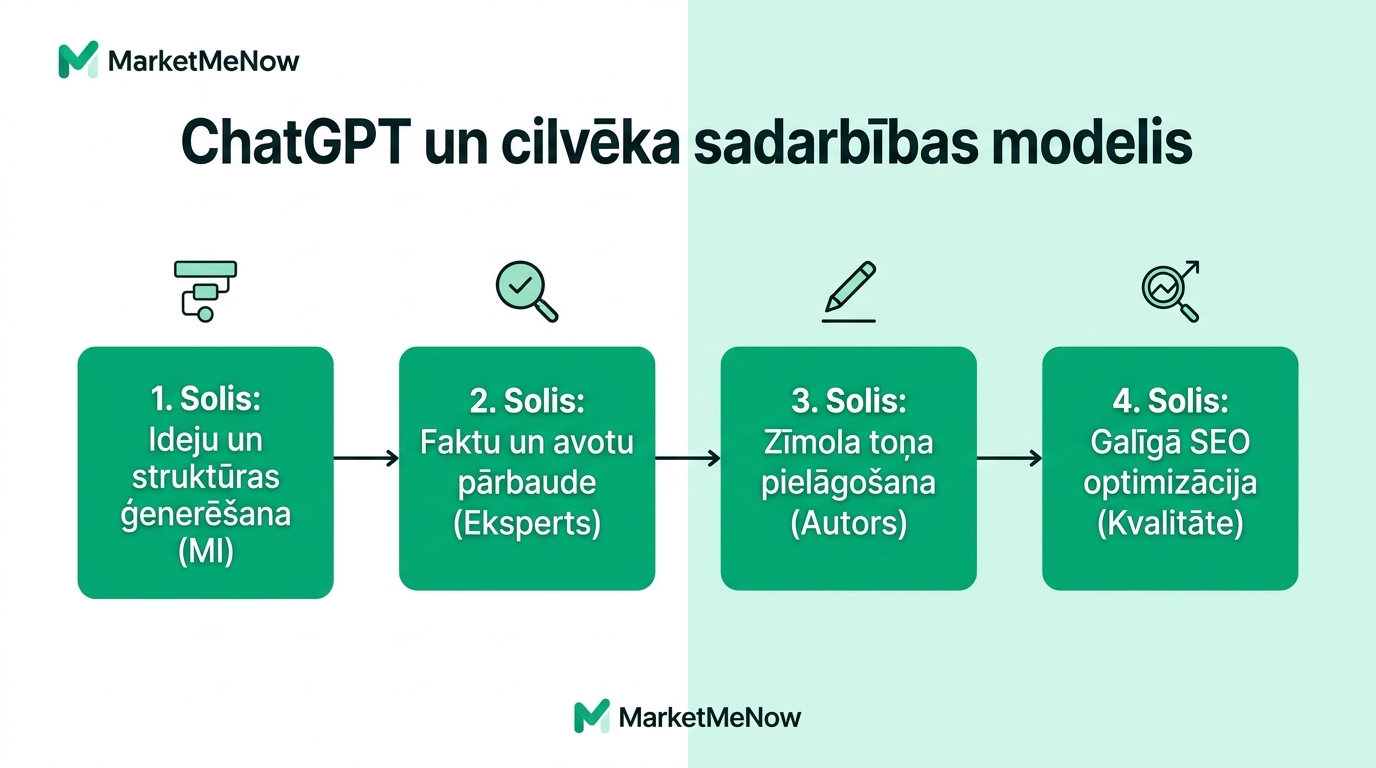
Five Areas Where ChatGPT Delivers Immediate Value
In practical daily work, companies gain the most benefit by using AI for these specific tasks:
1. Generating content ideas and topic clusters: By entering your core industry and target audience, the tool can suggest dozens of unconventional angles and questions that potential buyers are actually thinking about.
2. Creating article outlines: Before writing, AI can compile a detailed plan of H2 and H3 subheadings, ensuring the covered topic is explored comprehensively and in a logical sequence.
3. Meta description and alternative headline variations: Preparing 15 different headline variants for A/B testing or finding a concise 155-character SEO meta description is now a matter of seconds.
4. Simplifying complex information: Technical documentation or legal regulations can be quickly transformed into reader-friendly language suitable for blog readers.
5. Social media derivatives: From a single carefully crafted blog article, you can quickly generate short snippets for LinkedIn posts, Facebook updates, or email newsletters.
Where AI Capabilities End and Human Responsibility Begins
The biggest mistake made by inexperienced marketing creators is complete reliance on ChatGPT-generated text without editing (copy-paste approach). This creates three fundamental problems:
First, these are fact fabrications or hallucinations. The model can state non-existent study authors, erroneous years, or invented legal articles with complete confidence. Second, AI texts tend to use cliché phrases, wordiness, and monotonous sentence structures that quickly tire the reader. Third, AI lacks real life and work experience in a specific company - it cannot talk about your real customer cases, mistakes made, and practical lessons learned.
Practical Video Guide on Using ChatGPT
To better master prompt creation principles and see real text processing examples, watch this practical video material by Adrian Twarog:
How Google Evaluates AI-Generated Content
Google search leadership has officially confirmed that the search engine does not prohibit the use of AI tools. However, the algorithm strictly follows the Helpful Content system and E-E-A-T guidelines. This means low-quality, mass-produced content that is not based on first-hand experience and fails to satisfy user queries will be rated as low value.
The winners will be companies that use artificial intelligence as an assistant for faster work, but supplement each published paragraph with real industry practice, unique photographs, and author insight. If you want to build a sustainable and search-friendly content architecture, learn more about our SEO services or apply for a consultation with our team.
Frequently Asked Questions About ChatGPT in Content Marketing
Can Google recognize and penalize ChatGPT-generated texts?
How to best formulate a prompt to get a quality draft?
Can content created with ChatGPT be protected by copyright?
Want to create authoritative, search-cited content with AI and human synergy?
Book a 15-minute strategy call. Let's discuss your company's content marketing and GEO visibility opportunities.
Fixed budget. No hidden fees or forced services.