
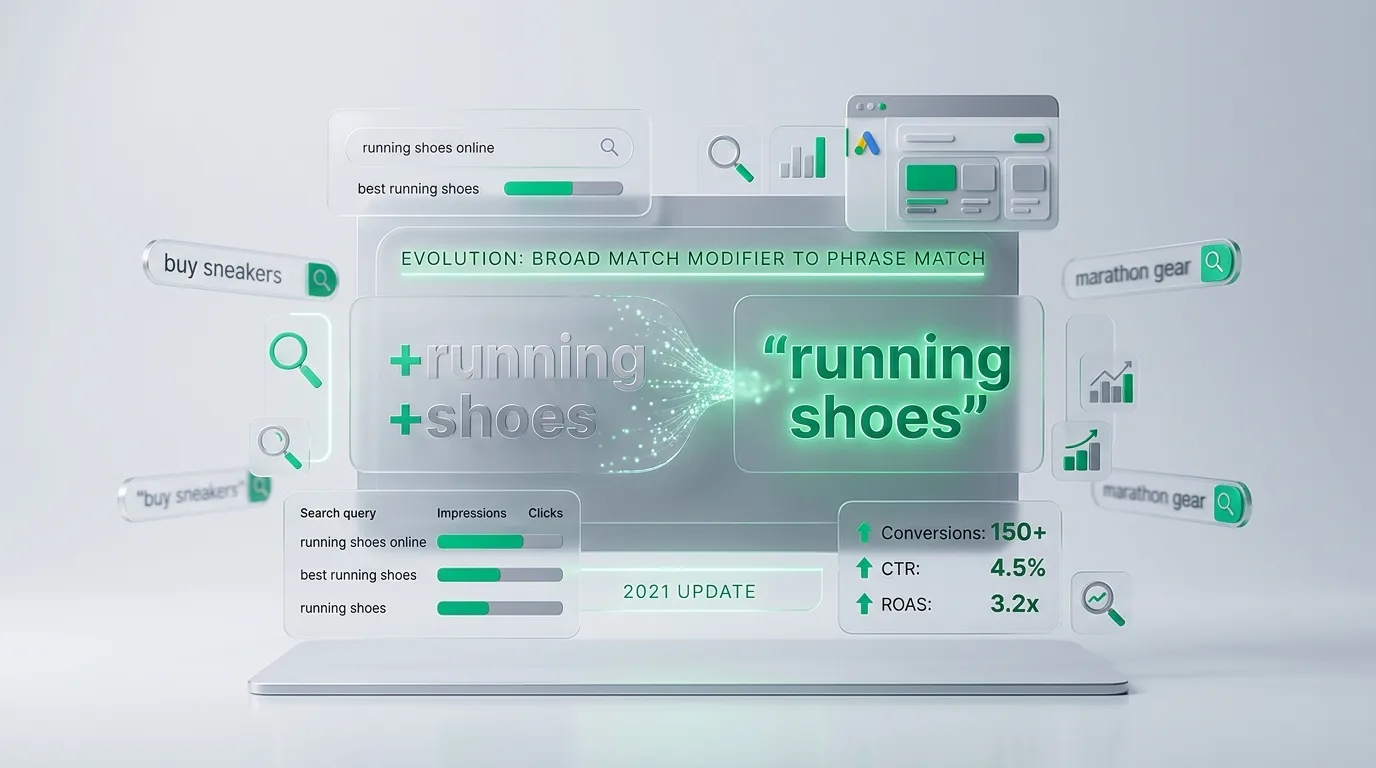
A historical analysis from February 2021 regarding the sunset of Broad Match Modifier and the reform of phrase match. Today, keyword management is based on semantic intent analysis and Broad Match combined with Smart Bidding. Learn more about our Google Ads campaign management.
Key Takeaways
- BMM Sunset: Starting February 2021, Google gradually phased out Broad Match Modifier (+keyword) support, merging its best features into the expanded Phrase Match ("keyword").
- Syntax Change: Manually adding plus signs to every word is no longer necessary - the new Phrase Match considers word order only when it is critical to the search intent.
- Impact on Costs: Campaigns with broad BMM lists may experience traffic fluctuations, making it mandatory to review negative keyword lists and auction precision.
- Strategic Direction: Google is shifting toward understanding semantic search intent rather than literal word matching.
In early February 2021, Google announced one of the most significant changes in the search advertising industry in recent years: the Broad Match Modifier (BMM) match type is being phased out, with its functionality integrated into the new, expanded Phrase Match. For years, BMM was the primary tool for digital marketers, allowing them to combine broad audience reach with strict control over the presence of specific words in a user's query. Now, that era has ended, and every advertiser must re-evaluate their keyword structure.
These changes are not accidental - they are a logical continuation of Google's strategy to move toward machine learning, semantics, and the user's actual search intent. However, for practitioners, this means one thing: if campaigns are not adjusted in time, there is a serious risk of overpaying for irrelevant clicks or losing valuable purchase queries.
What is changing: From syntax to search intent
Historically, Google Ads offered four main match types: Exact Match [exact match], Phrase Match "phrase match", Broad Match Modifier +BMM, and pure Broad Match. BMM was used as a safe bridge between the narrow Exact and the often unpredictable Broad match. By adding a plus sign (e.g., +sports +shoes +riga), we told the algorithm: these three words must be present in the user's query in any order.
With the new 2021 update, Google has integrated the flexibility of BMM into Phrase Match. The new logic works as follows:
- Word order is respected only when it changes the meaning: If a user searches for "moving from Riga to Jelgava", Google understands that the direction is crucial and will not show the ad for the query "moving from Jelgava to Riga". The previous BMM often ignored this nuance.
- Simplifying syntax: As of July 2021, the creation of new BMM keywords with plus signs is fully blocked. All existing BMM keywords automatically operate under the new Phrase Match logic.
- Looser filler words: Phrase match no longer requires words to be exactly next to each other without intermediate words, as long as the original meaning is preserved.
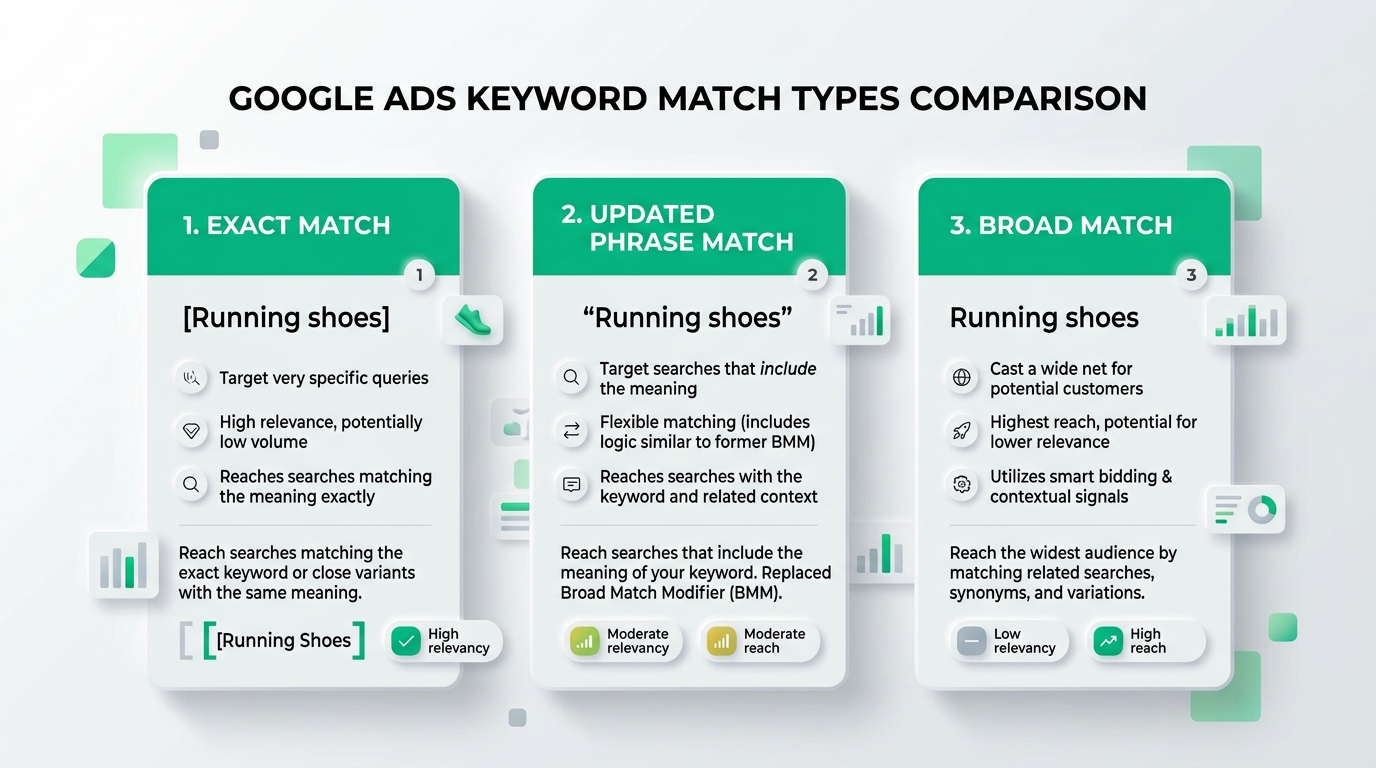
Comparison: How the system interprets queries in practice
To better understand how the new phrase match differs from the old BMM and how it affects your advertising budget, let's look at a real example involving moving services:
| User search query | Old BMM (+moving +services +riga) | New Phrase Match ("moving services riga") | Result and reason |
|---|---|---|---|
| best moving services in riga | Ad shows | Ad shows | Meaning and intent fully match the offer. |
| fast moving cargo services from riga | Ad shows | Ad shows | New Phrase allows intermediate words while maintaining the essence of the service. |
| office moving free boxes riga | Ad shows (inaccurate) | Ad is filtered or shows less frequently | The new algorithm better distinguishes buying a service from searching for free packaging. |
| moving services from ventspils to riga | Ad shows | Ad shows only if it matches the direction | Semantic direction control prevents unnecessary clicks on the wrong route. |
Historical video review: BMM sunset and practical steps
We invite you to watch the industry expert analysis and reaction at the moment of the update announcement in February 2021 on how to prepare accounts and adjust bidding:
4-step action plan for advertisers in 2021
How to implement these changes in your daily work so you don't lose conversion volume and prevent your cost-per-acquisition from rising? We recommend taking these four steps:
- Review negative keyword lists: Since the new Phrase Match is slightly broader than the old phrase match, unexpected search terms may enter your campaigns. Analyze search query reports weekly and add negative keywords at the campaign and account level.
- Do not rush to delete old BMM keywords: Existing BMM keywords will continue to work and retain their historical Quality Score. Build new campaign structures with Phrase Match, but migrate old keywords gradually based on data.
- Check for duplicate keywords in one ad group: If you previously had both
"keyword"and+keywordin one group, they now effectively become identical and compete with each other. Such duplicate sets should be consolidated to facilitate budget management. - Combine Phrase Match with smart bidding strategies: Google Smart Bidding (Target CPA or Target ROAS) is becoming even more important. The algorithm is able to evaluate the context of each query in real-time and reduce the cost-per-click if the probability of conversion is low.
How do these changes fit into the overall digital strategy?
This step perfectly demonstrates that mechanical keyword entry is no longer enough to generate profit. Effective Google Ads management today requires deep audience understanding, continuous data organization, and precise alignment of landing pages with user needs. If an ad brings a user to a slow or unclear website, even the most precise keyword will not bring the desired result. Therefore, in parallel with organizing campaigns, it is worth performing a technical audit and ensuring that organic search and website speed also meet modern requirements.
Frequently Asked Questions (FAQ)
Do I need to delete all my BMM (+keywords) immediately?
No, absolutely not. Google will automatically adjust existing BMM keywords to the new behavior without the need to delete them. By deleting existing keywords, you will lose historical data and quality scores. Perform consolidation gradually, first by eliminating obvious duplicates.
Does the new phrase match mean higher cost-per-click (CPC)?
There is no direct impact on the average cost-per-click, although cost fluctuations are possible. Since the new phrase covers a slightly wider range of searches than the old phrase, but narrower than a loose BMM, auction competition changes. Monitor the Search Terms report carefully and disable irrelevant queries with negative keywords.
What is the recommended distribution of match types in campaigns now?
The optimal structure in 2021 is based on a combination of two match types: Exact Match for high-priority, high-conversion queries and the new Phrase Match for broader audience engagement and discovering new search trends. Broad Match is recommended to be used only in conjunction with a well-trained Smart Bidding strategy and a sufficient advertising budget.
How to handle word declensions in the Latvian language?
Google algorithms for Latvian morphology have become significantly smarter over the years and are able to recognize basic declensions as close variants. However, in more complex cases and specific niches, it is still recommended to include the most popular declension variants separately to ensure maximum relevance between the ad text and the query.
Want to organize your company's Google Ads campaigns and keyword structure?
Book a 15-minute strategy call. We will review your campaign match types and eliminate budget waste.
Fixed budget. No hidden extra fees or forced services.