

A historical audit from June 2021, when Google officially began rolling out the Page Experience update. In today's web environment, performance and layout stability (CLS) are not optional: they are mandatory hygiene factors. See our approach to web development or request a website SEO audit.
Key Takeaways
- Official Launch: On June 15, 2021, Google officially began rolling out the Page Experience algorithm in search results.
- Gradual Rollout: The update process will continue through the end of August 2021, allowing for a gradual assessment of site performance and ranking impact.
- Combined Signals: Core Web Vitals (LCP, FID, CLS) are combined with existing search factors: mobile-friendliness, HTTPS security, and the absence of intrusive banners.
- The Deciding Factor: If two sites have equivalent content and backlink authority, a superior user experience becomes the primary factor for higher rankings.
After months of preparation and technical warnings, the day is here: on June 15, 2021, Google officially began the rollout of the Page Experience algorithm. The search giant has confirmed that this is a gradual process that will conclude by the end of August, protecting search results from sudden turbulence and giving administrators the opportunity to monitor real-world data.
This step marks a fundamental shift in the entire search engine optimization industry: technical performance and user comfort are no longer just recommendations, but a direct, mathematically measurable component of the algorithm. Sites that offer a fast, stable, and secure interface gain a tangible advantage in the competitive race for top positions.
What makes up the Page Experience ranking signal set?
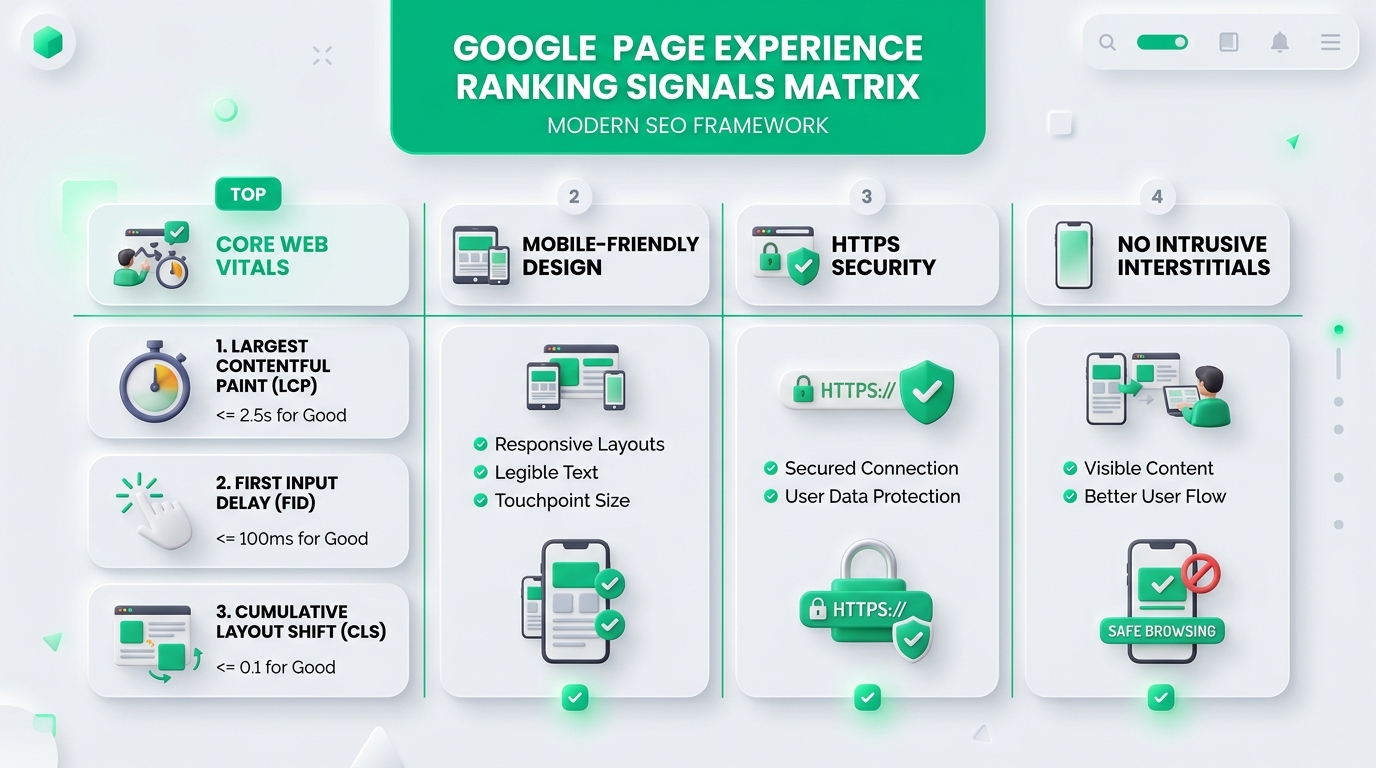
Google Page Experience is not a single metric: it is a comprehensive framework of signals that combines technological speed and usability into a unified system:
- Core Web Vitals metrics: Largest Contentful Paint (LCP < 2.5s), First Input Delay (FID < 100ms), and Cumulative Layout Shift (CLS < 0.1).
- Mobile-Friendly: Ensuring that text is readable without zooming, links are easily accessible with a thumb, and content does not exceed screen boundaries.
- HTTPS Protocol: The site must operate with secure SSL/TLS encryption. Unprotected HTTP pages are flagged as risky.
- No Intrusive Interstitials: Pages that display screen-covering ad banners or hard-to-close windows upon opening are subject to ranking penalties.
The real impact: What happens to rankings and content importance?
The most common myth currently circulating among marketing specialists is: "will a technically perfect empty page now outperform a good article with slow loading?" The answer is a categorical no. Google's official guidelines are clear:
- Content is still king: The most relevant, in-depth content will still rank first even if its Page Experience scores are not perfect. If a user is searching for unique expertise or a specific product offered by only one page, it will hold the top position.
- The decisive "Tie-Breaker" factor: In the real market, dozens of equivalent companies compete for popular keywords with good content and similar link profiles. In such cases, Page Experience metrics serve as the scale that determines who ranks #1 and who slips to #4.
- Top Stories and the removal of AMP requirements: Previously, to appear in the Google Top Stories carousel, using the Google AMP format was mandatory. As of June 2021, this requirement has been lifted: now any page that meets Core Web Vitals requirements can qualify for a Top Stories spot.
Video analysis: What to expect from the Page Experience update
Watch a professional industry explanation of how the Page Experience update will affect business websites and which mistakes must be avoided:
Action plan during the update rollout
Since the update is in full swing until the end of August, now is the right time to take three important steps:
- Monitor the Search Console Page Experience report: A new "Page Experience" section has been added to Google Search Console, where you can see what percentage of your site's URLs provide a good user experience. Aim for at least 80% to 90% "good" URLs.
- Eliminate intrusive modals on mobile: If your page immediately displays an email registration window that covers the entire screen, replace it with a discreet banner at the bottom of the page.
- Align SEO with web development: Technical parameters are not a separate SEO section: they require direct collaboration between content creators and developers. Modern web development and in-depth SEO audits must go hand in hand.
Frequently Asked Questions (FAQ)
Will my site's rankings drop tomorrow?
No. Google is rolling out the update very slowly and gradually from mid-June to the end of August. Sudden shocks within a single day are not expected. This is the time to monitor dynamics and calmly implement necessary technical fixes.
Does Page Experience also apply to desktop searches?
The initial June 2021 launch applies only to mobile search results. Google has announced that Page Experience signals for desktop versions will be introduced later (planned for early 2022). However, since Mobile-First indexing is already active, mobile optimization is the primary priority.
What should I do if my CLS score is red, but loading speed is good?
CLS is usually the easiest problem to fix. Most often, the culprits are images or video frames without HTML width/height attributes, as well as custom web fonts (FOUT/FOIT). Add fixed dimensions to all visual elements and use CSS font-display: swap to stabilize text loading.
Will a special Core Web Vitals badge appear in Google search results?
Google initially experimented with a visual indicator in search results but decided not to implement it publicly to avoid cluttering the results list. Instead, the signal works directly through algorithmic ranking.
Want to improve your website's user experience and loading speed?
Request a 15-minute strategy call. We will help identify the causes of slow loading and strengthen your website's positions.
Fixed budget. No hidden fees or forced services.