

Meta ads segmentation has fully transitioned from narrow audience building to a Creative as Targeting approach. With Advantage+ algorithms, campaign success is determined by visual contrast, the first 3 seconds of video, and accurate Conversions API (CAPI) server-side data feedback. Explore our Meta Ads services.
The Meta Ads platform has undergone significant changes in machine learning models, where the previously standard approach of dozens of narrow interest audiences is losing effectiveness. The new algorithm requires a simplified campaign architecture, greater trust in automation, and a focus on creative assets rather than complex audience labyrinths.
Key Takeaways
- Advantage+ audience dominance: Since the beginning of 2023, Meta machine learning algorithms have become much better at finding buyers within broad audiences, reducing the need for overly narrow interest segmentation.
- Campaign consolidation: Too many parallel campaigns and ad sets fragment the budget and prevent the algorithm from exiting the learning phase; an optimal structure involves no more than 2 to 3 core campaigns.
- CBO budget control: Campaign Budget Optimization (CBO) ensures automatic fund allocation to the most effective ad sets in real time, preventing manual overspending in weak groups.
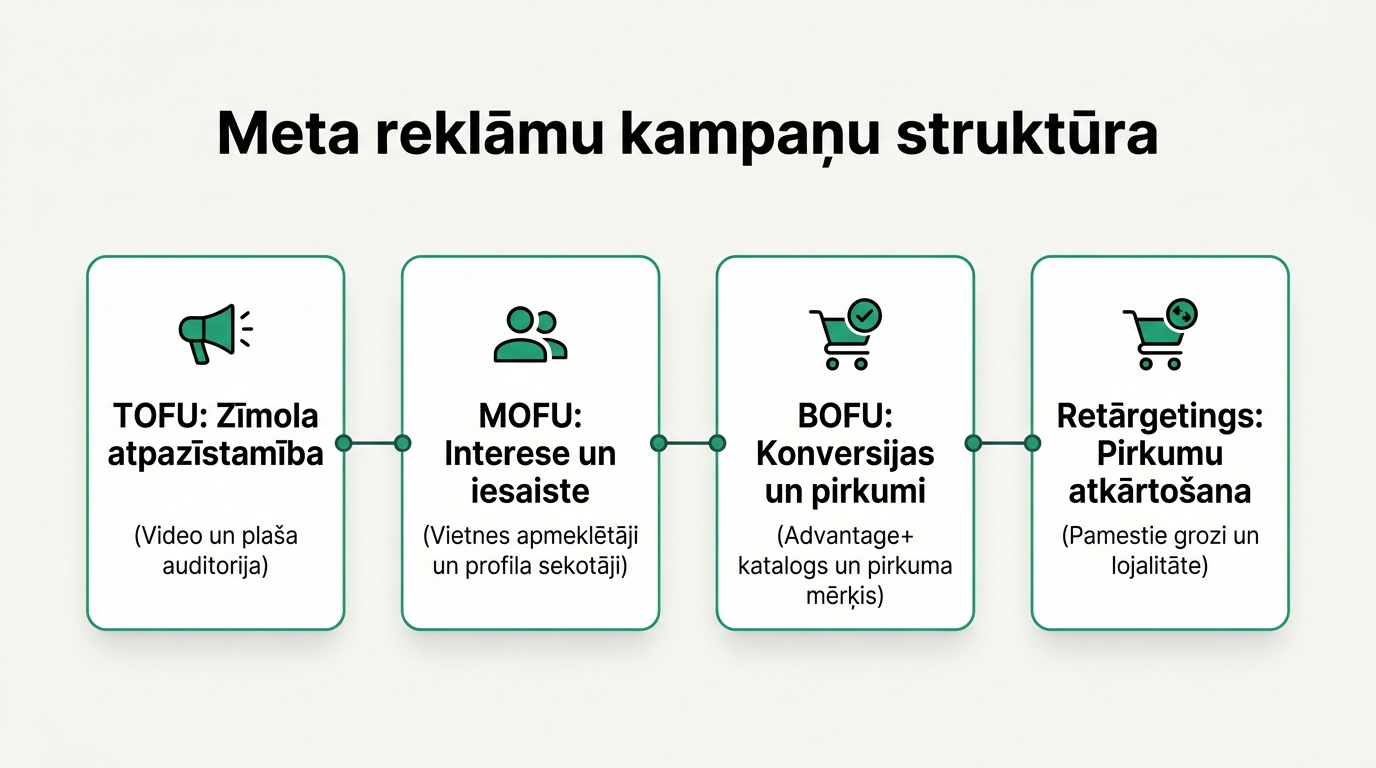
- Funnel stage balance: A successful budget split includes 70% for new user acquisition (TOFU), 20% for engagement maintenance (MOFU), and 10% for precise retargeting and cart recovery (BOFU).
Classic Audience Fragmentation and Why It Burns Budget
Just a few years ago, the standard practice for digital marketers was to create a separate ad set for every tiny interest group: one set for book readers, another for travelers, a third for tech enthusiasts. A few euros per day were poured into each group, hoping to find the magic sweet spot. Today, this tactic causes more harm than good.
The main issue is the Learning Phase. For the Meta algorithm to optimize delivery and accurately identify people with the highest purchase probability, each ad set requires at least 50 conversions within a 7-day period. If your budget is split across 10 different sets, none of them reach this threshold, resulting in volatile performance and increased cost per click.
Advantage+ Efficiency and Meta Conversions API (CAPI) Server-Side Tracking
Meta has been increasingly aggressively introducing Advantage+ automated solutions. In practice, this means advertisers no longer need to manually track hundreds of keywords or interests. By specifying only basic parameters - geographic location and age limits - the algorithm analyzes visual ad content, text, and historical pixel data to find suitable buyers on its own.
This approach works exceptionally well in e-commerce projects, where Advantage+ Shopping Campaigns can deliver a 15 to 30 percent higher ROAS compared to old manual structures. The system dynamically tests different product cards and displays the most relevant offer to the specific user.
Three-Tier Campaign Structure Guide
To maintain complete transparency and ensure data concentration, we recommend structuring your account into three main stages:
| Funnel Stage | Target Audience | Recommended Budget | Creative Format |
|---|---|---|---|
| TOFU (Top of Funnel) | Broad audience without interest filters | 65 - 75% | Short videos, pain point highlights, educational carousels |
| MOFU (Middle of Funnel) | Instagram/Facebook profile engagers, video viewers | 15 - 20% | Social proof and content (as explained in our review on user-generated content in advertising campaigns) |
| BOFU (Bottom of Funnel) | Website visitors in the last 14 days, abandoned carts | 10 - 15% | Dynamic product catalog, special offer, guarantee |
Thoughtful Digital Advertising and Budget Management: CBO vs ABO in Practical Application
The choice between Campaign Budget Optimization (CBO) and Ad Set Budget Optimization (ABO) often causes confusion. The golden rule is as follows:
CBO should be used for scaling and stable campaigns: If you already have proven creative assets and want to distribute your daily budget as efficiently as possible between broad and custom audiences, CBO allows the system to automatically direct more money to the group delivering cheaper purchases at any given moment.
ABO should be used for testing new creative assets: If you want to test a new video concept or product line and ensure that each variant receives an equal share of the budget, ABO is the right choice because it prevents the algorithm from prematurely giving all the money to the old winner.
Common Mistakes in Meta Campaign Setup
In addition to fragmentation, advertisers often make mistakes by making changes too frequently. Every time a campaign budget is changed by more than 20% or audience settings are modified, the campaign returns to the learning phase. Patience and stability are critical prerequisites for consistent profit.
Frequently Asked Questions
How often can you change budgets in Meta campaigns?
It is recommended to increase or decrease the budget no more than once every 48 to 72 hours and by no more than 15 to 20 percent at a time to avoid knocking the algorithm out of the optimization phase.
Are Advantage+ audiences suitable for B2B services as well?
Yes, but in B2B sectors, the ad visual and text itself play a decisive role. The text must precisely address business leaders or specialists, thereby selecting the right people even within a broad audience.
How many creative assets should be kept in one ad set?
The optimal number is 3 to 5 active assets with different visual formats: one video, one static image, and one carousel.
What is the minimum daily budget for CBO to work correctly?
For a CBO campaign with 2 to 3 ad sets, the recommended minimum daily budget is at least 20 to 30 euros to ensure sufficient data volume for decision-making.
Want to streamline your Meta ad campaign structure and increase order returns?
Book a 15-minute call. Let us discuss Facebook and Instagram campaign metrics, creative tests, and CAPI integration.
Fixed budget. No hidden extra fees or forced services.