
In 2026, autonomous AI agents and Make/n8n integrations allow companies to automate up to 70% of manual lead qualification routines. Learn more in our Business Process Automation guide.
In early 2025, open-source artificial intelligence models and breakthroughs like DeepSeek R1 radically transformed the economics of business automation. Companies no longer need to pay massive monthly bills to cloud giants for every processed token. In this article, we explain how self-hosted, private models slash operating costs while guaranteeing full protection of trade secrets.
Why Closed Cloud API Models Are Becoming a Corporate Burden
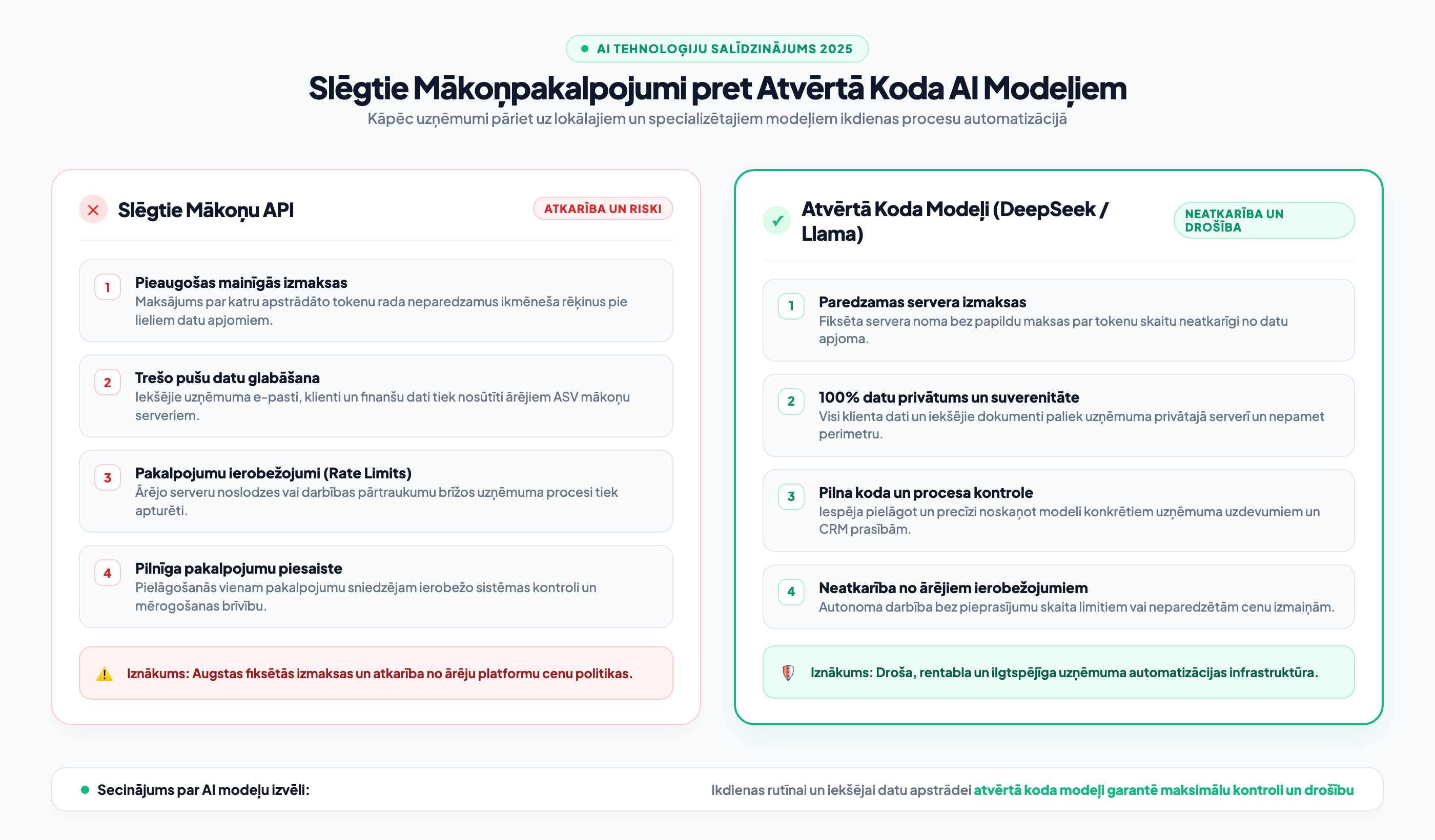
During the first wave of AI adoption, companies rushed to integrate mainstream cloud APIs into their enterprise workflows. Initially, costs seemed manageable. However, as organizations automated large-scale operations - such as analyzing customer emails, processing financial documents, and synchronizing extensive databases - token consumption fees skyrocketed. Furthermore, continuous reliance on a single third-party provider creates critical risks regarding uptime, service availability, and sudden price hikes.
The second major concern is data privacy and security. Transmitting customer details, financial reports, or internal communications to third-party servers exposes companies to legal liabilities and GDPR compliance risks. Consequently, an increasing number of enterprises are choosing to deploy independent AI assistants for businesses hosted on private servers, ensuring all data remains safely processed within their internal network.
The Strategic Advantages of Open-Source Models in Business Infrastructure
The latest generation of open-source models delivers logical reasoning, text classification, and data structuring at a level on par with the most expensive commercial solutions. The key difference lies in infrastructure: these models run on standard cloud servers with fixed monthly overheads. This means a company can process thousands of requests daily without fear of unpredictable end-of-month invoice spikes.
When combined with precise database and CRM synchronization, local AI models become an indispensable asset for daily operations. They automatically parse incoming requests, identify customer requirements, and populate system records without requiring human intervention for routine steps.

“Business owners often fear AI costs because agencies pitch expensive cloud software subscriptions. The 2025 turning point proves that a huge portion of internal business routine can be powered by open-source models on your own server, keeping commercial data completely secure.”
Step-by-Step Implementation of Local AI Solutions
Migrating to open-source models does not require massive upfront investments in enterprise hardware. Modern cloud infrastructure providers allow businesses to rent dedicated Graphics Processing Units (GPUs) for just a few dozen or hundred euros per month. As highlighted in our study on how customer service automation transforms business operations, successful implementation relies on clear task delegation.
Begin with a focused, well-defined routine - such as drafting standard replies for common customer inquiries or extracting structured data from incoming invoice files. Once the workflow is validated and operating reliably, you can systematically scale it across other business processes.
- Data Sensitivity Audit: Evaluate whether the data currently sent to external AI tools contains sensitive commercial or customer information.
- Subscription & Token Review: Calculate how much your organization currently spends on standalone AI software subscriptions and per-token API charges.
- Workflow Identification: Pinpoint at least one high-volume, routine process that could be handed over to a fixed-cost, self-hosted model.
Frequently Asked Questions About Open-Source AI Models
Do open-source AI models match ChatGPT in performance and quality?
For targeted business tasks - such as text classification, data extraction, document analysis, and logical reasoning - state-of-the-art open models (like DeepSeek R1 and Llama 3) deliver comparable or superior accuracy at a fraction of the cost.
What infrastructure is required to host a local AI model?
Smaller models run efficiently on a modern Virtual Private Server (VPS), while larger reasoning models require dedicated GPU hardware. These server resources can be rented on-demand without purchasing physical hardware.
Is enterprise data truly secure when using open-source models?
Yes, because the model runs entirely on servers under your control. Data is never routed to third-party data centers, never used to train public commercial models, and remains fully protected under your internal security protocols.
Key Takeaways and Next Steps
2025 marks the shift from ad-hoc commercial AI experiments to building sovereign, strategic corporate AI infrastructure. By taking control of your models and data, your organization establishes a resilient foundation for automation with predictable operating costs and uncompromising data security.
Ready to Automate Customer Service and Sync Leads to Your CRM?
Schedule a 15-minute consultation. We will build a custom AI assistant tailored to your business operations and connect your systems into a seamless workflow.
Fixed budget. No hidden recurring fees or upsells.