
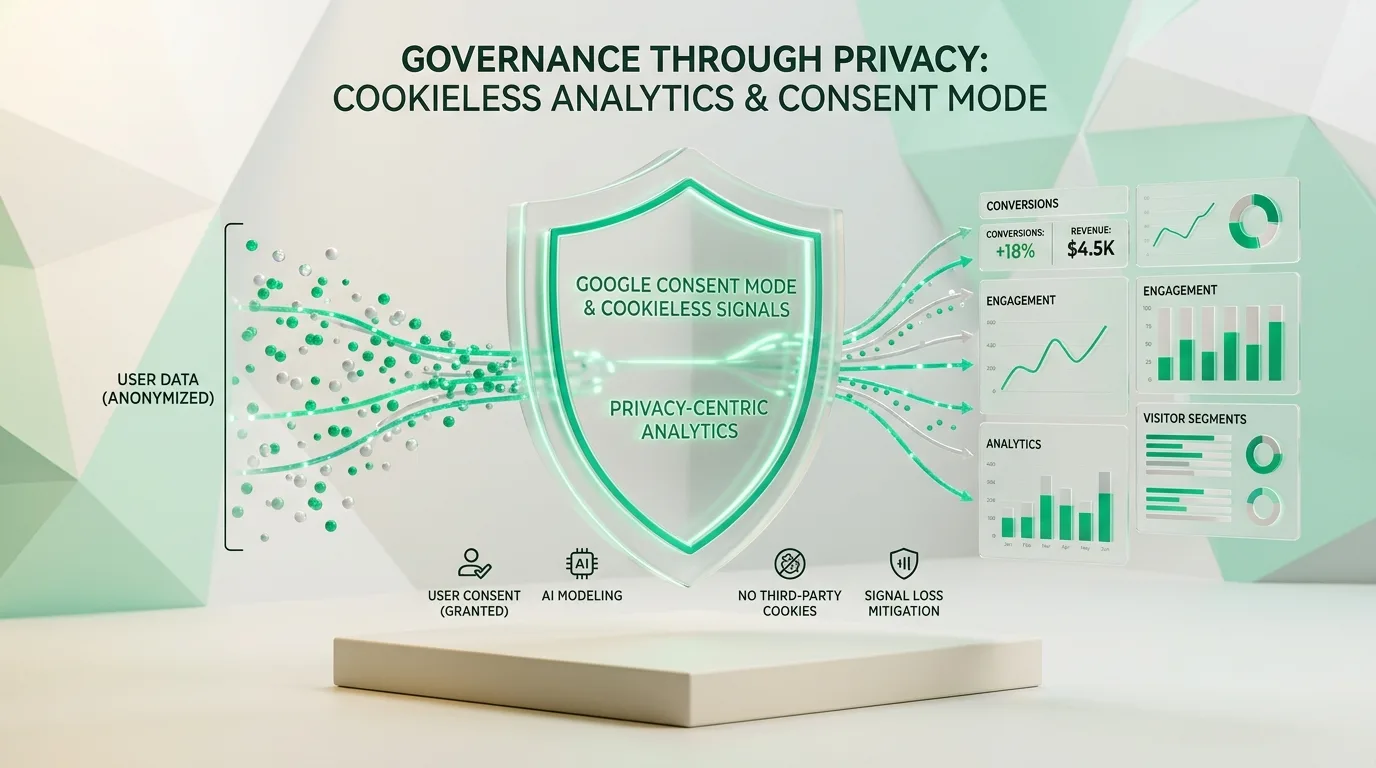
A historical 2022 guide on the fundamentals of Google Consent Mode. Today, the Consent Mode v2 standard with strict consent signal control is mandatory in the European Union. To organize your website measurements, see our data and analytics automation services.
Rising privacy requirements, where Google Consent Mode and GTM setup ensure accuracy, and stricter requirements for cookie consent banners in Europe have placed entrepreneurs in a dilemma. On one hand, the law requires blocking all marketing and analytics cookies until the user has explicitly consented. On the other hand, if 30-50% of visitors reject cookies, a massive data vacuum is created in Google Ads and analytics reports. Google Consent Mode is the technological bridge that resolves this contradiction.
Key Takeaways
- Data loss risk: Standard cookie blocking prevents auction algorithms from seeing purchases, artificially inflating the Cost Per Acquisition (CPA).
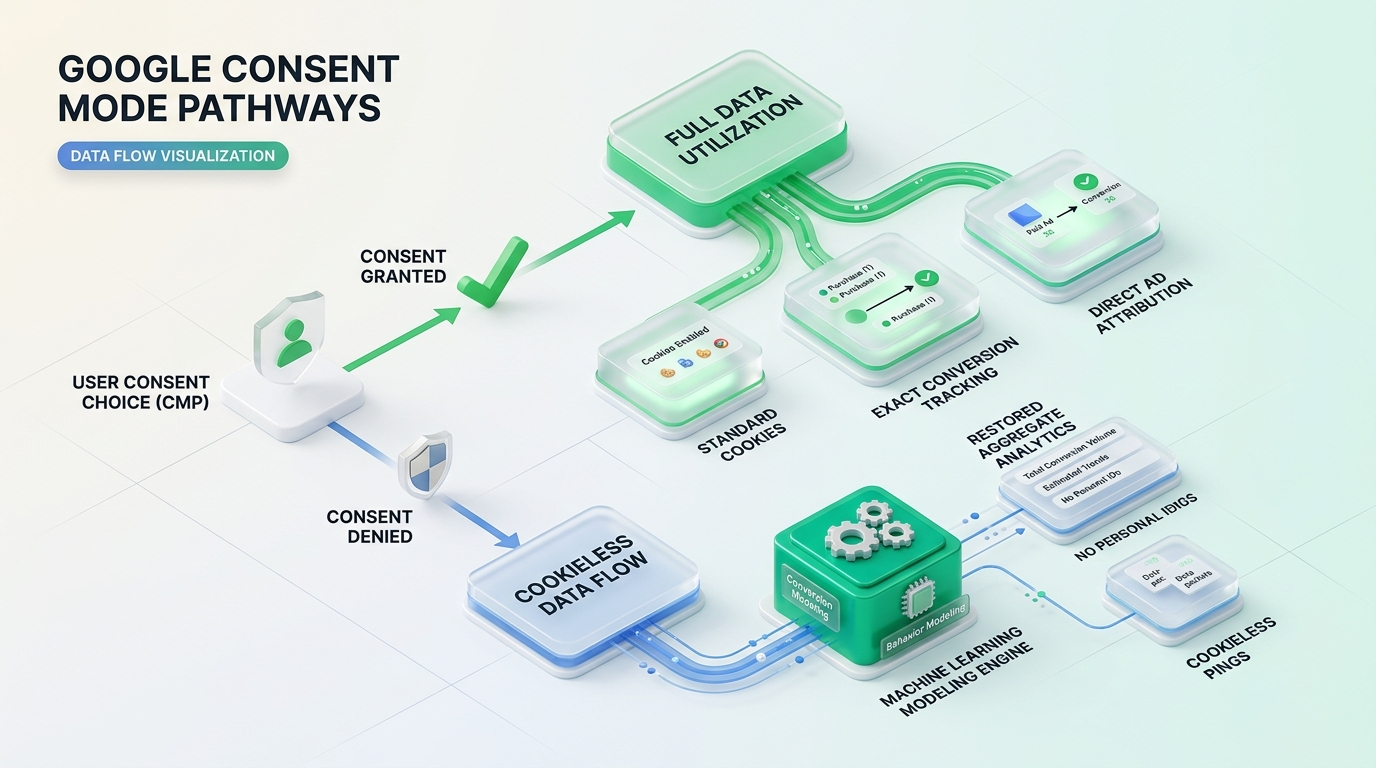
- Dual-stream architecture: If a user consents, data is recorded normally; if they decline, anonymous cookieless signals (pings) are sent.
- AI conversion modeling: Google machine learning uses anonymous signals to statistically recover lost conversions without personally identifiable information.
- Legal compliance: The solution is fully compliant with GDPR and the ePrivacy Directive, as no identifiers are stored or read on the user's device.
How the two data streams work in the Google Consent Mode system
In the classic approach without Consent Mode, if a user clicks "Reject" on the banner, all Google Tag Manager tags are completely stopped. As a result, the Google Ads system does not know whether this person later made a purchase or not. Campaign algorithms receive incomplete signals and begin bidding inaccurately.
Google Consent Mode introduces dynamic consent states (e.g., ad_storage and analytics_storage). Tags are not turned off but dynamically change their behavior based on the user's choice:
Data transmission: server-side tracking solutions and signal modeling
When consent is declined, Google Ads tags do not send or read cookies (neither _gcl_au nor user IDs are available). Instead, a minimal, anonymous ping about the event (e.g., a conversion page visit) is sent. This ping contains only technical information: timestamp, browser type, and referrer URL without any personally identifiable data.
Based on the behavior of users who have given consent, Google's artificial intelligence can model the total number of conversions with high mathematical precision. This allows marketing specialists to see the full return on campaigns, while Smart Bidding algorithms continue to receive the necessary data for auction optimization.
Official Google Ads tutorial video on Consent Mode
Watch the official Google Ads team video tutorial on Consent Mode integration, core operating principles, and benefits for ad efficiency:
Frequently Asked Questions about Consent Mode
Does Google Consent Mode replace the cookie consent banner on the website?
No, Consent Mode does not replace the banner itself (Consent Management Platform or CMP). It is a connecting protocol that receives the user's choice from the banner and immediately passes it to Google analytics and ad tags.
How long after implementation do modeled data start appearing?
To activate conversion modeling, a Google Ads account usually requires a certain volume of data (at least 700 clicks per day over a 7-day period). After reaching this threshold, modeled conversions are automatically included in reports.
Is Consent Mode compatible with Google Tag Manager?
Yes, GTM configuration (similar to what we analyzed in our review of Apple's iOS privacy revolution in advertising) is the most convenient way to configure Consent Mode. Most certified CMPs provide ready-made GTM template integrations that automatically set default and updated consent parameters.
Need a correct Google Consent Mode v2 and analytics configuration?
We will help you implement the appropriate consent mode to maintain ad measurements and stay compliant with privacy regulations.
Fixed budget. No hidden fees or forced services.