

Existing content audits and regular modernization (Content Refresh) in 2026 deliver 3x higher returns compared to the continuous publication of brand-new articles. Search engines prioritize updated materials featuring clear facts, fresh data, and direct answers. Learn more in our technical SEO and content audit section.
Most businesses thinking about SEO and content marketing fall into the exact same trap: they constantly chase new articles, publishing new material every week while texts written a year ago grow outdated and slowly lose their rankings. In reality, the fastest and most cost-effective way to double your organic visitor count is to restore your existing content. We have compiled 10 proven techniques for lifting old articles to the top of Google.
Key Takeaways
- The ultimate SEO goldmine: Refreshing existing articles delivers twice as fast traffic growth compared to publishing new articles from scratch, because the page has already built a foundation of search engine trust.
- The second-page paradox: Keywords sitting on Google's 11th to 20th positions require minimal improvements to leap into the TOP 5 and boost click-through rates by up to 300 percent.
- Search Console data audit: By filtering specific queries for which an article already shows up but receives no clicks due to low rankings, you can precisely expand the content with missing answers.
- Adding structured data and FAQs: Interactive FAQ blocks and Schema.org markup increase your occupied space in search results and capture user attention.
Why content refreshing outperforms writing new articles and how an AI blog article engine helps
When you publish a brand-new article, it takes Google anywhere from 3 to 9 months to index it, evaluate its authority, and gradually push it up in search results. A new article lacks external links and built-in user engagement history.
In contrast, an article published a year or two ago has already passed the initial review. Google knows the address of this page, and it already holds authority weight. By supplementing such material with fresh facts, a current year, and new subheadings, search engine bots register the content quality leap within days and immediately elevate your rankings.
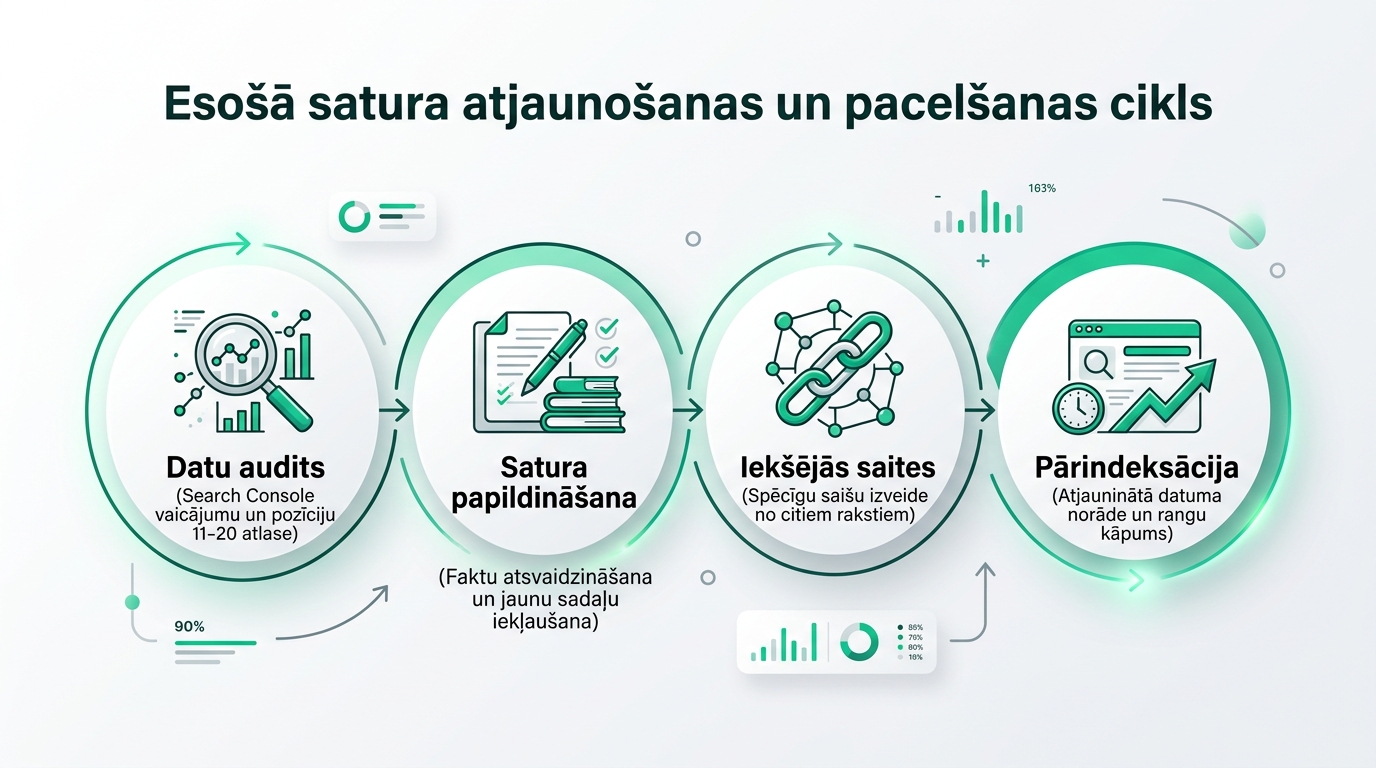
TOP 10 Content Optimization Techniques
Follow this plan (similar to what we outlined in our review on existing content audits and refreshing for visitor acquisition):
1. Filtering Search Console untapped potential: Open Google Search Console, select your specific page, and sort queries by impressions. Look for terms with positions between 8 and 20. These are queries Google already considers relevant to your article, but where the text lacks a specific answer.
2. Integrating missing subsections: Take the discovered second-page queries and create new H2 or H3 subsections with concrete, concise answers.
3. Updating years and dates: Replace old years in the title and text (for example, from 2021 to 2026). Ensure all mentioned tools, prices, and regulations match current reality.
4. Eliminating dead and outdated links: Check all outgoing links. If a page no longer exists (404 error), replace it with a fresh, authoritative source.
5. Creating new internal links: Go through newer articles published over the past half-year and place a link to the updated article using appropriate anchor text.
6. Adding visuals and infographics: A wall of text without visuals drives high bounce rates. Add a new process diagram, table, or illustration with appropriate ALT text.
7. Integrating an interactive FAQ block: Add 4 to 5 frequently asked questions with a collapsible accordion at the bottom of the article and mark them up with Schema FAQPage data.
8. Improving meta title and description: If your search CTR is below 2-3%, rewrite the title to include a clear benefit or emotion to capture attention.
9. Checking page-specific loading speed: Make sure images embedded in the article are in WebP format and the page loads instantly on mobile devices as well.
10. Requesting re-indexing: Once edits are complete, paste the article URL into the top search bar of Google Search Console and click Request Indexing.
Measuring Results and Leaping from Page 2 to Page 1
Our client practices show that professional website copywriting and refinement delivers stable results within 2 to 4 weeks:
| Metric | Before Refresh | After TOP 10 Optimization | Result |
|---|---|---|---|
| Average position for target queries | 14.8 | 4.2 | +10.6 positions up |
| Search click-through rate (CTR) | 1.1% | 4.9% | +345% click growth |
| Keywords ranked in TOP 10 | 3 words | 18 words | 6x larger semantic coverage |
| Time on page | 1 min 15 sec | 3 min 40 sec | Users read the full content |
Content Maintenance Regularity
Establish a golden rule within your company: dedicate 50% of your resources to new content and 50% of your resources to existing content audits and expansions every month. This strategy guarantees that your organic traffic base never ages out and continues generating leads for years to come.
Frequently Asked Questions
How often should old blog articles be updated?
Important articles that generate the majority of business leads or sales are recommended to be reviewed every 6 months. Other articles at least once a year.
Should I change the article URL address if the year changes?
Never! Do not change the URL address because it will destroy accumulated link authority. You should generally avoid including years in URL addresses.
Do I need to change the WordPress publishing date after updating?
Best practice is to leave the original publication date unchanged while adding an 'Updated: [date]' text label in the theme template, which Google highly values.
What should be done with articles that have not brought a single visitor for two years?
If the topic is no longer relevant, it is better to delete such an article and set up a 301 redirect, as provided by comprehensive SEO optimization for Google search.
Do you have articles on your website that are losing search rankings?
Book a 15-minute content audit consultation. Let us discuss updating existing articles and quickly boosting your search rankings.
Fixed budget. No hidden extra fees or forced services.