In 2026, automated bidding algorithms and AI agents demand even more precise human oversight and value-based data from real CRM revenue. Learn more in our Google Ads Campaign Audit.
Most advertising campaigns fail not because of incorrect keywords, but due to a poorly formulated offer. Generic headlines lacking specific facts, figures, and micro-reassurance elements receive low click-through rates (CTR) and drive up the cost per click. Data shows that clear deadlines and specific benefits in the headline can double a campaign's return on investment.
Many businesses spend months optimizing negative keywords, experimenting with bidding strategies, and adjusting target audiences, yet completely forget the only element the customer actually sees in the search engine: the ad copy and headline. Even the most precisely targeted campaign will not deliver results if the ad copy is bland, cliché, or creates the wrong expectations.
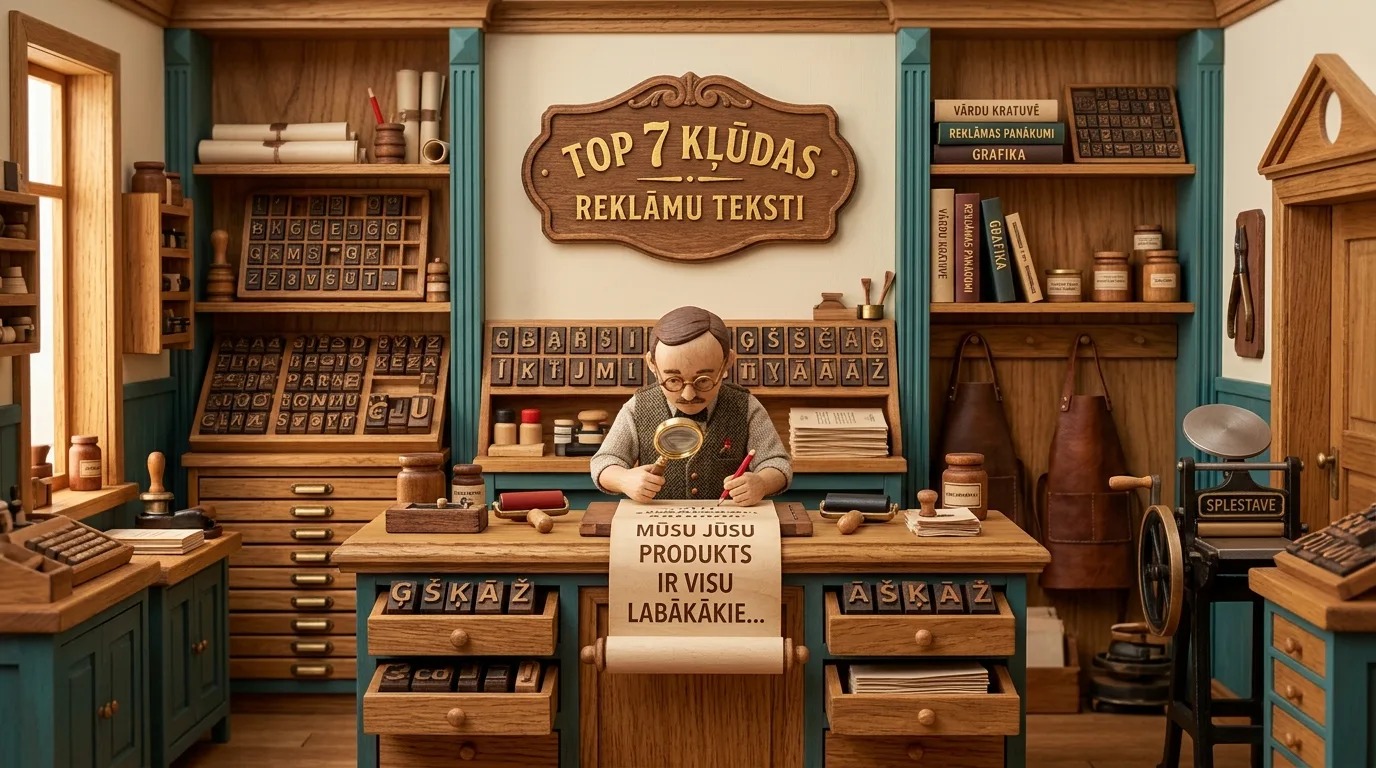
In the Google Ads campaigns we manage, we see that algorithms assign a higher Quality Score and lower CPC to ads with high expected click-through rates and relevance. Weak copy means fewer clicks, a poorer quality score, and inevitable budget overspending. In this list, we will look at the TOP 7 mistakes in ad formulation and provide proven solutions to fix them.
1. Mistake: Generic Clichés Instead of Concrete Facts
Phrases like "Highest quality at the best prices," "Individual approach to every client," and "Professional services" are used by 90% of businesses. The human brain perceives such text as "white noise" and automatically ignores it. A buyer is not looking for abstract quality: they are looking for an answer to a specific need.
- Bad example: "High-quality website development at affordable prices. Trust professionals with years of experience."
- Good example: "B2B Website Development in 96 Hours. Fixed Quote from €1,200. Lightning-fast loading under 400ms."
2. Mistake: Message Mismatch Between Ad and Landing Page
If you promise a "20% discount on winter tire fitting" in your ad headline, but the customer clicks through to the auto service homepage where this discount is nowhere to be seen, they will leave the page within 3 seconds. The ad headline and the landing page H1 headline must match almost word-for-word.

"The browser visitor is impatient. They won't go looking for your offer at the bottom of the page or in menus. If the element promised in the ad isn't the first thing they see after the page loads, you've paid for an empty click and increased your bounce rate."
3. Mistake: Lack of a Clear Call to Action (CTA)
Sales effectiveness is significantly boosted by strong website copy and sales copywriting, as a pure list of facts without a clear call leaves the user confused. At the end of the ad description, there must always be a specific verb that tells them exactly what to do and what the benefit will be: "Calculate your quote online," "Book a 15-minute call," "Download the price list."
4. Mistake: Hiding Prices and Guarantees
Business owners often fear mentioning prices in ads, thinking it will scare off prospects. However, in reality, stating the price performs an excellent filtering function: you don't pay for clicks from users whose budget is €50 if your service costs €1,000. Stating the price attracts serious decision-makers and saves budget.
5. Mistake: Filling All 15 Headlines with Synonyms
Google Responsive Search Ads (RSA) require up to 15 headlines. The biggest mistake is entering 15 variations of the same sentence ("Website development," "We develop websites," "Websites for business"). The algorithm needs variety: 3 keyword headlines, 3 benefit headlines, 3 fact/figure headlines, 3 calls to action, and 3 social proof headlines.
6. Mistake: Ignoring Ad Assets (Extensions)
Failing to use Sitelinks, Callouts, Call assets, and Image assets reduces your ad's visual size on the screen by 60%. A large ad with all assets takes up the entire first screen of a mobile phone and pushes competitors down.
7. Mistake: Imbalance Between Emotional and Rational Arguments
A purchase decision is made with both emotions and rational arguments, connected in a unified system by a well-thought-out digital advertising strategy. In the best ad copy, both of these layers are combined into one concise message.
Ad Copy Correction Summary
| Mistake | Account Impact | Recommended Solution |
|---|---|---|
| Generic clichés | Low CTR, high budget consumption | Specific numbers, hours, prices, and facts |
| Message mismatch | High Bounce Rate, lost conversions | 100% alignment between H1 headline and ad copy |
| Lack of CTA | Passive visitors without purchase intent | First-person verbs ("Calculate my quote") |
| Missing assets | Small ad, poor screen coverage | Add at least 4+ Sitelinks and Image assets |
Ad Copy Audit Checklist
Frequently Asked Questions about Google Ads Copy Optimization
Why shouldn't I write similar headlines in Responsive Search Ads (RSA)?
The Google algorithm tests headline combinations. If all 15 headlines contain the same message in different words, the system cannot find the most effective hooks for different user segments.
What elements are mandatory in high-converting ad copy?
A specific solution to a pain point, numerical proof (time, price, savings), micro-reassurance (no obligation, fixed budget), and a clear call to action.
How often should ad copy be updated?
Every 4-6 weeks, the weakest headlines and descriptions with low CTR should be replaced with new hypotheses to prevent audience fatigue and maintain a high Quality Score.
Want to ensure your Google Ads budget isn't wasted on empty clicks?
Book a 15-minute independent campaign audit. We will check your account architecture and uncover up to 30% savings potential.
Fixed budget. No hidden fees or forced services.