

Seasonal campaign preparation requires early audience warming and technical infrastructure testing: a slow e-shop or a misconfigured server during holiday shopping peaks causes massive losses. Explore our digital advertising management services.
Black Friday and Cyber Monday is the period where precisely managed Google Ads and shopping campaigns yield the highest returns, as consumer wallets are open like never before. However, for advertisers, this is also a time of brutal competition. Companies that start preparing campaigns only in mid-November usually pay astronomical click prices and end up with minimal returns. Winners lay their foundation as early as October.
Key Takeaways
- Early preparation in October: Planning campaigns at the last minute (contrary to the recommendations in our Google Ads budget and campaign preparation plan) is a guaranteed loss; preparation, lead list building, and creative approvals must begin in early October.
- CPM cost explosion (where targeted Meta Ads management becomes crucial): In the last two weeks of November, ad delivery costs (CPM) on Meta and Google networks increase by 50 to 150 percent, making new audience acquisition during this time too expensive.
- The power of First-Party Data: The highest profits on Black Friday are generated by previously collected email lists and remarketing audiences who already know the brand and are waiting for the right moment.
- Safety buffer for ad approvals: Ad materials must be submitted for approval on platforms at least a week before the campaign starts to avoid system delays in algorithmic congestion.
The Reality of Costs: What Happens to Ad Prices in November
Advertising platforms like Google Ads and Meta Ads operate on an auction basis. When thousands of local and international retailers simultaneously pour massive budgets into reaching the same audience, auctions become extremely heated. CPM (cost per 1,000 impressions) in November typically increases by 60 to 120 percent compared to a regular month.
If you try to target a 'cold' audience that is hearing about your brand for the first time during this expensive period, the acquisition cost (CPA) will eat up your entire profit margin. The only profitable approach is a two-stage strategy: accumulate an audience in October at low costs and monetize it in November with an irresistible offer.
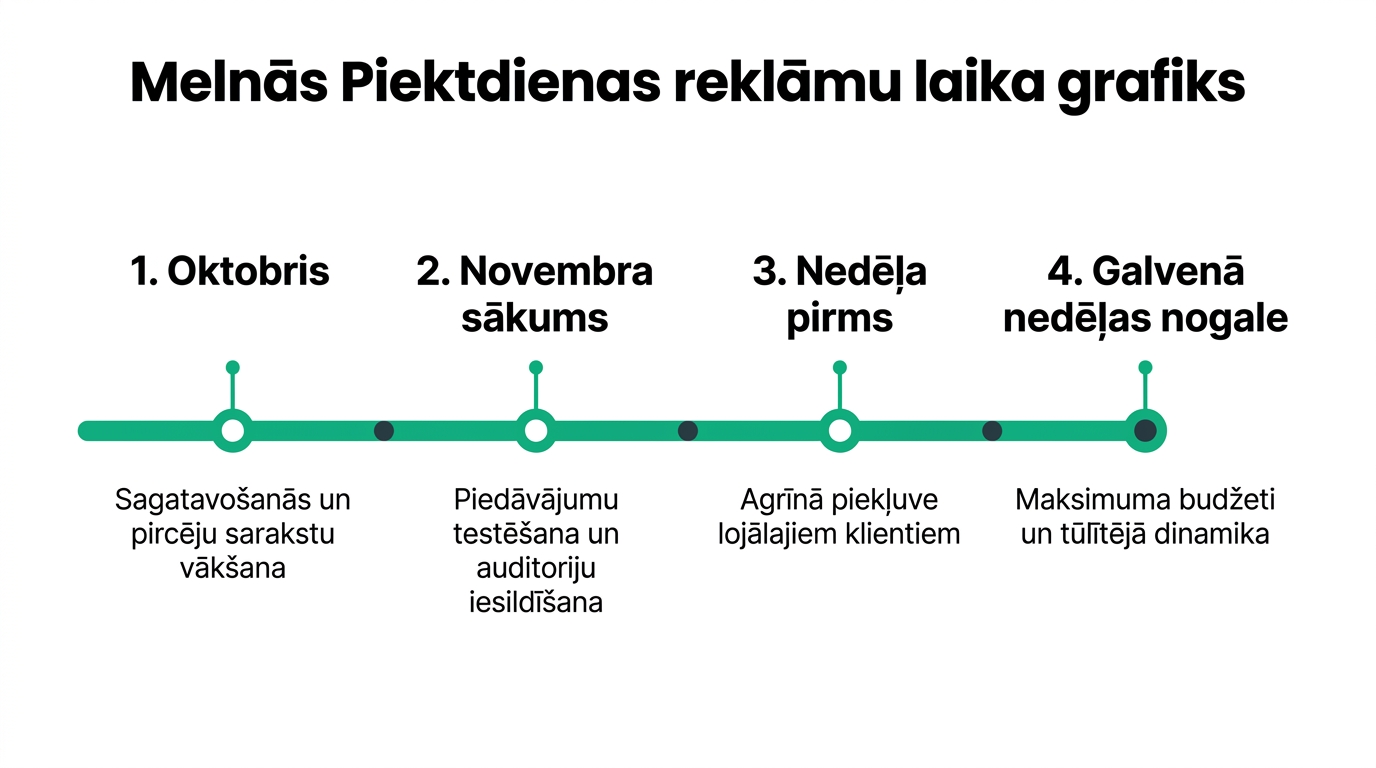
Four-Phase Campaign Timeline and Action Plan
To maximize returns, campaigns should be organized into four logical phases:
Phase 1 - October (Preparation and Lead List Building): Create a dedicated campaign while stable data control is ensured by GA4 and Google Tag Manager architecture for conversion tracking; set up 'Early Access' landing pages. Offer users the chance to register their email to receive Black Friday discounts 24 hours before everyone else. These contacts will become your most valuable and cheapest sales channel.
Phase 2 - First Half of November (Audience Warming and Offer Testing): Launch video and carousel ads featuring the brand story and most popular products. During this time, CPM is still reasonable, allowing you to build strong 30 and 60-day remarketing bases.
Phase 3 - Week Before Black Friday (Early Access): Open the promotion to your registered customers and email subscribers. This allows you to distribute the warehouse and order processing load, while also securing initial revenue before the general market frenzy.
Phase 4 - Black Friday Weekend (Peak Budgets): Shift all efforts to dynamic remarketing and Performance Max campaigns, reminding users of the remaining hours and limited stock.
Principles for Preparing Creative Materials and Offers
Users are bombarded with hundreds of banners during this time. To stand out through the noise:
| Element | Typical Mistake | Winning Approach |
|---|---|---|
| Offer Clarity | Vague discounts 'up to 20%' | Clear and strong offer, e.g., '-40% off everything' or 'Buy 2, get the 3rd as a gift' |
| Visual Format | Standard product photos with small text | Dynamic videos with bold text and specific promotion deadlines |
| Ad Approval | Submitting banners on the morning of the sale | All visuals submitted and approved at least 5 days in advance |
| Mobile Landing Page | Complex shopping experience with many steps | One-step checkout with Apple Pay and local parcel locker selection |
How to Prepare Budgets and Avoid Smart Bidding Paralysis
If you simply increase your campaign budget by 500% on Black Friday morning, Google and Meta algorithms will get confused and may stop showing ads. To prevent this:
Increase budgets gradually starting a week before the promotion. Use the Google Ads 'Seasonality Adjustments' tool to notify the algorithm that a 150-200% increase in conversions is expected over the weekend. This will allow the system to bid more aggressively in auctions without fearing learning errors.
Frequently Asked Questions
Is it worth participating in Black Friday if the profit margin is small?
If you cannot offer a large discount, it is better to offer additional value: free shipping, a useful gift with purchase, or an exclusive bundle.
When is the best time to turn off Black Friday campaigns?
The biggest mistake is turning everything off on Friday night. Many shoppers buy on Saturday, Sunday, and Cyber Monday; continue campaigns at least until Monday evening.
Should I use Advantage+ Shopping campaigns for Meta Ads?
Yes, Meta Advantage+ Shopping campaigns have shown excellent efficiency in e-commerce when fed with high-quality videos and dynamic product catalogs.
Conclusions and Next Steps
Black Friday is not a sprint, but a carefully planned marathon. Start preparing your audiences and materials today so that by the end of November, you can manage the process with confidence and gain maximum return from every euro invested.
Preparing for major sales campaigns and want maximum profit from every advertising euro?
Book a 15-minute campaign planning call. We will develop a precise plan for advertising and server load preparation.
Fixed budget. No hidden fees or forced services.