

Reducing cart abandonment is all about removing friction: eliminating mandatory registration, offering instant parcel locker selection, and enabling 1-click payments, combined with automated abandoned cart email sequences, can recover 15-25% of lost orders. Explore our business and email automation services.
Imagine a physical store where seven out of ten shoppers fill their carts, walk to the register, but the moment they reach for their wallets, they simply turn around and leave. This is exactly what happens in most e-commerce stores every single day. The global average cart abandonment rate is approximately 70%. Businesses spend thousands of euros on advertising to bring visitors to their site, only to lose the transaction at the very finish line. Let us look at the 8 main reasons and their technical solutions.
Key Takeaways
- 70% untapped potential: According to Baymard Institute research, an average of 70% of all e-commerce carts are abandoned without a purchase; even a small improvement in conversions leads to a significant jump in revenue.
- Shipping cost transparency: The number one reason for cart abandonment is unexpectedly high or hidden shipping costs that appear only at the final checkout step.
- The need for Guest Checkout: Mandatory requirements to register a user profile and verify an email before purchasing deter nearly one in four shoppers.
- One-page checkout optimization: Reducing checkout forms to a single clear screen with local parcel locker and express payment integration eliminates friction and speeds up the purchase.
Top 8 reasons why shoppers abandon carts at the last minute
Alongside checkout steps, the product page is crucial (as we explained in our guide on the most essential elements of an e-commerce product page). When studying shopper behavior, eight main friction points have clearly emerged:
1. Unexpected extra costs at checkout: A shopper sees a jacket for 50 euros, adds it to the cart, but at checkout, a 5-euro shipping fee, VAT surcharge, or packaging fee suddenly appears. This psychological blow makes them feel cheated.
2. Mandatory user profile creation: The user wants to buy one item quickly. If the store requires them to create a password with uppercase letters, numbers, and wait for a confirmation email, the purchase is postponed and forgotten.
3. Complex and overly long checkout process: If the checkout form requires 15 different fields (fax, second address line, zip code twice), people on mobile phones simply get tired.
4. Lack of local delivery methods (Omniva, DPD, Venipak): In the Baltic market, parcel lockers have become an absolute standard. If an e-store only offers courier delivery during business hours, a large portion of customers will abandon the order.
5. Limited or inconvenient payment options: If the only way to pay is a manual bank transfer or entering credit card details without Apple Pay/Google Pay support, friction increases.
6. Site slowness and technical errors at checkout: If page loading between steps takes 5 seconds or an error message appears without explanation, trust vanishes.
7. Lack of trust and security elements: In an unknown store without a clear return policy, company details, and security certificates, the shopper is afraid to enter their card details.
8. Invalid discount codes and coupon hunting: A huge 'Enter discount code' field prompts the shopper to open Google and search for coupons. If no code is found, they feel they are overpaying, and the purchase is not completed.
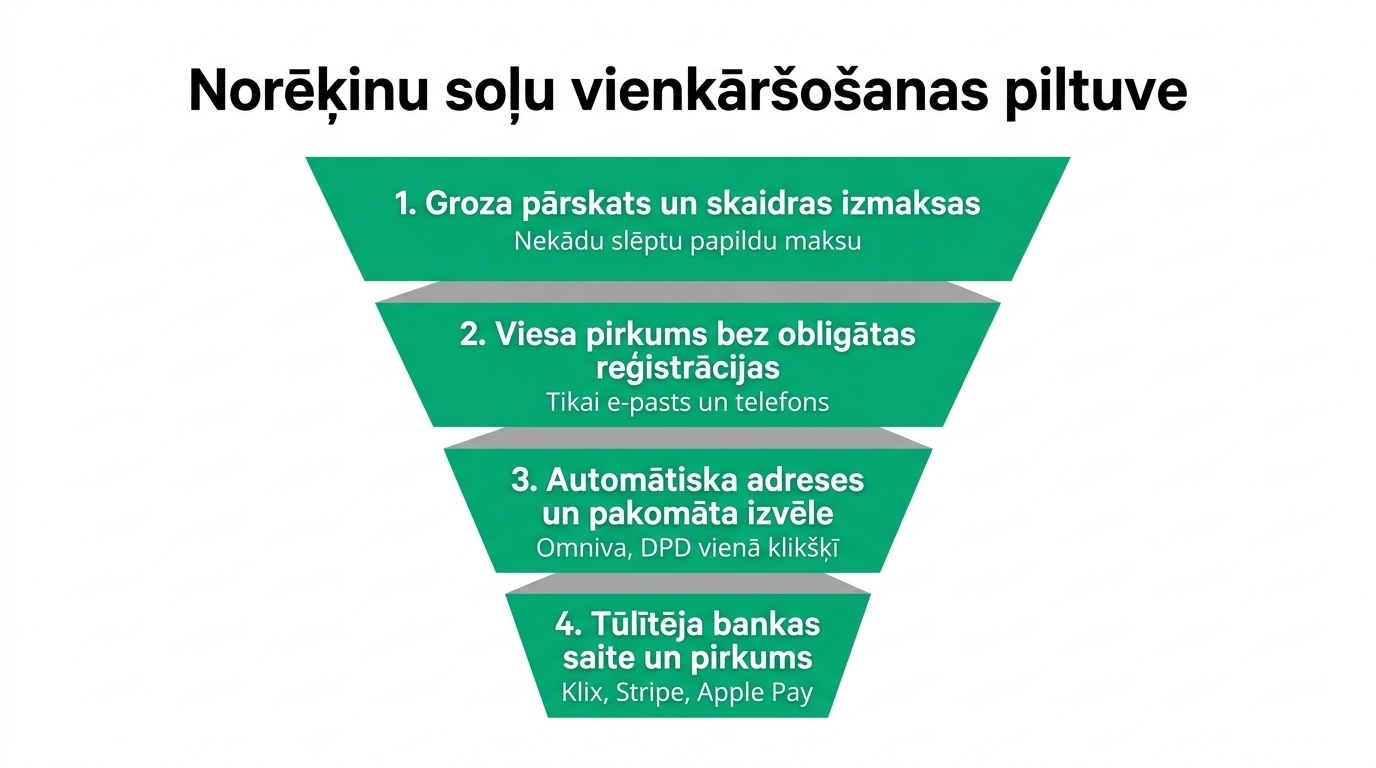
How to transform your checkout with One-Page Checkout
A standard e-commerce checkout process usually consists of four separate screens: Cart -> Details -> Shipping -> Payment. Each additional screen reduces conversion by 10 to 15 percent.
A modern solution is One-Page Checkout (similar to targeted landing page development), where all necessary information is entered on one clear screen in two columns: contact information, parcel locker, and bank on the left; cart summary with a clear final total on the right.
E-store checkout optimization checklist
Implement these technical solutions in your WooCommerce or Shopify store:
| Feature | Recommended technical solution | Impact on conversion |
|---|---|---|
| Guest Checkout | Enable purchase without registration with automatic background profile creation | +15% to +25% completed purchases |
| Parcel locker integration | Automatic nearest locker finder by city or geolocation | +20% in mobile purchases |
| Express payments | Apple Pay, Google Pay, and Klix / MakeCommerce banklink integration | Purchase time reduced from 3 min to 20 sec |
| Shipping calculator in cart | Show shipping price immediately, before opening checkout | Prevents 'hidden cost' shock |
| Abandoned cart emails | Automatic 3-email series (after 1h, 24h, and 48h) | Recovers 8% to 12% of abandoned carts |
Automated abandoned cart recovery strategy
Even with a flawless checkout, some users will turn away due to a phone call or urgent work. To bring them back:
Set up a three-step email chain powered by flexible email marketing automation. The first email should be sent just 60 minutes after abandonment with a friendly reminder: 'Was everything okay? Your selected items are waiting in your cart'. The second email after 24 hours can offer help or answer frequently asked questions. The third email after 48 hours can offer a small free shipping code valid for 24 hours.
Frequently Asked Questions
What is a healthy cart abandonment rate for an e-store?
On average in e-commerce, it is around 65-70%. If you manage to reduce cart abandonment below 60%, your checkout usability is well above the market average.
Should the discount code field be hidden on the checkout page?
Yes, best practice is not to show a large input field, but a small text link 'Do you have a gift card or discount code?', which opens the box only after clicking.
Does a free shipping threshold reduce cart abandonment?
Yes, a dynamic progress bar in the cart ('Add 12 € more and get free shipping!') not only reduces abandonment but also increases the average order value.
Conclusions and next steps
Cart abandonment analysis, accurately provided by e-commerce tracking and revenue accounting, is the most cost-effective way to increase e-store turnover without additional advertising spend. Eliminate hidden fees, provide guest checkout, and offer the most convenient local delivery and payment methods. Every removed friction point on the checkout page directly reflects in your business success.
Want to reduce cart abandonment and automatically recover indecisive shoppers?
Book a 15-minute call. We will implement automated email sequences and optimize your checkout flow.
Fixed budget. No hidden extra fees or forced services.