

A historical content strategy guide from July 2021. We are currently demonstrating this exact practice in our own archive: regular auditing of existing content, updating outdated facts, and strengthening cluster links is the fastest path to organic traffic growth. Learn more about our SEO audit services.
Key Takeaways
- Faster ROI: Updating an already indexed article with existing authority and backlinks is 3 to 5 times faster and more cost-effective than writing new content from scratch.
- Content Decay: Over time, even the best articles lose rankings due to outdated data, broken links, and competitor activity.
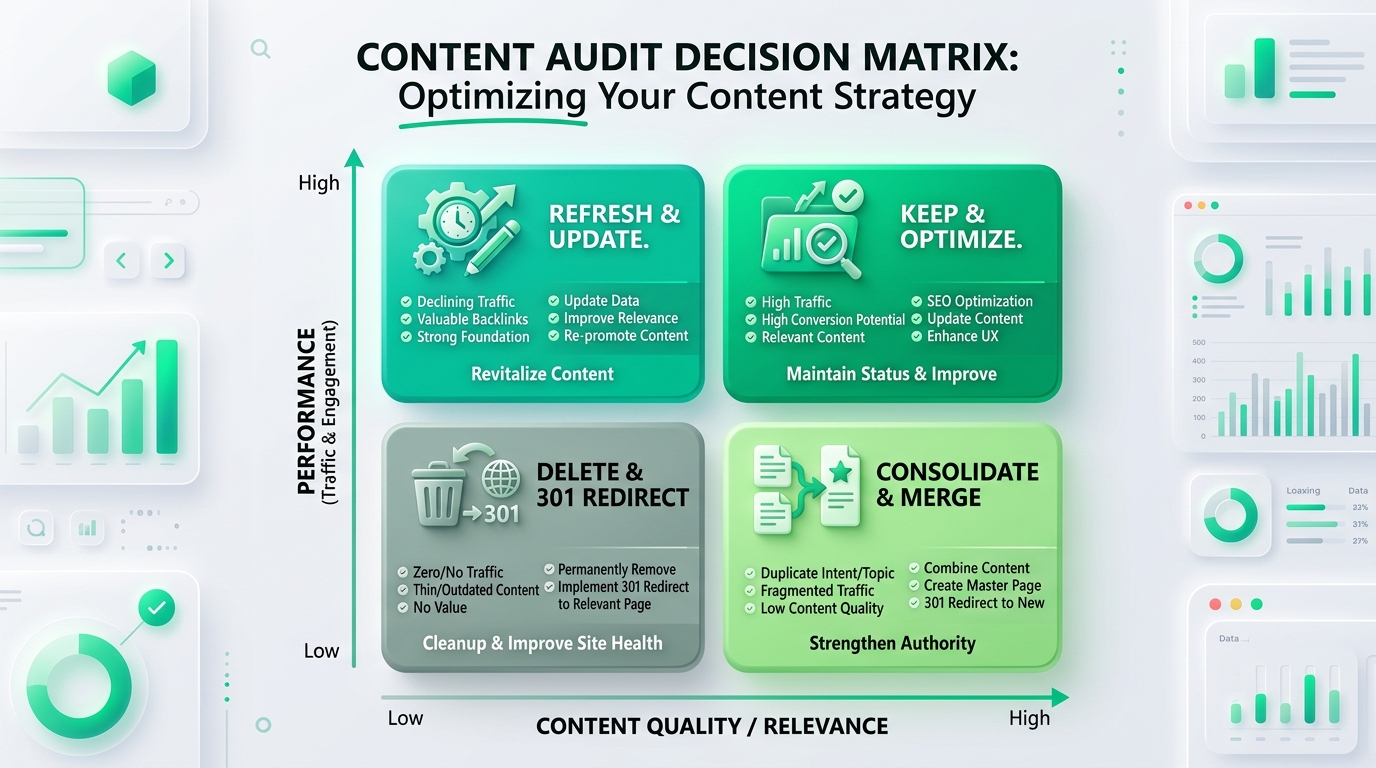
- Decision Matrix: A content audit allows you to categorize all pages into 4 clear actions: keep and optimize, consolidate, update, or delete with a 301 redirect.
- Quality over Quantity: Google values the overall content density of a site - deleting redundant, empty pages often boosts the organic ranking of the entire site.
Most companies, when thinking about SEO and content marketing, make the same strategic mistake: they continuously create new pages and blog posts while completely forgetting about the content that has been on their website for years. However, the reality is harsh: over time, content decay occurs - data becomes outdated, links stop working, and competitors create more in-depth materials, gradually taking your positions in search results.
In the summer of 2021, one of the smartest SEO moves is to perform a comprehensive content audit. Experience shows that updating and structuring existing articles can provide a significantly larger and faster increase in organic traffic than publishing dozens of new, weak articles.
What is a content audit and the 4-decision matrix?
A content audit is a systematic evaluation of all public URLs on your site, based on three main data sources: Google Search Console clicks, Google Analytics engagement data, and your backlink profile. Each page is assigned one of four statuses:
- Keep & Optimize: Articles with good traffic and stable positions. These only require minor improvements: updating Title and Description tags for a higher CTR, and adding internal links to new services.
- Refresh & Update: Articles that have historically had high traffic and valuable backlinks, but have seen a decline in the last year. These need updated data, fresh examples, improved structure, and a refreshed publication date.
- Consolidate & Merge: Several short articles on the same topic that compete with each other (keyword cannibalization). These are combined into one powerful resource, and the old URLs are redirected with a 301 code.
- Delete & 301 Redirect: Outdated, empty pages (thin content) with no traffic and no value. Such pages burden the Googlebot crawl budget and drag down the authority of the entire site.
Step-by-step: How to properly update an old blog post
Once you have selected the articles that need a refresh, follow this 5-step process:
- Check search queries in Google Search Console: See which terms this article is already getting impressions for. Often, you will discover questions that are not answered in the article. Create a new subsection with an H2/H3 header specifically for this purpose.
- Replace outdated facts and dates: Ensure the text does not mention old years, defunct tools, or broken external links. Add the latest market data and examples.
- Improve visual format and readability: Break long blocks of text into short paragraphs, use bulleted lists, add infographics, and include collapsible FAQ sections.
- Never change the URL without necessity: Keep the original URL slug unchanged to avoid losing received external links and authority.
- Update the publication date and request re-indexing: After significantly supplementing the content, update the date and submit the URL for inspection in the Search Console "URL Inspection" tool.
Video tutorial: How Ahrefs updates content and gains traffic
Watch one of the best industry video tutorials on how the Ahrefs team regularly reviews their old blog posts and systematically grows their search metrics:
Integrating content audit with business goals
A content audit is not just about fixing text - it is a powerful tool for strengthening overall site health. While reviewing content, simultaneously check if old pages meet the new Core Web Vitals speed standards and if they are adapted for Mobile-First indexing. If your site has accumulated a large number of outdated sections, a professional SEO audit and thoughtful website structure improvement will allow you to get rid of digital ballast and pave the way for stable traffic growth.
Frequently Asked Questions (FAQ)
How often should a company website perform a content audit?
We recommend performing a comprehensive content audit at least once a year, while reviewing data for priority articles and main service pages every quarter. This allows you to notice position fluctuations in time before traffic drops.
Can I just delete old articles that have no traffic?
Yes, but only with proper redirection. If an article is useless and has no traffic, it can be deleted, but its URL must be redirected with a 301 code to the most thematically relevant category or service page. It is forbidden to leave 404 errors, especially if that page has historically had any external links.
Does changing the publication date by itself improve SEO positions?
No. Mechanically changing the date without real content improvement does not yield long-term results and can even be harmful if the Google algorithm detects manipulation. It is only justified to update the date when the article has been significantly revised, supplemented with new information, and provides fresh value to the reader.
What is keyword cannibalization and how to detect it in an audit?
Keyword cannibalization occurs when your site has multiple pages optimized for the same keyword or search intent. Google cannot decide which page is the main one, and both fluctuate on the 2nd or 3rd page of results. During an audit, such pages are identified and combined into one comprehensive resource.
Want to uncover the untapped organic traffic potential in your website's existing content?
Request a professional content and technical SEO audit. We will identify the pages with the highest growth potential.
Fixed budget. No hidden fees or forced services.