
A proven strategy for Black Friday campaigns focusing on margin protection, audience re-engagement, and smart bidding. Learn more about our Google Ads services and Google Merchant Center optimization.
Key Takeaways
- Auction Heat: During Black Friday and the holiday season, cost-per-click (CPC) in search and shopping networks increases by 30 to 70 percent, making blind budget increases a direct path to losses.
- Margin Principle: Advertise only those products and categories whose profitability can absorb the rising cost-per-click; low-margin product ads should be paused during holiday auctions.
- Warm Audiences First: The highest return comes from cart abandonment recovery and re-engaging existing customers with dynamic remarketing, rather than buying expensive cold traffic.
- Seasonality Adjustments: Use Google Ads Seasonality Adjustments so that smart bidding algorithms do not break campaign models after the holidays end.
November in e-commerce has always been a time of testing, but the end of the year brings unique challenges. Epidemiological restrictions and weekend shopping center closures mean one thing: all buyer traffic moves online. Retail giants and major brand networks pour massive ad budgets into auctions, and competition for every visitor becomes fierce.
Many small and medium-sized online stores make a classic mistake at this point: they panic and start blindly bidding higher amounts on generic keywords, hoping to grab their slice of the pie. The result? After two weeks, the ad budget is empty, clicks are high, but the actual net profit after paying all discounts and ad bills is zero or even negative.
How do you participate in the Black Friday and holiday shopping frenzy with a clear head and maintain profitability? Here is our tactical plan.
Auction Economics: Why the Standard Approach Fails in November
In a normal month, your Google Ads campaigns operate in a state of balance: average CPC is predictable, conversion rates are stable, and profitability metrics stay within normal limits. However, in the second half of November, two processes occur:
- CPC Spike: Major retailers artificially heat up auctions, resulting in a 30 to 70 percent increase in popular keyword prices.
- Surge in Window Shoppers: People search for discounts, compare prices across five different stores simultaneously, and open dozens of browser tabs. The conversion path becomes longer, and every unfinished click costs you more than usual.
If your product profit margin is only 10 to 15 percent, a doubled CPC will simply eat up all your potential profit. Therefore, the first and most important step is campaign segmentation based on product profitability.
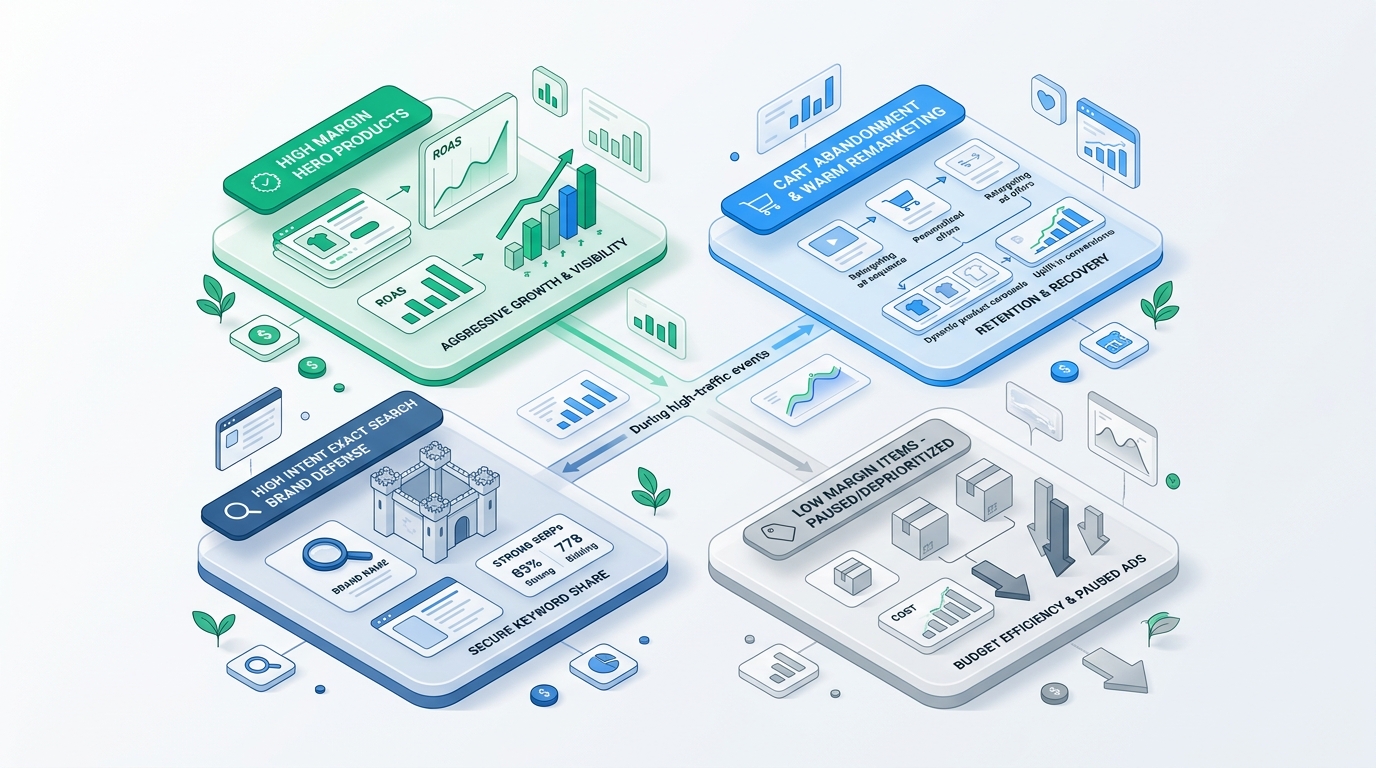
The Four-Tier Budget and Margin Matrix
To protect your business from unprofitable spending, divide your product catalog and advertising campaigns into four clear groups:
| Campaign Tier | Goal & Audience | Budget Strategy |
|---|---|---|
| Tier 1: Hero Products | High-margin items, exclusive offers, or bundles. | Aggressive growth with increased budget; higher CPC acceptable because margins absorb it. |
| Tier 2: Abandoned Carts | Users who added items to cart in the last 3 to 7 days but did not complete purchase. | Priority budget. This is the cheapest and most effective conversion throughout the holiday season. |
| Tier 3: Brand Defense | Your company name and specific brand searches (Exact Match). | Absolute 100 percent Impression Share to prevent competitors from stealing your loyal buyers. |
| Tier 4: Low-Margin Products | Mass products with low markup (sub-15 percent) and fierce competition. | Pause or reduce bids to a minimum during Black Friday week. |
Practical Steps Before Launching Campaigns
To avoid having to wake up your account manager at night during the holiday weekend, perform these preparatory steps well in advance:
1. Use Seasonality Adjustments
If Smart Bidding (Target CPA or Target ROAS) is enabled in your campaigns, the algorithm relies on historical conversion rates daily. However, on Black Friday, purchase volume surges for a couple of days and then drops. Set up Google Ads Seasonality Adjustments: this notifies the algorithm that the conversion rate will increase by, for example, 40 percent for 3 to 4 days, preventing the system from breaking bidding models after the promotion ends.
2. Prepare Promotion Extensions
Do not create entirely new ad groups unless necessary, as this pushes campaigns back into the learning phase. Instead, add Promotion Extensions to existing ads with specific discount codes and expiration dates. This increases click-through rate (CTR) without extra costs.
3. Check Server and Payment Gateway Readiness
Many marketers forget the technical side. If visitor numbers triple suddenly, will your e-store server handle the load? Do payment gateways operate without delay? Every slow second or checkout error means wasted ad money.
Black Friday and Christmas shopping is a marathon, not a sprint. The winner is not the one who spends the most money on loud slogans, but the one who carefully calculates the return on every invested euro. If you want your Google Ads campaigns to generate real profit rather than empty clicks, apply the margin matrix today!
Frequently Asked Questions About Black Friday Ads
When should Black Friday ads start running?
The optimal time is at least 7 to 10 days before Friday itself. Shoppers do price research early and prepare shopping lists, allowing you to build warm audiences for remarketing.
What to do if a competitor outbids my brand name?
Never leave your brand keyword without ad support during the holidays. Even if you rank first organically, a competitor ad above you will pull away up to 30 percent of your buyers.
How to properly lower budgets after the holidays end?
On the Monday after Cyber Monday, gradually return daily budgets to normal levels. Reduce budgets by 20 to 30 percent per day to let algorithms normalize delivery pacing smoothly.
Want to prepare your e-store campaigns for maximum sales returns?
Book a 15-minute strategy call. We will evaluate your product feed and ad structure, and prepare an effective action plan.
Fixed budget. No hidden fees or forced upsells.