

Preparing for the European Accessibility Act (EAA) in 2024 was a forward-thinking move. Today, in 2026, digital accessibility standards (WCAG 2.1 AA) are a legislative norm across the European Union, simultaneously boosting both usability and SEO visibility. Learn more through our website development services.
With just over a year until the European Accessibility Act (EAA) comes into full force, the clock is ticking. From June 28, 2025, digital accessibility requirements will no longer apply only to public sector institutions. The law becomes binding for most private companies selling goods or services online within the European Union. Many entrepreneurs still cling to the myth that accessibility simply means installing an 'accessibility widget' plugin. In reality, true accessibility requires a thorough overhaul of your site's code, design, and content to meet WCAG 2.1 AA standards.
Key Takeaways
- Deadline: June 28, 2025: The European Accessibility Act mandates that all private sector e-commerce stores, banking services, and digital platforms must ensure accessibility for people with disabilities.
- WCAG 2.1 AA as the Technical Foundation: The law is based on international guidelines: at least 4.5:1 text contrast, full keyboard navigation, and screen reader support.
- Broader Business Benefits: An accessible website means better usability for all users, including seniors and mobile shoppers, while providing a positive boost to SEO rankings.
- Significant Penalties for Non-compliance: Ignoring the directive's requirements can lead to substantial administrative fines and restrictions on providing digital services in the EU market.
Who the European Accessibility Act Applies To
The directive covers a wide spectrum of digital services:
• All online stores and e-commerce platforms selling goods to consumers.
• Banking and financial services (payments, loan applications, online billing).
• Transport services (ticket purchases, schedules).
• Digital books and media services.
The exemption applies only to micro-enterprises (fewer than 10 employees and a turnover under 2 million euros); however, even for small businesses, accessibility is becoming a prerequisite for collaboration if they wish to become suppliers for larger B2B partners.
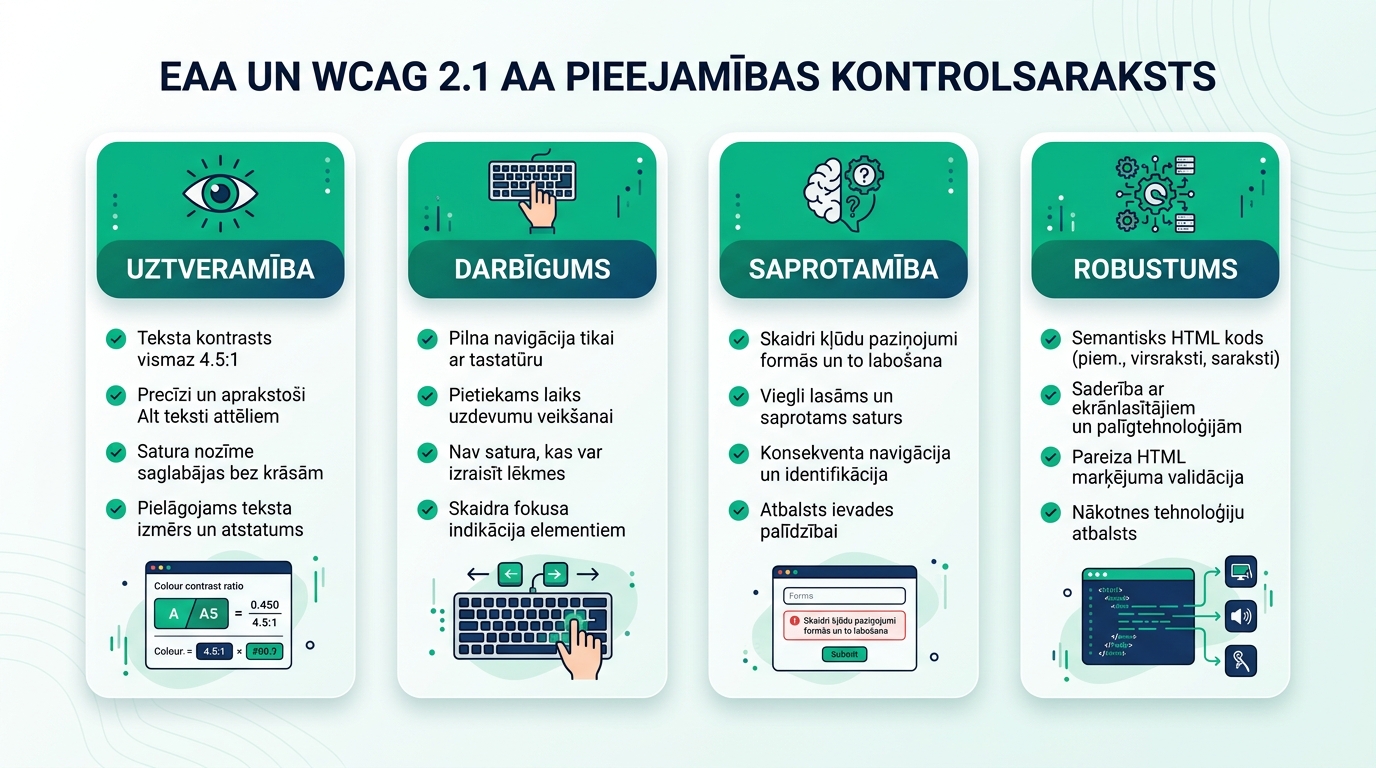
The Four Principles of WCAG Accessibility in Practice
The accessibility standard is based on four core principles (POUR):
| Principle | What it means for the user | Common website error | How to fix it correctly |
|---|---|---|---|
| 1. Perceivable | Information must be available to different senses | Light gray text on white background, images without Alt text | Ensure 4.5:1 contrast and descriptive image text |
| 2. Operable | Interface must be controllable with any input device | Website cannot be navigated using the Tab key | Ensure clear focus indicators for all buttons and links |
| 3. Understandable | Content and navigation must be predictable and clear | Error messages in forms are just a red line | Clear text explanations of what needs to be corrected |
| 4. Robust | Code is compatible with assistive technologies | Custom buttons built as <div> without semantics | Use proper HTML5 tags (<button>, <nav>, <header>) |
Adapting your site to these standards is significantly aided by modern website development, where accessibility is built into the foundation of the design system.
Why Accessibility is an Excellent Business and SEO Investment
Companies often view accessibility as a bureaucratic burden. In reality, the benefits are much broader:
Higher conversion for every shopper: Larger buttons, readable fonts, and clear error corrections in forms help not only people with visual impairments but also every busy mobile phone user.
SEO improvements: Screen readers interpret website code very similarly to Google search bots. Clean semantic structure, correct H1-H3 headings, and image descriptions provide a direct boost to page rankings.
For sites with an outdated code base, the most cost-effective solution is timely website code modernization and regular technical maintenance.
As we explained in our detailed guide on website accessibility requirements and WCAG standards, preparing early prevents expensive last-minute overhauls.
Frequently Asked Questions
Is it enough to install an accessibility overlay plugin?
Absolutely not! Most international accessibility experts and courts recognize that overlay plugins do not solve underlying code issues and often even interfere with screen reader functionality. Requirements must be met within the site's source code itself.
How can I evaluate my site's current accessibility?
You can use free automated tools such as axe DevTools, WAVE, or the 'Accessibility' section in Google Lighthouse. These will help you discover approximately 40% of the most common errors.
Do the requirements also apply to PDF documents on the site?
Yes! If your website contains product catalogs, user manuals, or invoices in PDF format, these must also be accessible and readable by assistive technologies.
Conclusion
The European Accessibility Act is an opportunity to make your digital business friendlier, more convenient, and accessible to a larger part of society. By starting your audit and improvements early, you will ensure a smooth transition and gain a loyal customer base.
Does your website meet European Accessibility Act (EAA) requirements and standards?
Book a 15-minute consultation. We will conduct an accessibility audit and implement the necessary improvements for smooth business operations.
Fixed budget. No hidden fees or forced services.