

The competition between Performance Max and standard Search campaigns created significant cannibalization risks in 2024. By 2026, modern account architecture with precise brand exclusion lists and Search Themes allows these two campaign types to operate in perfect synergy. Learn more in our Google Ads services.
One of the most common sights in 2024 Google Ads account audits is the collision of two powerful campaigns: a classic Search campaign running in parallel with an all-encompassing Performance Max (PMax) campaign. The advertiser notices a strange situation: Search campaign clicks are plummeting, while PMax shows incredibly strong results, yet the total number of business orders remains stagnant. This phenomenon is called internal cannibalization. The Performance Max algorithm begins to intercept your own search keywords and brand queries, artificially inflating its results. To prevent this, you must clearly define the boundaries between both campaigns.
Key Takeaways
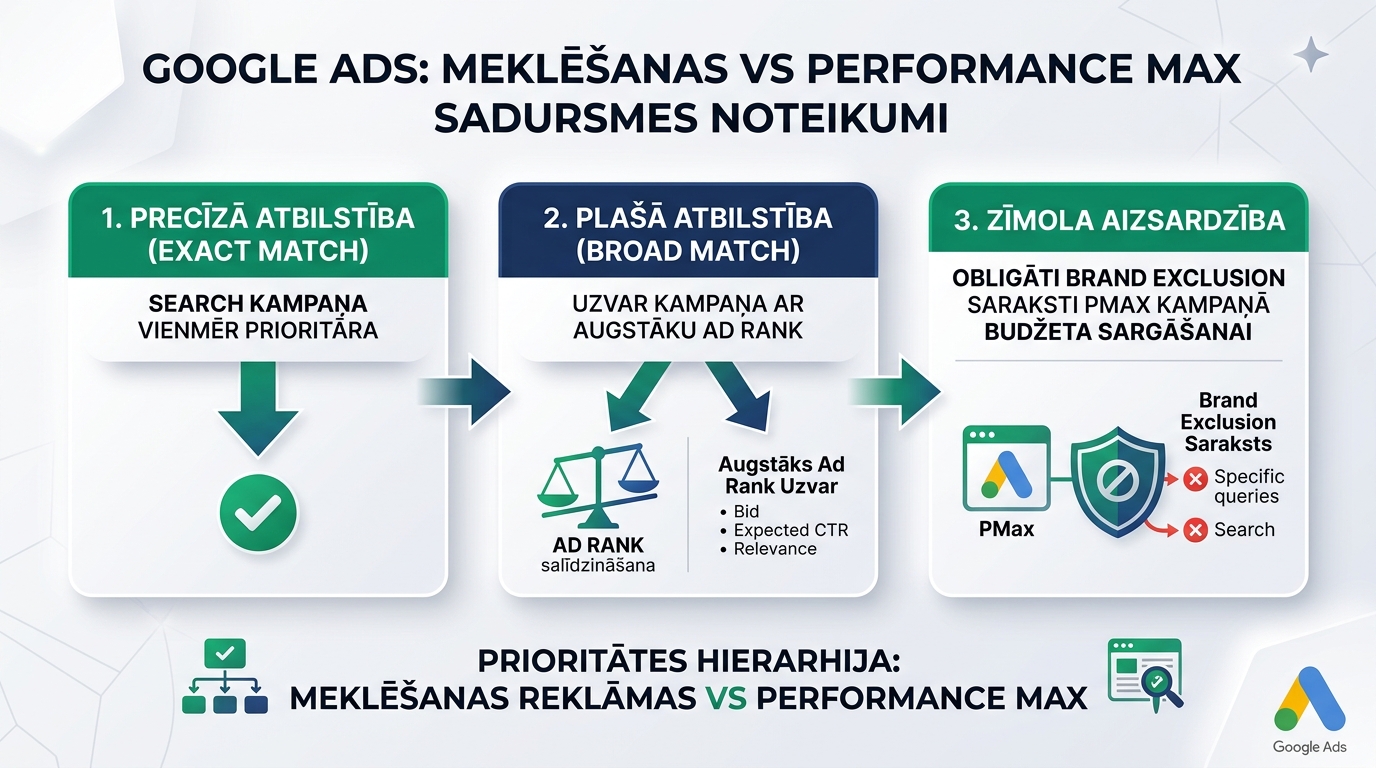
- Collision Rule Hierarchy: A Search campaign with an Exact Match keyword always takes priority over a PMax campaign if the search query is identical.
- Broad Match Risk: If you use Broad or Phrase match in your Search campaign, PMax may intercept the query if it has a higher Ad Rank.
- Mandatory Brand Exclusions: You must add brand exclusions to PMax campaigns so the AI does not waste budget on shoppers already searching for your company name.
- Role Distribution: Search campaigns serve as a precise surgical instrument for high-intent searches, while PMax handles scaling across all Google channels.
How Google Resolves Collisions Between Search and PMax
Google's official auction hierarchy is based on very specific principles that every ad manager must know:
Rule 1 - Exact Match Priority: If your Search campaign contains an exact match keyword [buy bicycle in riga] and a user enters that exact phrase, the system will ALWAYS favor the Search campaign, regardless of the PMax Ad Rank.
Rule 2 - Ad Rank Auction for Other Matches: If you use Phrase or Broad match in your Search campaign, or if the query differs slightly, Search and PMax compete in an equal auction. The campaign with the higher Ad Rank (bid x expected CTR x ad relevance) at that specific millisecond wins.
Rule 3 - Brand Poaching: If a PMax campaign does not have a brand filter applied, it will gladly bid on your own company name because it yields an 80% conversion rate. This creates an illusion of excellent PMax efficiency, even though these buyers would have found you organically anyway.
Four Steps to Prevent Cannibalization
To ensure both campaigns complement each other instead of fighting for the same budget, implement these measures:
| Action | Impact on Account | How to Set Up | Final Result |
|---|---|---|---|
| Brand Exclusion list in PMax | Prevents PMax from bidding on your brand name | PMax Settings -> Additional Settings -> Brand Exclusions | Brand budget is protected |
| Account-level negative keywords | Blocks unwanted and low-quality queries in both campaigns | Tools -> Negative Keyword Lists | Budget is not wasted on spam |
| Focus Search on Exact/Phrase | Ensures Search priority for key terms | Review keyword match types | Strict human control over core phrases |
| Audience signals in PMax | Teaches the PMax algorithm to find new customers | Add customer and high-value audience lists | PMax finds new market segments |
This precise campaign synergy is the foundation for profitable Google Ads management, ensuring that every invested euro brings real growth.
How to Properly Allocate Budget and Goals
In a successful account, campaigns must have distinct tasks and performance goals:
Search campaigns as a profitability anchor: Maintain Search campaigns with a stricter Target ROAS or lower tCPA, focusing on your most profitable product and service groups.
Performance Max as a scaling tool: Use PMax with a slightly more flexible goal to attract buyers from YouTube, Gmail, Maps, and Display networks. This strategy can be perfectly combined with signals from other channels, such as Meta Ads campaigns.
In an overall digital advertising strategy, properly balancing both campaigns prevents artificial spikes in click costs.
As we emphasized in our guide on Performance Max negative keyword management and optimization, regular control is the only guarantee against algorithmic arbitrariness.
Frequently Asked Questions
Is it better to turn off standard Search campaigns and leave only PMax?
No! Search campaigns provide much deeper control over search queries, the ability to test specific ad copy, and guarantee presence at the most critical moments. A combination of both campaigns always outperforms relying on just one.
Why does Google support always suggest trusting everything to PMax?
Google's business goal is to maximize the fill rate of its network inventory (Display, YouTube, Discovery). The advertiser's goal is profit and ROI, which requires strict control.
How often should I check search queries in a PMax campaign?
At least once a week, check the 'Insights' -> 'Search terms' section to ensure the campaign is not wasting budget on irrelevant phrases.
Conclusion
Performance Max and Search are not competitors, but allies in a unified marketing orchestra. By implementing proper collision rules, brand exclusions, and disciplined negative keyword monitoring, you will achieve maximum sales volume without unnecessary spending.
Want your Google Ads campaigns to work in synergy instead of competing?
Book a 15-minute call. We will organize your keyword priorities and campaign structure for maximum budget return.
Fixed budget. No hidden fees or forced services.