
Key Takeaways: Where Google Ads in Latvia Is Heading Over the Next 1.5-3 Years
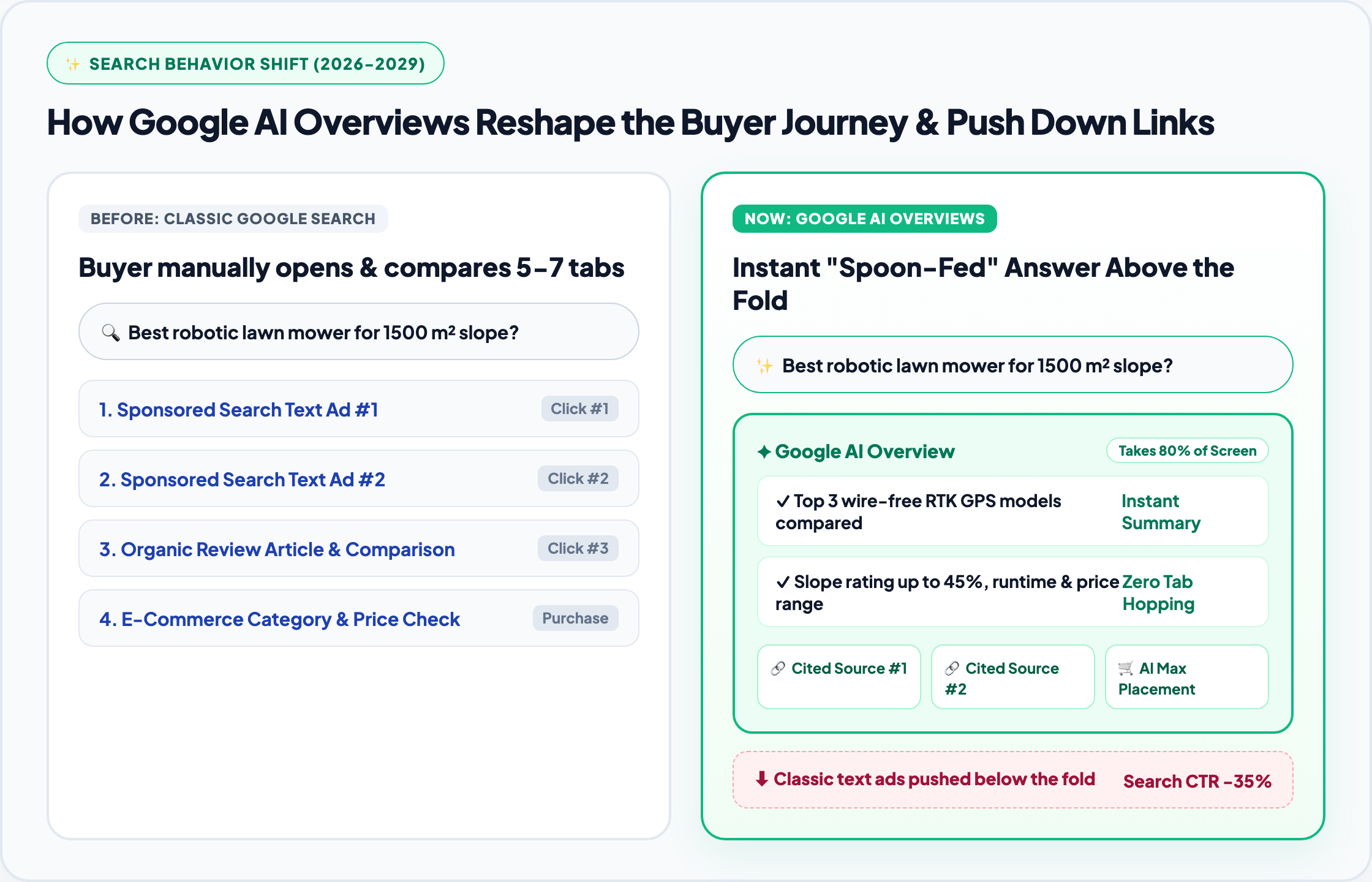
- Information is now spoon-fed: Buyers no longer open 5-7 browser tabs to read and compare manually. Google AI Overviews and AI assistants deliver a ready-made summary right at the top of the screen without requiring a website visit.
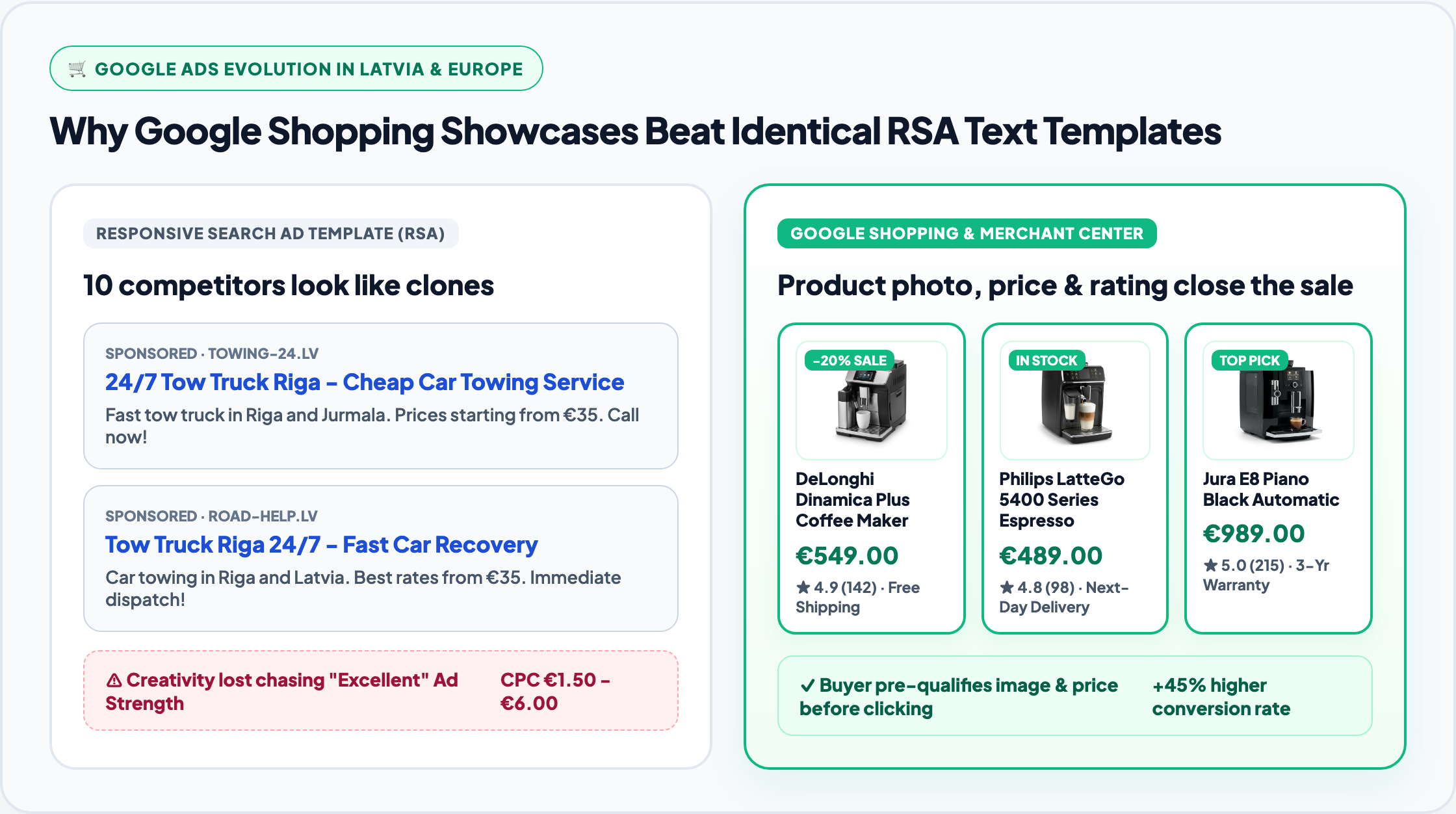
- The death of creativity in text ads (RSA): Chasing an "Excellent" Ad Strength rating forces specialists to repeat exact keywords in every headline. As a result, all competitors in a niche look like identical clones.
- Western Europe and the US are our time machine: 20 years ago, my very first client paid €0.02-€0.03 per click in Google Search. Today in Latvia, average Search CPC sits around €1.00-€1.50, while in Western Europe and the US the exact same industries already pay €5.00-€6.00+ per click.
- Google Shopping and video ads will win: Within 2-3 years, classic text Search and static Display ads in Latvia will lose their dominance. What sells will no longer be three lines of text, but a well-structured Google Merchant Center feed, standout product photography, competitive pricing, and video.
Today I want to look into the crystal ball and share my candid thoughts on how Google Ads campaigns in Latvia and the Baltics will evolve over the next 1.5 to 3 years. These are not textbook theories. They are practical observations from nearly 20 years of hands-on work in Google Ads and managing export campaigns across Western Europe and the United States every single day.
1. How AI Changes Buyer Behavior: From Searching to Being Spoon-Fed
We all see how fast artificial intelligence has entered everyday life. Granted, the vast majority of consumers still use AI at a very basic level - asking where to buy something cheaper, how to get from point A to point B, or how to solve a quick daily question. Only a small fraction uses AI deeply and professionally. Yet even this basic adoption is already reshaping how people buy online.
Think back to how the buyer journey looked just a couple of years ago:
- A buyer had a problem or needed a specific product.
- They went to Google and typed in a search query.
- They opened five, six, or seven links in separate tabs, read reviews, compared specs, dug into details, and only then decided where to buy.
Today, that behavior has shifted dramatically. Information is spoon-fed to the user. When you type a question into Google, an AI Overview appears right at the top of the page. The buyer barely needs to click into individual websites anymore because the core summary is already extracted in front of them.
Why Blindly Trusting the First AI Answer Is Like Asking a Random Auntie on the Street
There is a flip side to this convenience. Users become more passive and often accept the first AI paragraph as absolute truth without checking a second source. Frankly, that is no different from walking up to a random auntie on the street, asking her a question, and believing every single word she says without verifying it anywhere else.
Even the latest AI models still hallucinate and mix up outdated facts. In my own daily workflow, I have developed a simple habit: whenever an AI answer about a Google Ads or analytics nuance feels even slightly off, I immediately follow up with a double-check prompt: "Are you sure it really works this way right now in November 2026?" More often than not, the AI apologizes and corrects itself because it initially pulled data from articles written two or three years ago.
Will AI Agents Do All the Shopping for Us Soon?
Tech giants openly dream of autonomous AI agents handling the entire shopping journey for the consumer. Technically, an AI agent can already scan dozens of online stores, compare prices, and place an order automatically.
However, looking at the next 2 to 3 years, I do not see everyday consumers handing their bank card over to an AI and saying: "Go buy me the best TV or buy me a car!" Human psychology simply does not change that fast. Remember the early 2000s when the internet and first online stores appeared - it took years before people trusted websites enough to enter their card details online. For the foreseeable future, buyers will still want to make the final call themselves. At the same time, trillions of dollars have been invested into AI, so this technology will never be written off - short of a sci-fi "Terminator" movie scenario, which we certainly don't expect.
2. 20 Years of Google Ads Evolution: How Algorithms Killed Creativity
Until recently, AI inside Google Ads worked mostly behind the scenes - powering Smart Bidding, audience signals, and budget allocation. Over the last three months, however, AI has visibly entered creative production itself, automatically turning static images into animated display banners and mixing text combinations. This brings us to a major problem: ads are increasingly stamped out from the exact same cookie-cutter mold.
When we look back across 20 years of Google Ads history, the shift is striking:
- 15-20 Years Ago (Early AdWords): Character limits were tight - just one or two short headlines and two brief description lines. Yet specialists had complete creative freedom! We constantly ran true A/B split tests. Inside every ad group, we tested two distinct angles. Ad A was the pragmatic, numbers-first angle - exact prices, discounts, and hard metrics for analytical buyers. Ad B was the creative hook - a witty slogan, an unexpected twist, or an emotional phrase designed to spark curiosity among creative souls. After a few weeks, the data clearly showed which psychology won.
- Google's Graveyard of Formats: Over the decades, Google repeatedly launched hyped campaign types, pushed businesses to adopt them, and then retired or folded them into automated black-box campaigns a few years later.
- Today's Responsive Search Ads (RSA): Now we feed 10 to 15 headlines and 4 descriptions into a single ad, letting Google's algorithm mix and match them. On paper, it sounds great - showing "buy fresh white bread" to one person and "buy cheap white bread" to another. In reality, it has wiped out creative differentiation.
| Era / Campaign Format | What Happened to It? | Avg. Search CPC in Latvia | Impact on Advertisers |
|---|---|---|---|
| Early AdWords (2005-2015) Standard Text Ads (A/B Split Tests) |
Replaced by expanded formats | €0.02 - €0.15 | Full creative freedom: testing exact numbers vs. emotional and witty creative hooks. |
| Expanded Text Ads (ETA) & Gmail Ads (GSP) | Sunset completely (2021-2022) | €0.25 - €0.60 | Removed the ability to lock a single crafted message without algorithmic remixing. |
| Smart Shopping, Local & Discovery Campaigns | Force-merged into Performance Max & Demand Gen | €0.60 - €1.20 | Less placement transparency; product feeds and visual assets become the primary lever. |
| Responsive Search Ads (RSA) & Dynamic Search (DSA) | Current standard transitioning into AI Max & Shopping | €1.00 - €1.50+ (West EU/US: €5.00 - €6.00) |
Chasing "Excellent" Ad Strength forces all competitors to write identical keyword-stuffed headlines. |
The "Tow Truck" Trap: Why Every Competitor's Ad Looks Like a Twin
Why can't we write bold, creative search ads today? Because Google introduced the Ad Strength score (ranging from Poor to Excellent), which directly influences impression share and cost per click. How does the algorithm grade Ad Strength? Primarily by checking whether your exact target keywords appear word-for-word inside your headlines.
Take a classic real-world example: roadside assistance and tow trucks (in Latvia, queries like "auto evakuators Rīga" or "tow truck Jurmala"). If you try to write a warm, human headline such as: "Stuck on the road? Don't worry - our team is on the way to help you!", Google immediately penalizes your Ad Strength because it lacks the exact keyword string.
To get an Excellent rating, every specialist is forced to write: "24/7 Tow Truck Riga - Cheap Car Towing". And all ten competitors in that auction do the exact same thing! When a driver searches on Google, they see four identical ads with the exact same phrasing and "Prices starting from...". True copywriting has been sacrificed to satisfy an algorithmic checklist.
3. Western Europe & the US as Our Time Machine: From 2 Cents to €6 Per Click
On Google's global map, Latvia is a tiny dot. While new features often roll out here later than in English-speaking markets, that delay gives local businesses a huge strategic advantage: Western Europe and the US act as our crystal ball. Whatever happens there today arrives in Latvia 1.5 to 3 years later.
Two historical proofs make this undeniable:
- Mobile Traffic (80% on Smartphones): Ten years ago, US e-commerce shifted heavily to mobile while businesses in Latvia insisted that serious buyers only purchase on desktop computers. Fast-forward to today: smartphones are powerful pocket computers, and around 80% of all search and ad traffic in Latvia now happens on mobile devices.
- Click Price (CPC) Inflation: When I started running Google Ads around 20 years ago, my very first client paid 2 to 3 euro cents (€0.02-€0.03) per click in Google Search (not video views, actual search clicks!). Today in Latvia, average Search CPC is €1.00 to €1.50 (with calmer niches at €0.50 and competitive ones at €2-€3 or up to €10). Meanwhile, in our export client accounts targeting Western Europe and the US, the exact same industries already pay €5.00 to €6.00+ per click.
Because Google's auction is a closed box where you never see competitors' true bids, businesses have to pay whatever threshold Google sets for top visibility. And the math is unforgiving: paying €0.10 for 100 clicks costs €10, whereas paying €5.00 for those same 100 clicks requires €500 before you even make a sale.
4. What Works in Western Markets Today - And What Will Replace Classic Search Ads in Latvia
Across our export accounts in Western Europe and North America, one trend over the past 12 months stands out clearly: classic Search text ads and standard Display banners are losing their efficiency. Clicks are expensive, and users increasingly tune out repetitive text blocks.
What delivers the strongest return on ad spend instead? Two core formats:
- Google Shopping Ads (powered by Google Merchant Center)
- Video Ads (YouTube and Demand Gen campaigns)
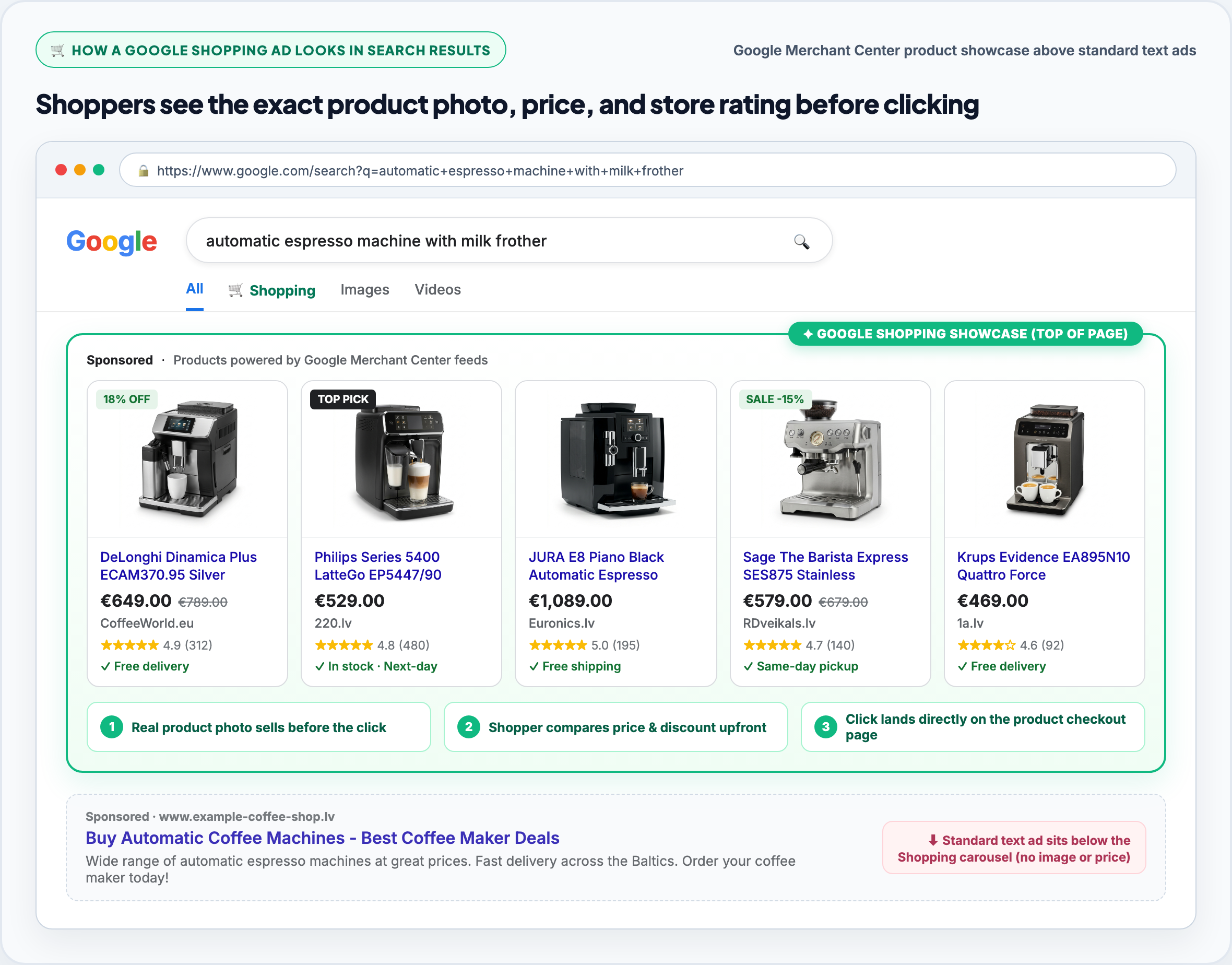
Why does Google Shopping win? Because it matches the modern buyer's desire to have everything spoon-fed visually. Right at the top of the search results, the shopper sees the actual product photo, exact price, discount badge, and store rating. Text no longer closes the click - the product photo and price do. When a user clicks a Shopping card, they have already seen the product and accepted the price, resulting in far higher purchase conversion rates.

"For the next 1.5 to 2 years, classic Search ads in Latvia will still work by inertia because local competition remains moderate compared to Germany or the US. But within 2 to 3 years, the winners will be the online stores and brands that set up clean Google Merchant Center feeds today, invest in standout product visuals, and shift toward Shopping and video formats. Relying on what worked 10 or 20 years ago is no longer an option."
5. Action Plan for Business Owners: How to Prepare Today
To make sure your business stays profitable as click costs rise and search behavior shifts toward AI and visual shopping, here are five concrete steps to execute now:
5-Step Preparation Checklist for Google Ads
Frequently Asked Questions About the Future of Google Ads
Will classic Google Search text ads disappear completely in Latvia?
No, they won't disappear overnight. Over the next 1.5 to 2 years, Search text ads in Latvia will remain a steady lead source, especially for local service businesses (repairs, clinics, B2B services). However, over a 2 to 3-year horizon, their share of clicks will shrink as Google AI Overviews and visual Google Shopping placements take over the top of the screen.
Why do Google Shopping ads convert better than standard text ads for online stores?
Google Shopping displays the product photo, exact price, and seller rating before the user ever clicks. Visitors arriving on your product page are already pre-qualified on appearance and price, which cuts wasted clicks and boosts checkout conversion rates.
What should service businesses do if they don't sell physical products for Google Shopping?
Service companies should focus on engaging video campaigns (YouTube and Demand Gen), accurate offline/first-party conversion tracking so Smart Bidding optimizes for real signed clients rather than empty form fills, and authoritative website content that Google AI Overviews cites directly.
How much does a Google Search click (CPC) cost in Latvia vs. Western Europe today?
In Latvia, average Google Search CPC currently ranges between €1.00 and €1.50 (around €0.50 in low-competition niches and €2.00 to €10.00 in high-urgency niches like towing or finance). In Western Europe and the US, those same categories routinely cost €5.00 to €6.00+ per click.
Is your Google Ads account ready for the next 3 years?
Book a free 15-minute consultation with Mārtiņš. We will review your current campaign structure, check your Google Merchant Center readiness, and show you where to eliminate wasted click spend.
Book my 15-minute call →
Fixed budget. No hidden fees or pushy retainers.