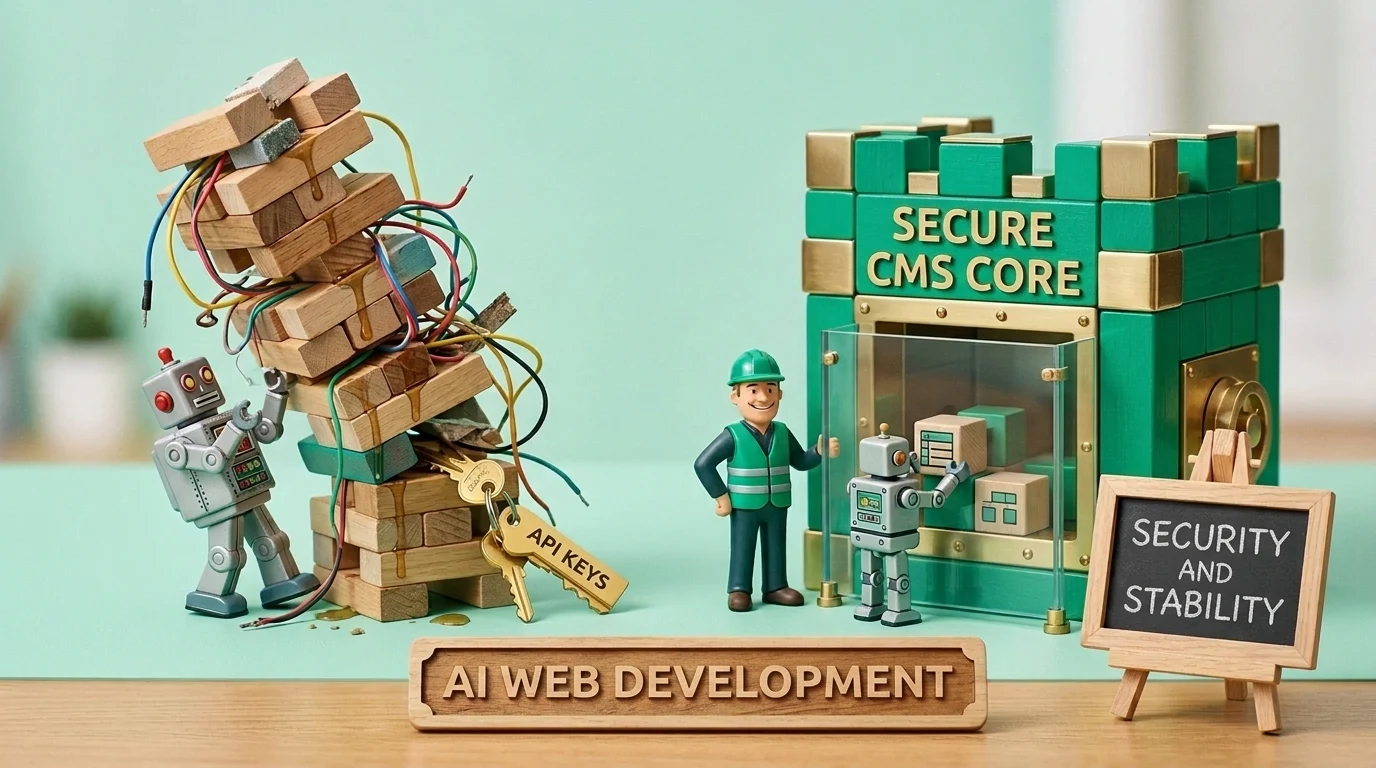
AI coding platforms like Lovable, Replit Agent, Bolt.new, and v0 have created the illusion that any business owner can build a production-ready website or client portal from scratch over a weekend simply by chatting with an AI. However, recent cybersecurity audits reveal a harsh reality - thousands of these scratch-built sites suffer from critical vulnerabilities, including exposed Supabase databases lacking Row Level Security (CVE-2025-48757), secret API keys compiled directly into public JavaScript bundles, and unprotected admin dashboards. In this analysis, we examine why scratch-generated AI code in non-technical hands becomes a ticking time bomb for corporate reputation, and why the smartest strategy is harnessing AI speed within the battle-tested architecture of established Content Management Systems (WordPress, WooCommerce, Magento).
The "Vibe-Coding" Wave and Why a Seemingly Working Site Can Be Dangerous
Over the past year, the digital landscape has seen an explosion of so-called "vibe-coding" - prompt-driven, intuitive AI software creation. A founder or marketing manager opens Replit, Lovable, Bolt.new, or ChatGPT and types a prompt: "Build me a modern corporate website with a price calculator, a lead capture form, a database, and an admin panel where I can view all orders."
Twenty minutes later, a sleek interface appears on screen. Buttons click, forms submit, and test entries populate a table. It creates the impression that professional developers and web architecture are obsolete. Yet right here lies the fundamental divide between a visual prototype and a secure production system.
When an experienced developer and systems architect works with artificial intelligence, they use AI as a high-powered accelerator. They know exactly how server sessions operate, where encryption keys must and must never be stored, how SQL injection filters work, and which lines of code require strict auditing. Conversely, someone without deep development expertise evaluates only the surface - if the layout looks sharp and the button works, everything must be fine.
By design, large language models are trained to be maximally helpful and reach a visual result as fast as possible. If a strict security check or complex authentication flow blocks the code from running on the first try, an AI agent frequently takes the path of least resistance - disabling security filters so the user does not see an error message in the chat. In professional corporate website and e-commerce development, such compromises are unacceptable because the consequences translate directly into financial and data losses.

"I work with the latest AI models every single day and firmly believe each new generation will get better at correcting the mistakes of previous models. However, building a business website with AI completely from scratch right now - without a proven CMS architecture underneath - is like building a three-story house without a structural specialist or a foundation. From the outside, the facade looks colorful, but every door is unlocked and gas pipes run exposed along the exterior walls. When we combine AI power with a battle-tested WordPress or WooCommerce core, we place this unruly artificial intelligence inside a strict, secure frame where core infrastructure and data protection are already guaranteed."
The 4 Most Dangerous Security Flaws in Scratch-Built AI Websites
In recent months, global cybersecurity researchers have conducted extensive audits across thousands of new websites and web apps built on popular AI coding platforms. The findings show that the exact same critical flaws repeat in nearly every second project built by non-specialists.
1. The Lovable, Bolt, and Supabase Data Leak Scandal (CVE-2025-48757)
Most modern AI builders (Lovable, Bolt.new, v0, Replit) rely on Supabase as their database engine. It is a fantastic technology when configured by a specialist, as it allows direct database communication from the web browser. However, this convenience comes with one mandatory requirement - every database table must have properly configured RLS (Row Level Security) enabled.
Cybersecurity investigations (including documented vulnerability CVE-2025-48757) revealed a shocking pattern. When a non-technical user asks AI to build a lead form or client registry and complains in the chat that "data isn't saving," the AI agent simply turns off RLS protection or sets the policy to USING (true) for all anonymous visitors. The form starts working, and the business owner is thrilled. In reality, any competitor or automated bot can open the browser's developer console (Inspect -> Network), grab the public database URL, and download the company's entire client database with a single command - names, phone numbers, emails, physical addresses, and order totals.
2. Exposed API Keys and ENV Variables in Public JavaScript Code
The second widespread issue is leaking confidential API keys (such as OpenAI, Stripe payments, Resend, or Make webhooks) directly into the visitor's browser. Users without coding backgrounds routinely paste secret keys straight into the AI chat or store them in a .env file without realizing how modern frontend bundlers like Vite or Next.js process these files.
If the AI prefixes a variable with VITE_ or NEXT_PUBLIC_, the build process literally copies that secret key into the public JavaScript bundle downloaded by every visitor's phone or computer. Worse yet, on misconfigured Replit instances or DIY servers, the /.env file or /.git folder itself is often publicly accessible via the browser. Automated scanners constantly sweep the web for newly deployed domains and steal these API keys within minutes, draining thousands of euros in OpenAI credits or cloud quotas.
3. Illusory Admin Panels Without Server-Side Authorization
When an entrepreneur asks AI to create an /admin or /dashboard route to view incoming leads and update prices, the AI frequently generates a purely client-side (React/SPA) route. Password verification is often written solely in the visual layer - if the user is not logged in, the browser redirects them to the homepage.
Meanwhile, on the server side, the API endpoints (such as /api/orders or /api/delete-user) completely lack session token and role verification. This is known as IDOR (Insecure Direct Object Reference) and broken access control. An attacker does not even need to guess the password - they can send a direct HTTP request to the server endpoint to wipe data or alter website pricing without any authorization.
4. Code Hallucinations, Outdated Libraries, and the Maintenance Dead-End
Even if a site is not breached on day one, a maintenance nightmare begins a few months later. Scratch-generated AI websites lack unified architectural standards. Every subsequent chat prompt ("add another button here" or "change the calculator formula") causes the AI to rewrite hundreds of lines of code, frequently breaking previously working features. Furthermore, AI models routinely pull dozens of external npm packages into the project that nobody updates. When the business owner brings this "spaghetti code" project to a professional agency six months later, it turns out to be cheaper and safer to rebuild everything from scratch rather than patch a chaotic AI experiment.
Why the Smartest Path Is Deploying AI Inside Proven CMS Frameworks (WordPress, WooCommerce, Magento)
Does this mean businesses should abandon artificial intelligence in web development? Quite the opposite! Artificial intelligence delivers a massive leap in speed and capability, but the secret lies in the architecture in which you place that AI.
Instead of letting AI reinvent the wheel from scratch - writing its own authentication logic, database connections, session management, and routing - the professional approach is deploying AI inside battle-tested Content Management System (CMS) frameworks refined over decades, such as WordPress, WooCommerce, or Magento.
In this model, a proven CMS acts as an ironclad security cage and architectural backbone that constrains and structures artificial intelligence:
- Strict Server and Browser Separation: In a WordPress and WooCommerce environment, database credentials (
wp-config.php) and API keys reside strictly on the server's PHP layer. They are never compiled into public JavaScript files visible to visitors. - Built-In Database and Access Protection: All database queries pass through the standardized
$wpdb->prepare()mechanism, automatically blocking SQL injections. Meanwhile, admin access is guarded by a proven user role hierarchy (current_user_can) and cryptographic security tokens known as WordPress Nonces. - Battle-Tested E-Commerce and Payment Core: WooCommerce and Magento already contain thousands of hours of tested cart, tax, invoicing, and payment gateway logic. AI is never allowed to improvise with customer funds or order records - instead, AI is used for custom UI design, high-speed modules, interactive calculators, and SEO and GEO content architecture.
- Global Security Ecosystem and Effortless Maintenance: When a new zero-day threat emerges globally, the WordPress core security team and enterprise firewalls roll out automated patches. Moreover, your internal team can easily edit copy, add products, and publish blog posts in an intuitive visual interface without fearing that a single chat prompt will accidentally delete half the website.
Comparison: Scratch-Built AI Website vs. AI Development Inside a Proven CMS
To clearly illustrate the difference in business security and long-term total cost of ownership, we have summarized the core technical parameters below:
| Criterion | Scratch-Built AI Site (Lovable, Replit, Bolt in amateur hands) | AI Development in a Proven CMS (WordPress / WooCommerce) |
|---|---|---|
| Client Data & Database Security | High risk (frequently disabled RLS and publicly readable tables) | Server-side isolation behind a PHP core and enterprise firewall |
| API Key Storage | Frequently leaked in public VITE_ bundles or exposed .env files |
Hidden server-side, completely inaccessible to visitor browsers |
| Day-to-Day Content Editing | Burns AI chat credits with a constant risk of breaking existing code | Intuitive visual editor with zero risk of damaging architecture |
| SEO & AI Search (GEO) Readiness | Often renders an empty client-side JavaScript shell (SPA) invisible to crawlers | Full Server-Side HTML, structured Schema data, and XML sitemaps |
| Payment & ERP/Inventory Integrations | Must be coded from scratch with a high risk of calculation bugs | Ready, certified modules for banks, couriers, and accounting |
| Maintenance & Scaling After 1-2 Years | Non-standard code that professional developers refuse to take over | Global standard with comprehensive documentation and stability |
How to Properly Combine AI Speed with Professional Web Architecture
When our team at MarketMeNow builds high-conversion websites in 96-hour sprints, we leverage AI agents at every stage, but we do so under strict technical discipline. Here are the 5 principles that separate secure AI web development from a dangerous amateur experiment:
- A Proven CMS Foundation as an Unshakeable Backbone: We build solutions on a clean, optimized WordPress or WooCommerce core hosted on high-speed Nginx cloud servers. Authentication, user sessions, and database security are handled by the platform's battle-tested architecture.
- AI Code Strictly Confined to Controlled, Isolated Modules: Artificial intelligence is used to craft lightning-fast, clean HTML/CSS layout blocks, interactive cost calculators, and bespoke features without bloating the site with unnecessary libraries. This achieves minimal JavaScript payload and 95+ Google PageSpeed scores.
- Strict Server-Side Data Validation: All lead forms, calculator outputs, and CRM webhooks are validated server-side using
check_ajax_referer(Nonce) protection and strict data sanitization. No secret API key ever touches browser code. - Full Compliance with EU Regulations and Privacy Standards: When an intelligent chatbot or AI assistant is integrated into a site, its architecture is built in strict compliance with EU AI Act and GDPR security requirements, ensuring end-to-end data encryption.
- Continuous Security Monitoring and Automated Backups: Every serious business website is connected to a professional website maintenance and security monitoring system featuring a server-level WAF firewall, automated daily off-site backups, and active bot mitigation.
Self-Check Security Checklist for AI-Built Websites
VITE_, NEXT_PUBLIC_, or sk_live secret tokens, and navigating to /.env returns a 403/404 status.Frequently Asked Questions About AI Website Development and Security
Should tools like Lovable, Replit, and Bolt.new be avoided entirely?
These tools are outstanding for rapid idea visualization, internal wireframing, or testing simple clickable prototypes that do not handle real customer data. However, the moment a website becomes your company's public face, collects client contact details, processes payments, and serves as the foundation for Google Ads and SEO, it must be built on a secure, professionally audited CMS architecture.
Why do scratch-generated AI websites often fail to rank on Google?
Most no-code AI generators build Single Page Applications (Client-Side Rendered SPAs based on React or Vite) by default. When a Googlebot or AI search crawler visits the page, it receives a blank HTML file containing a single <div id="root"></div> tag - missing canonical tags, metadata, and structured schema. By contrast, WordPress natively generates complete server-side HTML markup that search engines index immediately.
What should we do if we already built our site with an AI generator and want to make it secure?
The smartest move is to treat your AI-generated site as a finished visual mockup and functional blueprint, and migrate it onto a clean, secure WordPress or WooCommerce architecture within a few days. You keep the exact visual design and calculator logic you envisioned while gaining a 100% secure database, fast server response times, full SEO readiness, and effortless content management.
Is WordPress itself secure against hacking?
The WordPress core is one of the most rigorously audited software foundations in the world. Historically, security issues on WordPress sites have been caused by installing dozens of poorly coded third-party plugins. This is exactly where the AI + WordPress alignment shines - instead of installing 30 heavy, vulnerable plugins, our developers use AI to write clean, lightweight custom code directly inside the theme architecture, leveraging WordPress's native security mechanisms.
Want a Modern Website Built at AI Speed, Inside a 100% Secure Architecture?
Book a 15-minute strategy call. We will build your corporate website or migrate your AI prototype onto a secure, lightning-fast WordPress and WooCommerce core in 96 hours.
Fixed budget. No hidden fees or forced retainers.