
Calculating campaign profitability and using Smart Bidding in 2024 was a turning point. In 2026, Smart Bidding is fueled by real business profit data (tROAS and CRM purchases), ensuring the algorithm attracts the most valuable customers. Learn more in our Google Ads optimization services.
Key Takeaways
- Value-Based Bidding: Shifting from standard conversions to tROAS allows the algorithm to prioritize higher-revenue purchases.
- Weekly Negative Keyword Audit: Reviewing search terms prevents budget waste on irrelevant and informational clicks.
- First-Party Data Synchronization: Linking customer emails and purchase history with Google Ads provides a crucial advantage in the cookie-less era.
- Landing Page Speed and Mobile Experience: Slow page loading lowers Quality Score and increases cost-per-click.
Prices, Prices, and More Prices
The final cost-per-click for Google Ads is determined by a combination of factors, but to simplify - the better the ad position you want, the more you must be willing to pay per click. The more businesses that want to show their ads, the higher the costs.
A brief look back: 10 years ago, the situation in the Latvian online advertising market was quite simple - average click prices were relatively low. There were even industries where you could easily get click prices of 0.03 - 0.05 EUR. Yes, of course, there were also industries with significantly higher bids, such as the financial sector, especially the quick loan industry, where click prices rapidly developed and quickly reached the 2-3 EUR range. I remember doing research on prices outside Latvia at the time and couldn't understand how advertising profitability could be achieved with click prices in the 5-7 EUR range. Today, in Latvia, there are industries where such prices are a reality, and unfortunately, it's no longer limited to just the financial sector.
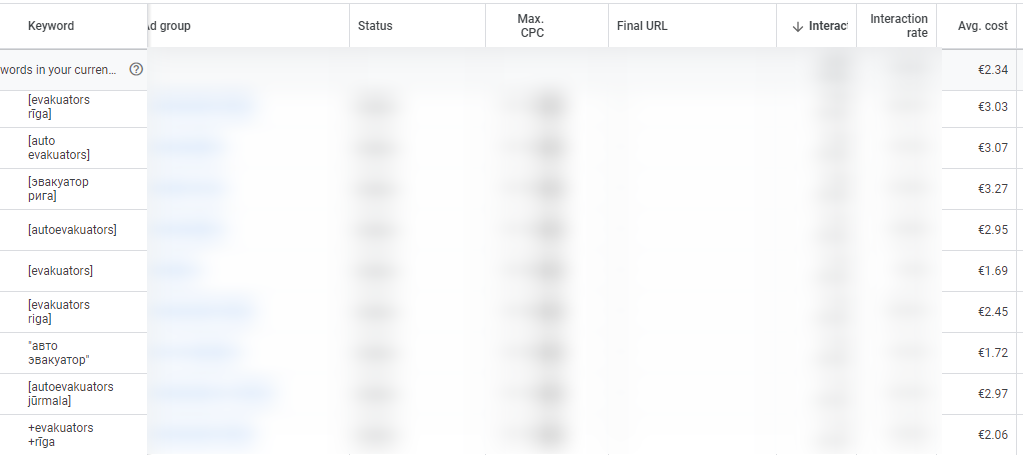
This is just an example showing real prices.
Overall, average click prices in Latvia are currently much higher than they were 10 years ago, which is logical, as the number of businesses using Google Ads has increased, directly impacting price dynamics.
This raises the question of how to achieve any profitability from advertising with such costs. To answer that, I believe we need to look at this from a slightly different perspective.
Firstly, data analysis is crucial. It's impossible to accurately determine profitability without tracking as much data as possible. In situations where it's feasible, we always strive to use the most precise data tracking. Starting to advertise an online store with Google Ads before data tracking is set up and necessary Ecommerce solutions are implemented is the biggest folly I can imagine; you'd be better off eating, drinking, or gambling that money away. Spending money on Google Ads is easy; spending it wisely is much harder. If it's possible for the respective business model, we utilize the solutions offered by Google Analytics. This is a one-time investment that will 100% pay off very quickly. Only when we can precisely track every potential incoming euro do we start spending money on advertising, whether it's Google Ads or any other ad network.

Okay, but what about cases where the business model makes it difficult to track results? Yes, such cases still exist. For example, you own a physical store that you also want to advertise online. You have a website, but purchases only happen in the physical store. What to do in such situations? Undoubtedly, this is a common situation in Latvia. Here, data tracking and processing require a slightly more creative approach. If we want to measure visitor traffic, various technological solutions can help record footfall in the store. We can analyze revenue dynamics, for example, a month with advertising versus a month without. Of course, this data will never be as precise as Google Analytics Ecommerce solutions, and it will be harder to isolate the return from specific advertising channels, but there are still possibilities to test here.
A theoretical example: You own a beauty salon and have been advertising on both Google Ads and social media for the past 3 months. The increase in client numbers and revenue indicates that advertising has a positive result, but it's not entirely clear which channel contributes more. Of course, you could always say "it's good that it's good" and continue in a similar vein, but you could also try to understand which channel is better. How to figure this out if you only see the click and cost metrics for each channel? Well, there won't be a super-perfect way, but, for example, you could create an ad like "Visit the salon, mention the secret CODE, and get a 20% discount."
For Google Ads, we use a specific code word, and for social media ads, a different one. There will certainly be people who want to use the available discount, and by the code word they mention, you'll be able to understand where they saw the ad. Of course, this data won't be 100% accurate, but it will at least give you insight into trends. You might suddenly find that one code word is mentioned in 90% of cases and the other only 10%. Then you can plan budgets for each channel much more precisely and invest more in the one that yields a greater return.
This is just an example. In any case, advertising costs are increasing across all channels, not just Google Ads, and it's quite safe to predict that click prices will continue to rise in the future. Therefore, precise Google Analytics 4 and GTM conversion tracking is even more critical.
What to Do, How to Do It, and Why
Alright, all of this is just theory. What to actually do when Google Ads click prices can be measured in euros, not cents? First, it's important to remember that every case is different, and there's no single universal solution. Yes, very often, every marketing specialist has their own "template" for how things work and how they build campaigns, but an experienced and honest specialist will find the best solution for each situation.
Over 15 years, I have built and managed campaigns in many countries worldwide; it would probably be easier to list the countries where I haven't worked. There is one main limitation that affects both what can be done with advertising campaigns and the results achieved: the budget. In my entire career, I've only had a "limitless" budget a couple of times, and even then, several factors had to align simultaneously for that to be possible.
Every project has its budget, and that's perfectly right. The hardest part for a marketing specialist is investing this budget correctly, or rather, investing it in a way that yields the best short-term and long-term results.
Each product/service has its own lifecycle and specific characteristics. This, in turn, affects Google Ads effectiveness.
For example, you have a new and innovative service; nothing like it exists on the market yet. Initially, it seems great - no competitors, just launch the ad, and everything will happen. Wait a minute! A new and innovative product often means that no one knows about it, and therefore, demand for it is limited. We create a campaign with service keywords - no one searches for it, and consequently, website traffic is precisely zero. What to do in such a case?
Here we return to the product lifecycle. For a new product, the informational and educational phase is initially much more important. Consumers need to be shown why my product is "super," how to use it, and how it can improve their lives. All company activities, both paid and free, must be aimed at educating consumers and increasing demand. Product sales campaigns are initially defined as secondary. I probably won't say anything sensationally new, but to make money, you have to invest work, time, and money.
What specifically to do in this product phase? We look for ways to convey information as effectively as possible. We use all free opportunities, as they still exist. Utilize various media formats - images, texts, infographics, videos, etc. It's important to remember that people perceive information differently, so diversity improves effectiveness. Specifically for Google Ads, PMax campaign solutions are excellent, as ads are placed in various formats across all Google properties (Google Maps, YouTube, Google Business, etc.) simultaneously.
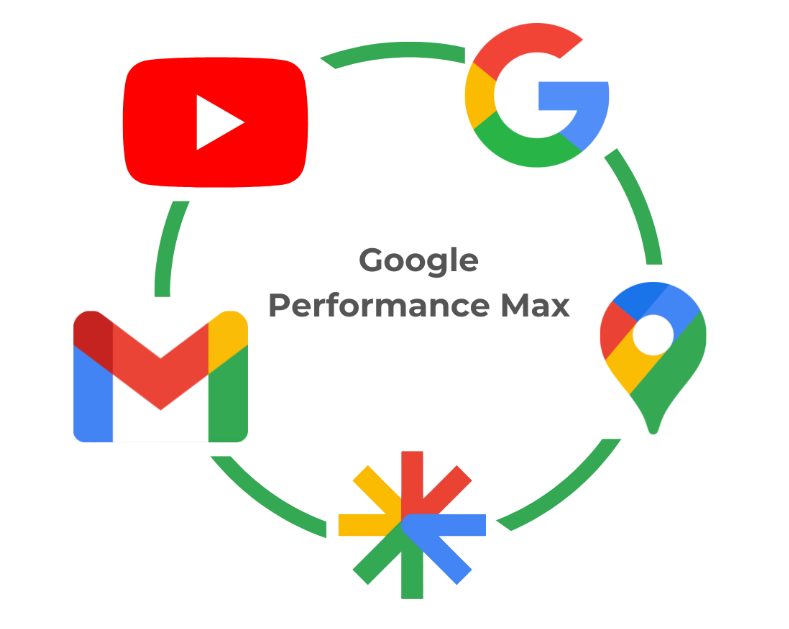
The campaign can operate with a relatively low cost-per-click, and from personal experience, I can say that this campaign type pleasantly surprised and convinced me with its results.
A situation where you have a product or service that already exists in the market. A very common scenario. What to do? Again, everything is determined by the budget. Even if you have a significant budget that you can afford to spend, starting advertising with a large budget is not always the best solution. I would even say the opposite: in the first month or months, conduct all activities with a limited budget to gather initial data, which can then be used to measure further development and trends. Perhaps it's better not to aim for top ad positions in the first month; perhaps it's better to settle for lower positions but, in turn, get a cheaper cost-per-click and thus more overall website traffic? Perhaps in the first month, you should only use direct competitors' brand names as your keywords, because we know that people searching for your competitors are interested in the product you can also offer them.
Each tactic has its pros and cons, and therefore, they should be tested as painlessly as possible. Here, again, results tracking and limited budgets are crucial. The main thing is to carefully monitor campaign development, both on the campaign manager's side and the client's side. From my experience, I can say that the best results are achieved when there is mutual cooperation, data exchange, and sharing of advice.
Conclusion
In conclusion, very briefly and simply: The internet isn't going anywhere; consumers are increasingly moving to the online environment, and if a business wants to reach them, digital marketing - paid or free - is an indispensable part of its overall development. We can argue extensively about illogically high click prices and how it can't possibly be profitable, but the fact that businesses continue to invest money in digital advertising indicates that it pays off. Does this mean that to achieve results, I immediately need to invest thousands in Google Ads? Of course not, but you always have to start somewhere. The main thing is to think critically, test different options, adapt to the situation, listen to advice, and accept criticism.
Want to precisely measure how many euros of profit each euro invested in advertising brings?
Book a 15-minute consultation. We'll discuss the correct application of conversion values and Smart Bidding.
Fixed budget. No hidden fees or forced services.