In 2026, automated bidding algorithms and AI agents demand even more precise human oversight and value-based data from real CRM revenue. Learn more in our Google Ads campaign audit.
Most Google Ads campaigns fail not because of incorrect keywords or bidding algorithms, but because ad copy relies on generic marketing clichés. Consumers and B2B clients ignore abstract promises of 'highest quality'. In this article, we cover a scientific approach to ad copy A/B testing based on concrete benefits, pricing transparency, and post-click anxiety reduction.
Why Generic Clichés Destroy Your Ad Budget
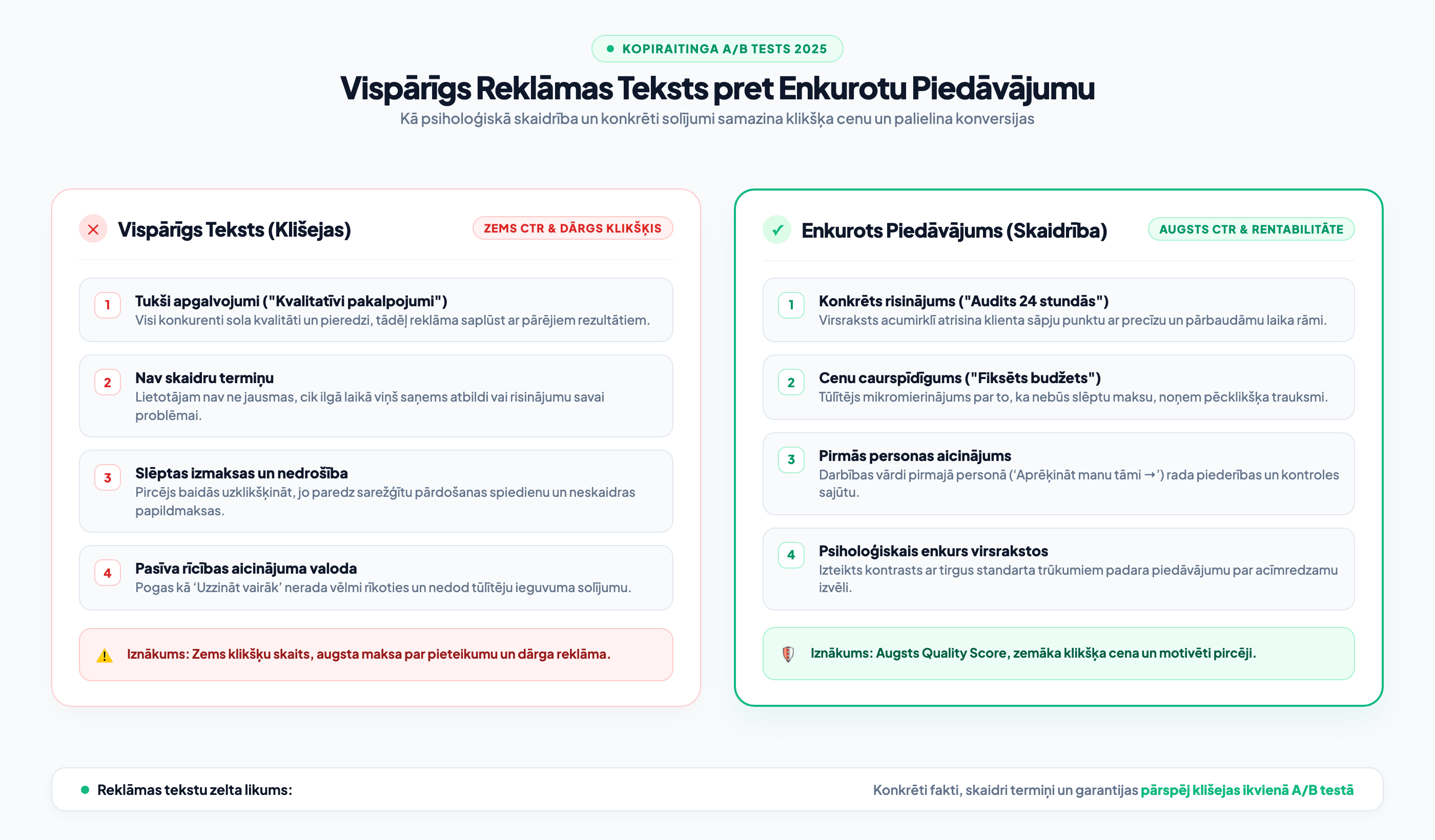
When a client searches for a solution on Google, they are in an active evaluation phase. If all four ad slots present the exact same copy ('Experienced specialists', 'Individual approach', 'Best prices'), the user has no rational reason to choose your offer. As a result, click-through rates (CTR) plummet, Quality Score declines, and cost-per-click (CPC) increases.
In the Google Ads advertising campaigns we manage, we replace clichés with clearly defined guarantees, timelines, and pricing parameters that attract motivated buyers right from the search results page.
Using AI Tools to Generate and Validate Ad Variations
In modern ad management, you no longer need to manually write dozens of similar sentences. By using structured prompt models, you can quickly prepare 15 headlines and 4 descriptions for Responsive Search Ads (RSA) campaigns, adhering to a strict psychological breakdown: pain point, guarantee, deadline, and call to action.
As outlined in our module on artificial intelligence ad automation, a properly trained AI assistant can generate hundreds of precise semantic variations while maintaining your brand's unique voice and tone.

“The job of sales copy is not to sound witty or poetic, but to instantly eliminate buying hesitation. A concrete deadline, guarantee, and clear benefit consistently beat any generic marketing slogan about 'highest quality'.”
Copywriting Psychology: First-Person Framing and Action Clarity
As we detailed in our guide on how to write high-converting ad copy, minor phrasing changes make a massive difference. First-person calls to action ('Request My Free Audit →' or 'Calculate My Estimate →') give users a sense of control compared to formal phrasing like 'Apply Here'.
Meanwhile, adding micro-reassurance ('Fixed budget. No hidden extra fees.') significantly reduces friction and boosts lead submissions on the destination page.
- Cliché audit: Review your ad headlines and delete words like 'best', 'high-quality', or 'cheap'.
- Concrete fact: Add at least one measurable metric (e.g., 'Delivery within 24 hours' or 'Fixed quote').
- First-person CTA: Ensure your closing copy features a personalized call to action with an arrow.
Frequently Asked Questions About Ad Copy A/B Testing
How long should an A/B test run to gather reliable data?
A test needs to collect at least 100 to 150 clicks and a statistically significant number of conversions for each variation. In medium-volume campaigns, this typically takes 2 to 4 weeks.
How do I correctly configure Responsive Search Ads (RSA)?
Add at least 10 to 12 different headlines. Pin your primary keyword in Position 1, and allow the Google algorithm to test different benefit and guarantee offers in Positions 2 and 3.
Why does high CTR sometimes fail to generate leads?
This discrepancy occurs when the ad copy promises something that is not delivered on the landing page (Message Mismatch). The ad offer and the top section of the website must be 100% synchronized.
Want to ensure your Google Ads budget isn't wasted on empty clicks?
Request a 15-minute independent campaign audit. We will inspect your account architecture and reveal up to 30% potential savings.
Fixed budget. No hidden fees or upsells.