

The debate over the balance between human and artificial intelligence in Google Ads in 2024 was just the beginning. In 2026, daily bidding and search query clustering are handled by algorithms, while the primary value of a human expert lies in defining business profitability, inputting real profit margins, and setting strategic campaign direction. Learn more in our Google Ads management services.
By 2024, it was impossible to imagine the Google Ads platform without artificial intelligence. Smart Bidding, Performance Max, and Responsive Search Ads (RSA) have become industry standards. Google sales managers regularly urge users to enable all automated recommendations with a single click. However, practice reveals a harsh truth: campaigns left entirely on 'autopilot' often generate impressive click numbers but rapidly erode business profit. To achieve true efficiency, a balance between the power of machine learning and the firm hand of an experienced specialist is essential.
Key Takeaways
- The 2024 AI campaign boom: Google Ads is increasingly pushing automation: Performance Max, Smart Bidding, auto-generated headlines, and broad match queries.
- Blind trust burns budgets: Leaving a campaign entirely to the algorithm without human oversight often leads the system to optimize for cheap, worthless clicks or cannibalize your own brand search terms.
- The hybrid management model: The algorithm handles real-time bidding across millions of auctions, while the specialist provides the strategic framework: negative keywords, business profitability caps, and audience signals.
- Value-Based Bidding: The highest returns come from campaigns where the algorithm is trained not on the number of conversions, but on actual profit margins.
What the Google Ads algorithm does brilliantly and where it needs control
Artificial intelligence in advertising systems is not an enemy, but a powerful engine. A human cannot physically analyze thousands of signals for every search user in real-time: device model, browser language, location precision, and search history context. This is why Auction-Time Bidding outperforms any manual bid management.
However, the algorithm has one fundamental flaw: it does not understand your company's true business model and profit structure. If the system is tasked to 'Maximize conversions,' it will just as happily attract a student signing up for a sample as it will a large corporation ready to sign an annual contract. Therefore, professional Google Ads management is focused on steering the algorithm in the right direction.
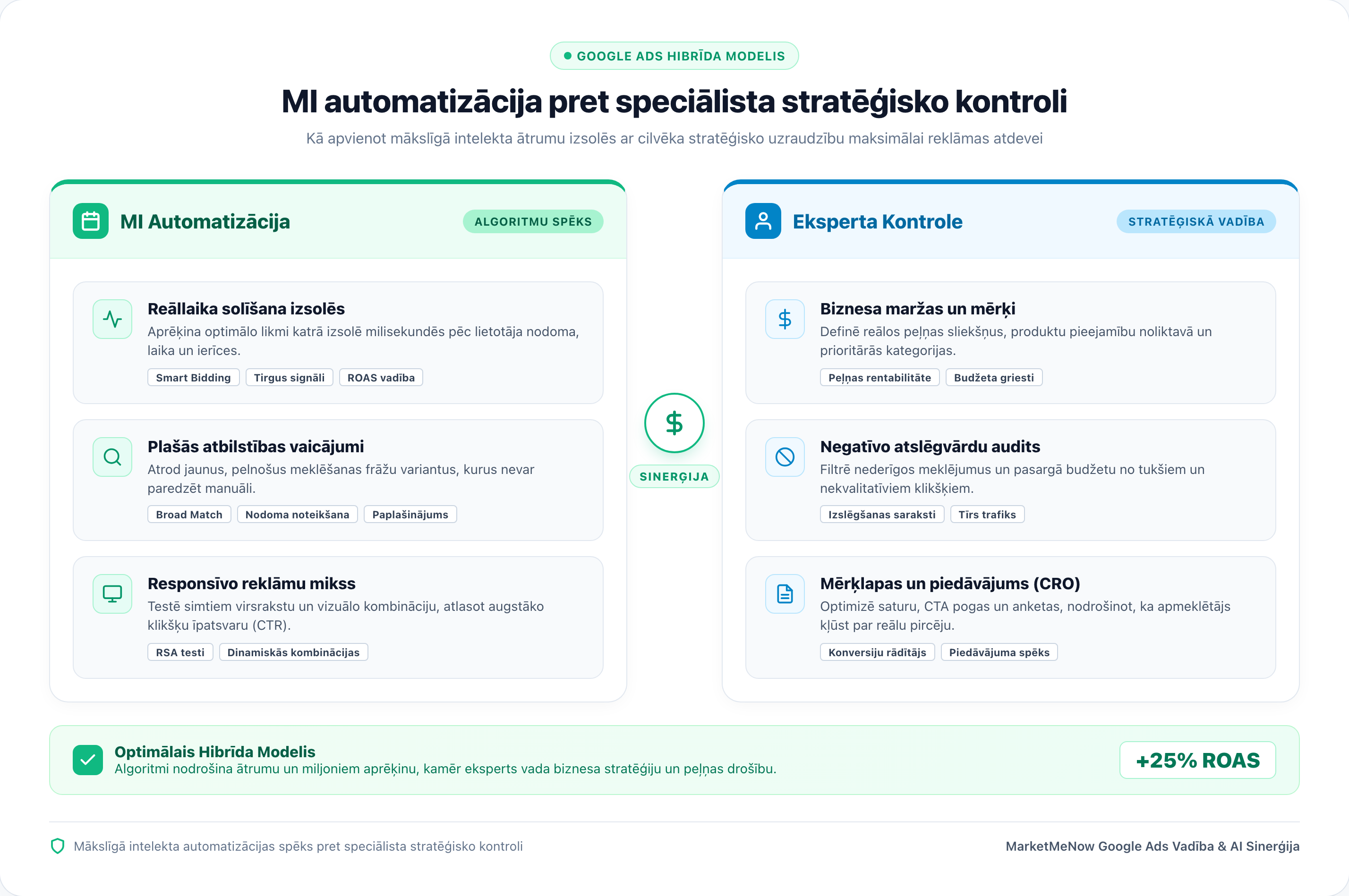
The four cornerstones of the hybrid model
To gain maximum return, successful advertisers use a hybrid management model:
| Management Area | What Google Ads AI does | What the specialist must control | Business Benefit |
|---|---|---|---|
| Bidding | Adjusts click price in milliseconds based on conversion probability | Sets target ROAS and tCPA based on real product margins | No overpaying for low-value transactions |
| Search Queries | Expands Broad Match coverage with semantic synonyms | Regularly audits search terms and updates negative keywords | Budget is not wasted on irrelevant searches |
| Creative Assets | Combines headlines and descriptions based on the user | Writes persuasive offers and checks brand tone | Ads maintain human appeal and high CTR |
| Audiences | Finds new similar users across the network | Inputs first-party customer data and precise signals | Algorithm learns from the best real buyers |
This approach is the foundation of all modern digital advertising strategy, ensuring that technology serves business goals, not the other way around.
How to correctly transition to Value-Based Bidding
In 2024, the biggest leap in profitability is achieved by replacing standard 'Target CPA' with 'Target ROAS' or conversion value adjustments (Conversion Value Rules):
1. Assign different values to different goals: If a consultation request from Riga is twice as valuable to your business as a request from a region where you have no service center, input this difference into your conversion values.
2. Use offline conversion imports: Connect your CRM to Google Ads to pass information about which leads actually turned into paid invoices. This prevents the algorithm from chasing 'empty' leads.
3. Use the latest automation tools wisely: Alongside Google's solutions, companies are beginning to integrate specialized AI advertising assistants and tools that help analyze data and generate testing ideas faster.
As we explained in our comparative analysis of how Google Ads Smart Bidding strategies work, choosing the right strategy for a specific data volume is decisive.
Frequently Asked Questions
Should I enable all Google Auto-Apply recommendations?
Absolutely not! Automated recommendations often expand keywords to Broad Match without sufficient negative lists or remove budget caps, which can lead to a rapid increase in costs without corresponding results.
How many conversions are needed for Smart Bidding to work well?
For the algorithm to learn and make informed decisions, it is recommended to receive at least 30 conversions in the last 30 days. At lower volumes, it is necessary to use micro-conversions.
Can I use negative keywords in Performance Max campaigns?
Yes, but adding them at the account level or through Google support requires special attention to avoid accidentally excluding important search phrases.
Conclusion
Artificial intelligence in advertising is not a magic button that solves all problems. It is a powerful turbine that requires a skilled pilot. By combining the speed of algorithms with strategic business vision, Google Ads becomes a stable and profitable growth channel.
Want to get maximum return from Google Ads with thoughtful human control?
Book a 15-minute strategy call. We will review your campaign structure, budget flow, and eliminate unnecessary spending.
Fixed budget. No hidden fees or forced services.