
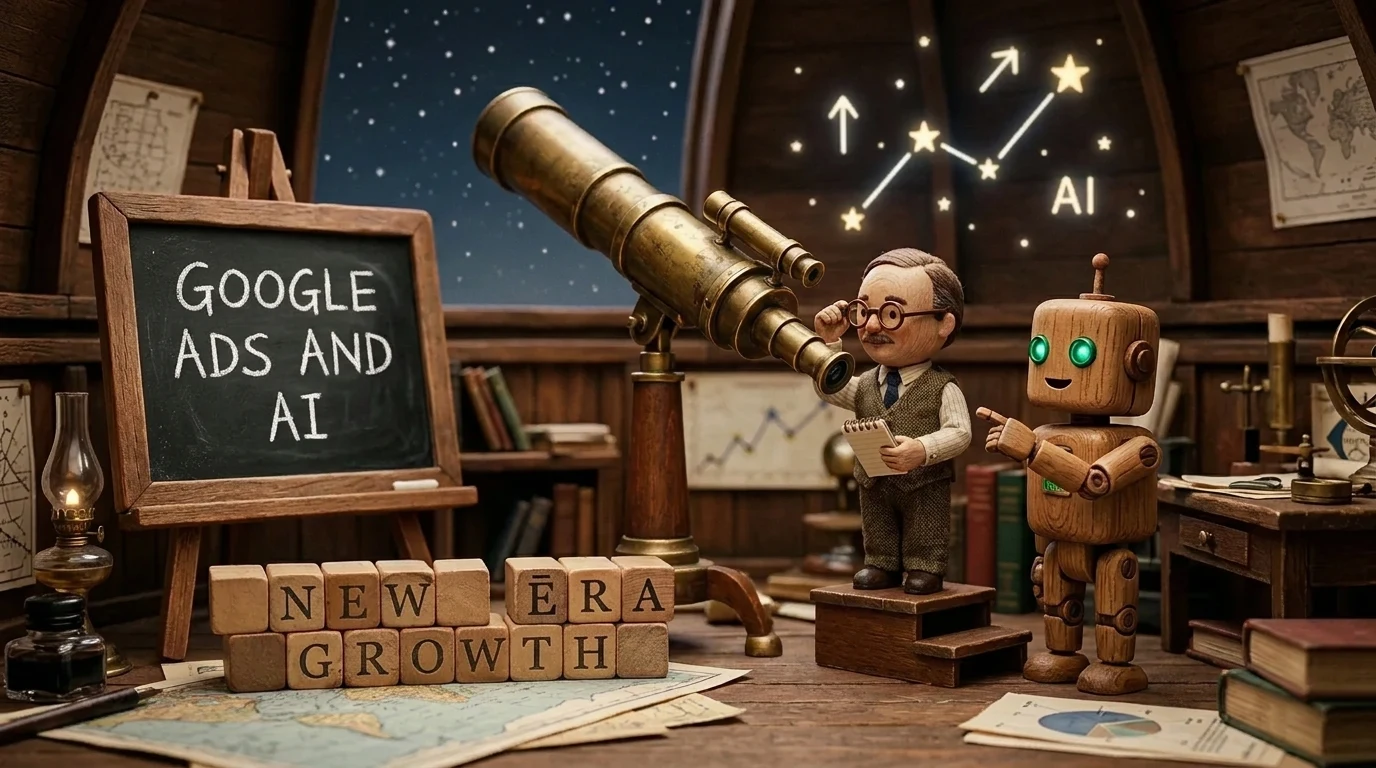
The 2024 discussion regarding artificial intelligence and advertising has evolved into concrete solutions. By 2026, AI automates data processing, customer service, and initial content research, allowing business leaders to focus on strategy and growth. Learn more about our AI assistant solutions.
Key Takeaway: This article examines the rapid development of artificial intelligence (AI) and its role in digital marketing, particularly in Google Ads campaign optimization. The author acknowledges the efficiency of AI in campaign management but expresses skepticism regarding AI-generated text, favoring human-crafted content. AI will become a daily staple, but its use requires a critical approach.
Lately, I have been having more and more conversations with people and colleagues about AI (artificial intelligence). These discussions frequently revolve around the advertising niche, which is logical given that I have been part of the online marketing industry for 15 years, where daily processes are automated by smart AI assistants and algorithms. Therefore, this article will not be technical in nature (unlike our study on the future of Performance Max campaigns), but rather a reflection on AI and its real role in digital marketing.
Key Takeaways
- The Automation Revolution: Artificial intelligence is already managing the majority of Google Ads bidding, formatting, and audience optimization.
- The Rising Value of Human Strategy: As more tools become automated, deep business understanding, accurate first-party data, and original ad messaging provide a greater competitive advantage.
- Data Quality Drives Results: If AI is fed low-quality or incomplete conversion data, it amplifies errors and burns budget; sGTM and server-side analytics are fundamental requirements.
- The Hybrid Work Model: The winners of the future are companies that combine the speed of machine learning with human oversight and strategic management.
The Era of Artificial Intelligence
We can definitively say that AI is currently in a phase of rapid development. The capabilities of artificial intelligence are becoming increasingly impressive, reaching a level we once imagined while watching 80s and 90s Hollywood sci-fi movies. From text writing and data synthesis to video content, the possibilities of AI seem almost limitless. It is safe to say that over the next 5 years, this development will only accelerate and integrate even more deeply into business operations.
AI and Google Advertising
Naturally, as a technology giant, Google has not missed the potential of artificial intelligence and is purposefully working to integrate AI solutions into its products. Personally, my greatest exposure is specifically with the Google Ads platform, where artificial intelligence is also being used intensively. Currently, machine learning algorithms are primarily utilized in campaign optimization and real-time bidding (Smart Bidding) to facilitate campaign management and make Google advertising more accessible to a wider audience.
I must admit that in my experience, there have been cases where campaigns based on AI solutions showed excellent results and high returns. However, in fairness, I have also seen less-than-ideal results - especially in situations where the system is not provided with sufficiently clear data or lacks human strategic control and negative keyword management. In any case, in the long run, AI is an integral part of Google Ads, and in the future, we must treat it as a self-evident standard.
The Downsides and Limits of AI
In my view, artificial intelligence also has clear downsides and limitations. Recently, a friend asked me: how much do I use AI in my daily work? Honestly, it took me several days to formulate my answer precisely. Simply put, I could have said - yes, I use AI every day because I manage client ad accounts that run automated campaigns. But I realized his question was in the context of the creative and personal side. My answer was: I use it minimally.
I do not use AI to write final ad copy or create articles for me. Yes, technically it would be faster and more convenient, but I personally do not like these AI-generated texts. While they are often technically correct, when reading AI-created texts, the feeling that they were written by a robot never leaves. They lack living emotions, humor, deep industry empathy, and a personal touch. I even conducted an experiment where a colleague sent me several articles, some of which were created with the help of AI - it was very easy to distinguish which were written by a human and which by a machine.
The ability of artificial intelligence to optimize campaigns on the Google Ads platform is largely based on predictive analytics. It not only processes data but also uses it to predict future trends, user behavior, and campaign performance. This ability to predict allows for more accurate decision-making, utilizing advertising budgets more rationally. This is how AI turns numbers into practical action.
However, we must not forget about data privacy and ethical issues. It is vital to ensure a responsible approach to user data processing to maintain trust and build long-term relationships with the audience. This requires a critical evaluation of how AI is used, not only in terms of efficiency but also regarding reputation and compliance.
Regarding AI-generated texts, they are based on Large Language Models (LLM) and generative AI. These technologies imitate human writing, but they still lack the authentic nuances and strategic sharpness that an experienced industry professional can provide. While these models are excellent at data processing and structural formation, they cannot fully replace human-created, emotionally engaging content when it comes to ad copy.
Reflections and Future Outlook
I am not a technology conservative and always acknowledge solutions that provide tangible value. But at this moment, I am not a blind AI worshiper either. I know that I will continue to create Google advertising messages myself, just as I do with articles. In technical campaign optimization, we will continue to use AI algorithms where they prove stable returns and profitability.
Artificial intelligence will be an integral part of our daily lives, but the main competitive advantage will be determined by how an entrepreneur can combine the power of technology with human strategic vision, true values, and respect for their customers.
Frequently Asked Questions about AI and Google Ads
How is artificial intelligence (AI) used in the Google Ads platform?
What is the opinion on AI-generated ad copy?
Does AI always guarantee good results in Google Ads campaigns?
Will AI become an integral part of digital marketing?
Want to automate your marketing and customer service processes with custom AI assistants?
Book a 15-minute consultation. We will evaluate your company's routine tasks and suggest the most suitable solution.
Fixed budget. No hidden fees or forced services.