
In 2026, accurate data tracking is only possible through an independent server-side (sGTM) infrastructure with full Consent Mode v2 compliance. Learn more in our Server-Side Analytics Architecture.
It has been exactly one year since Google made Consent Mode v2 mandatory for advertisers in the European Economic Area. This period has clearly demonstrated the difference between companies that implemented the advanced v2 configuration with AI data modeling and those that merely added a superficial banner. In this article, we examine real-world practice and how to restore ad performance without violating user privacy.
What GA4 Reports Actually Show Without Proper v2 Implementation
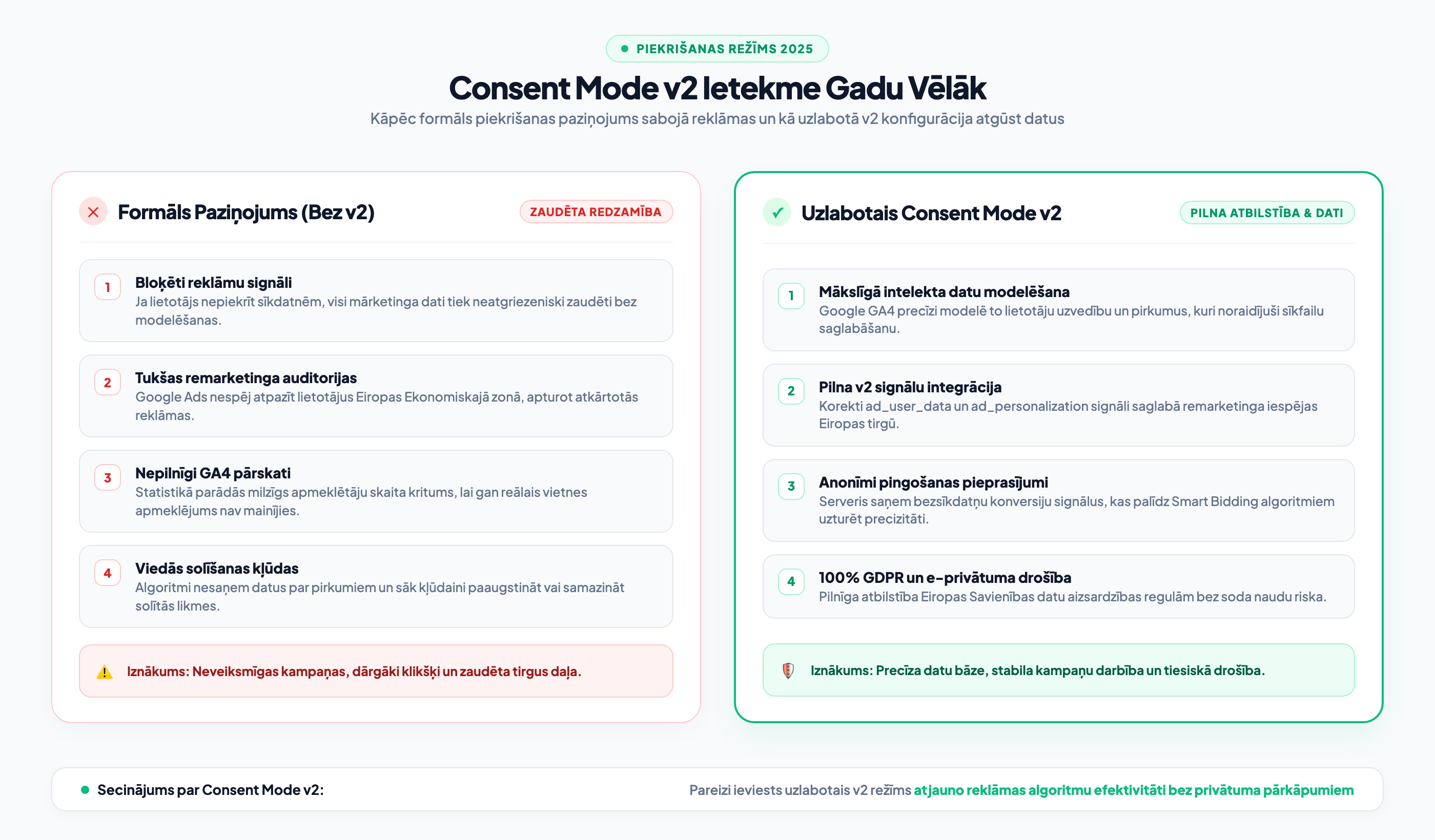
Many marketing directors over the past year were puzzled by why Google Analytics 4 showed a significant drop in user numbers, even though actual company revenue and orders in the bank account remained unchanged. The reason is simple: if a website uses a simplified cookie blocker without Consent Mode v2 integration, every visitor who clicks 'Decline' becomes completely invisible to analytics.
To recover data completeness, you need privacy-compliant ad analytics leveraging Google Advanced Consent Mode. In this mode, when a user rejects consent, anonymous cookieless pings are sent, allowing Google's machine learning models to reconstruct true visitor behavior.
How v2 Signals Impact Google Ads and Meta Ad Campaigns
Consent Mode v2 introduced two new mandatory parameters: `ad_user_data` (permission to send user data for Google advertising purposes) and `ad_personalization` (permission to use data for personalized remarketing). If these signals are not passed correctly, ad campaigns in the European Union lose the ability to build audience lists.
This also affects audience remarketing restoration and cross-channel attribution. When an ad network cannot observe the purchase path, Smart Bidding algorithms mistakenly reduce impression frequency for top-performing keywords, assuming they do not generate results.

“It has been a year since Consent Mode v2 implementation, and we see a massive gap between those who set it up professionally and those who installed a temporary plugin. Data quality determines how effectively ad algorithms can acquire new customers.”
How to Audit and Fix Configuration Shortfalls
As we outlined in our Consent Mode v2 implementation guide, most errors occur when the consent banner is fired too late or out of sequence relative to the Google Tag Manager container. Default consent states must be defined at the very top of the page code before any other script runs.
Check the 'Diagnostics' section under Conversion settings in your Google Ads account. If warnings appear regarding missing v2 signals, it is an urgent signal to conduct a code audit.
- Google Tag Assistant: Open the Tag Assistant tool and check whether the `consent default` event is sent before the page loads.
- Signal Presence: Ensure that after consent is granted, `ad_user_data` and `ad_personalization` update to `granted`.
- GA4 Data Modeling: Verify in GA4 Property Settings under 'Reporting Identity' that 'Blended' mode is activated.
Frequently Asked Questions About Consent Mode v2
What is the difference between Basic and Advanced Consent Mode v2?
In Basic mode, all Google tags are blocked until the user consents. In Advanced mode, tags load immediately, but if consent is denied, they store no cookies and transmit only anonymous pings, allowing GA4 and Google Ads to use AI-modeled data.
Is Advanced mode legally compliant under GDPR?
Yes, because when consent is rejected, no identifier is stored or read on the user's device, and the transmitted technical pings contain no personally identifiable information.
How does modeled data improve advertising ROI?
Modeling restores a full picture of how many purchases were actually generated by each campaign, preventing Smart Bidding algorithms from cutting budgets for high-performing ads.
Conclusions and Next Steps
Privacy standards and accurate marketing analytics are not mutually exclusive. By configuring Consent Mode v2 according to modern requirements, your business gains full data clarity for decisions while maintaining flawless legal compliance.
Want Independent and 100% Accurate Marketing Tracking Without Data Loss?
Book a 15-minute consultation. We will implement first-party server-side analytics and connect real purchase data with your ad accounts.
Fixed budget. No hidden fees or pushed upsells.