

The official launch of the Google Gemini model in December 2023 ushered in a new era of multimodal analysis. In 2026, Gemini is integrated into the core search engine, and content structured with facts and direct answers gains maximum visibility in AI search blocks. Learn more in our full-cycle SEO and GEO section.
On December 6, 2023, Google and DeepMind made a long-awaited and ambitious announcement: Gemini was officially unveiled as Google's most powerful and capable artificial intelligence model to date. After months of speculation in the tech world, Google finally put its direct answer to OpenAI's GPT-4 model on the table. Gemini marks a new era in AI development, where multimodality is no longer an add-on, but a core feature.
Key Takeaways
- Multimodality from the Ground Up: Unlike earlier tools (such as those we examined in our article on ChatGPT and real-time search), which separately connected text and image modules, Gemini was trained simultaneously on text, code, audio, and video data from day one.
- Three Sizes for Different Purposes: Gemini Ultra for complex analytical tasks in data centers, Gemini Pro for broad business applications, and Gemini Nano for local operation directly on smartphones.
- Search and Bard Integration: Google immediately began integrating Gemini into Google Bard, Search Generative Experience (where SEO and GEO search optimization becomes the rule), and Workspace products.
- Rising Importance of GEO (Generative Engine Optimization): Content creators who prioritize regular blog post creation must start optimizing content not just for keyword search, but for multimodal assistants capable of directly interpreting infographics, tables, and video summaries.
What Makes Gemini Unique: Native Multimodality
Until now, most multimodal systems were built by combining separate models: one model recognized speech, another generated text, and a third analyzed images. This patchwork approach often led to context loss and inaccuracies.
Gemini was created as a natively multimodal model. This means that from the very beginning of the training process, the model simultaneously learned text, images, video clips, audio recordings, and computer programming code. This allows Gemini to seamlessly understand complex visual diagrams, read physics problems from hand-drawn sketches, and synthesize responses in multiple formats simultaneously.
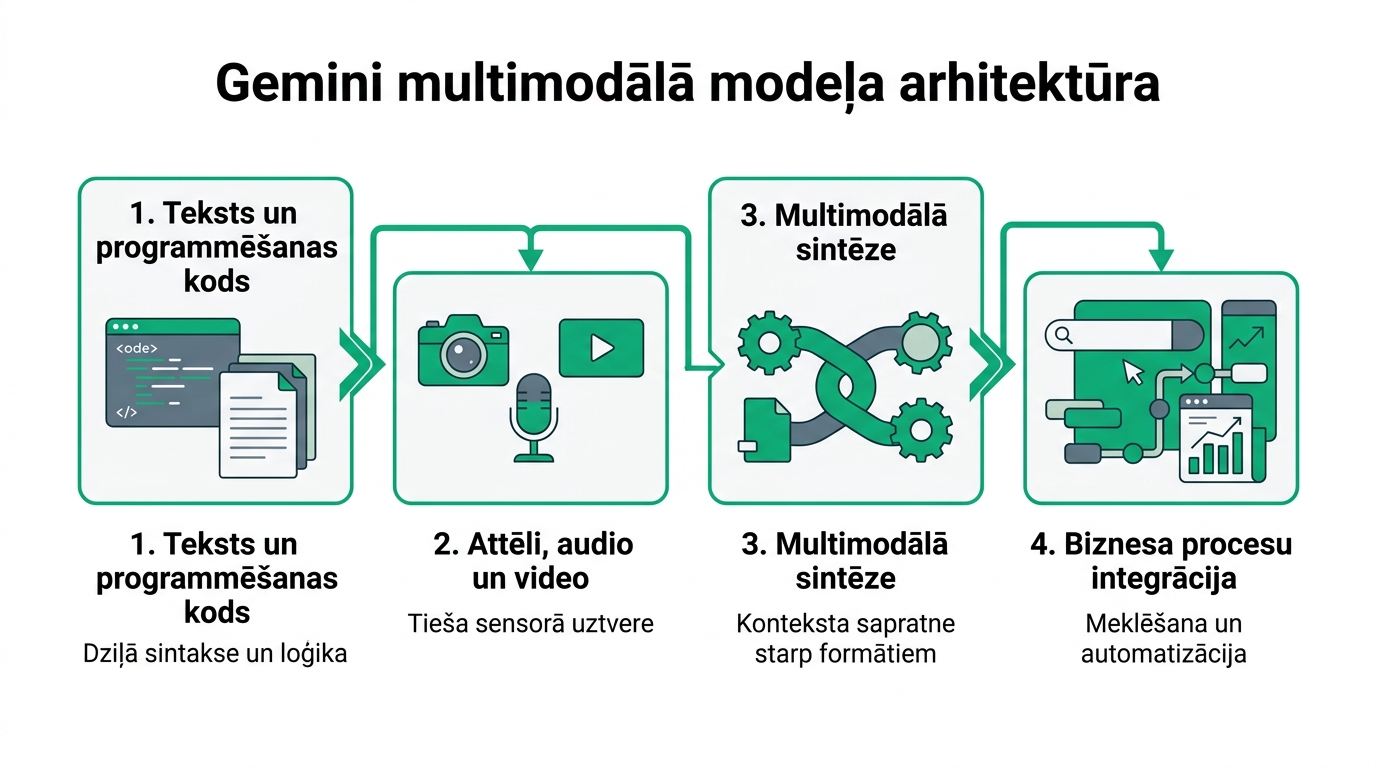
Three Versions of the Gemini Model for Different Applications
To ensure efficiency across both massive servers and mobile devices, Google offers three performance tiers:
| Version | Target Audience and Environment | Key Advantage | Practical Application |
|---|---|---|---|
| Gemini Ultra | Data centers, complex research tasks | Outperforms human experts on MMLU academic benchmarks | Deep data analysis, scientific research, complex code |
| Gemini Pro | Business applications, APIs, Google Bard | Optimal balance between speed, cost, and power | Content generation, customer service automation |
| Gemini Nano | Local device (e.g., Google Pixel 8 Pro) | Operates without an internet connection, complete privacy | Recorded conversation summaries, smart keyboard replies |
What Gemini Means for Content Marketing and Website Owners
The introduction of Gemini into the search engine will radically change how people search for information:
Multimodal Information Synthesis: Users will no longer search using text phrases alone. They will photograph a broken part, attach a voice question, and expect an exact instruction. Websites that offer quality visual guides and tables will have a massive advantage.
Transition from SEO to GEO (Generative Engine Optimization): The traditional battle for the top spot in 'blue links' becomes less significant than the ability to be cited and included in AI-generated search summaries.
Deeper Code and Technical Integration: Gemini's ability to understand and generate code will allow programmers to instantly automate routine tasks, from database query optimization to custom API integrations.
Comparison: Gemini vs. GPT-4
In tests published by Google, Gemini Ultra outperforms GPT-4 on thirty out of thirty-two industry-standard benchmarks, excelling particularly in mathematics, coding, and visual logical analysis. Although real-world user experience will show the true balance of power, it is clear that the monopoly at the summit of artificial intelligence has ended, and competition is accelerating the pace of innovation.
Frequently Asked Questions
When will Gemini become available to every user?
Gemini Pro is already integrated into Google Bard in English today, while Gemini Ultra will be released to the general public and developers in early 2024 with Bard Advanced.
Can Gemini be used in Latvian?
The initial release focuses primarily on English, but support for other languages, including Latvian, will be expanded over the coming months.
How can I prepare my content for the multimodal era?
Ensure your articles feature clear, informative images with descriptive titles, structured data with tables, and authoritative factual sources.
Conclusions and Next Steps
The release of Google Gemini is a clear signal: artificial intelligence is moving toward full multimodal interaction with the digital world. Businesses looking to maintain visibility must think about professional content creation, multimedia integration, and deep expertise starting today.
Want to adapt your business content for Google Gemini and future search requirements?
Book a 15-minute strategy call. Let's discuss GEO optimization and artificial intelligence search opportunities.
Fixed budget. No hidden fees or forced services.