
In 2026, the search landscape has irrevocably changed: content is now valued based on its direct quotability in ChatGPT, Perplexity, and Gemini search engines. Learn more about our SEO and GEO services.
The first half of 2025 marked a significant turning point in the business landscape: the era of uncontrolled marketing tool subscriptions and chaotic experimentation is over. Business leaders and CFOs now demand a clear return on every euro invested. This retrospective examines key insights from H1 campaigns, common budget drain channels, and a strategy to simplify infrastructure before the second half of the year.
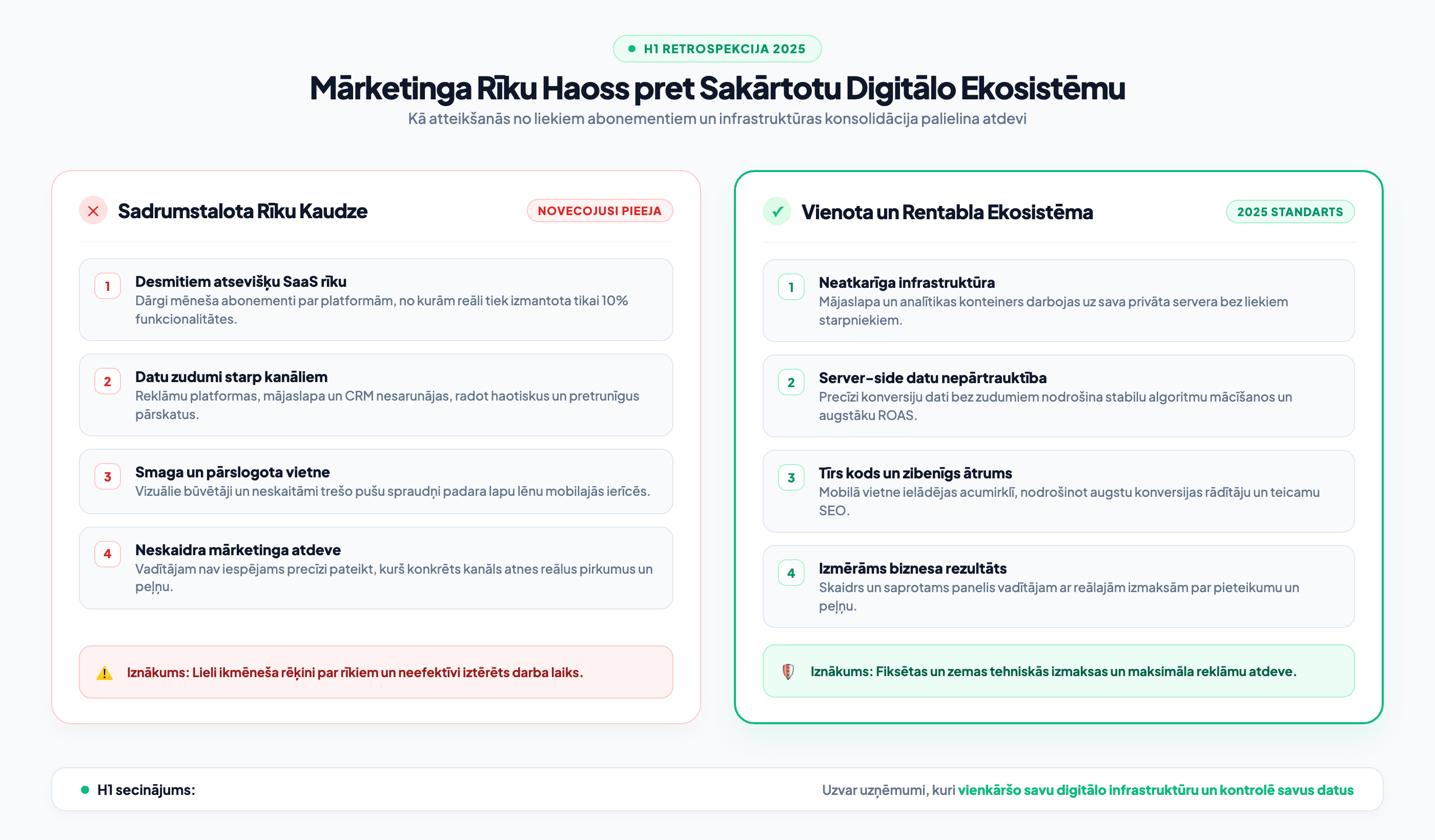
Tool Fragmentation Syndrome: Why More Means Less
The average company in Latvia pays monthly for 7 to 12 different marketing, analytics, and automation services. Each tool individually promises excellent functionality, but in reality, they don't communicate with each other. Data discrepancies between ad accounts, CRM, and accounting create chaos in decision-making.
As we emphasize in our integrated digital marketing and advertising services, success goes to teams that reduce the number of intermediaries and focus on a unified, stable infrastructure with direct data flow.
Sales Funnel and Team Efficiency Audit
The second most significant H1 lesson is conversion friction. Many companies increased their advertising budgets but didn't receive more qualified leads because their websites failed to serve users with a clear value proposition. Application forms with 7 unnecessary fields and slow mobile loading speeds deterred buyers within the first few seconds.
By implementing a transparent sales management and lead processing system, a business owner can see the real path from the first ad click to a closed deal and invoice payment.

“The first half of the year proved that success belongs not to those who subscribe to the most tools, but to those whose infrastructure is simple, fast, and precise. Every marketing channel must justify its investment in real numbers.”
Preparing for H2 2025
As we predicted in our early-year study on digital marketing trends for 2025, success in the autumn and winter sales season will go to those whose websites are clean, fast, accessible (EAA), and equipped with server-side analytics.
Utilize the quieter summer months to drop unnecessary SaaS tools, streamline data flows, and implement fixed, measurable marketing budget management.
- Tool Inventory: Count all marketing and software subscriptions from the last 6 months.
- ROI Balance: Verify which of these tools genuinely help attract or serve customers.
- Infrastructure Consolidation: Evaluate the possibility of combining hosting, analytics, and email systems on a single private server.
Frequently Asked Questions About Marketing Profitability
How do you assess if a marketing agency is working profitably?
Demand reports on real business results: the number of qualified leads, cost per lead (CPL), and the value of acquired customers, rather than just abstract metrics like impressions or clicks.
What are the first steps in simplifying infrastructure?
Start by deactivating unused marketing plugins on your website, implementing Server-Side GTM on your own server, and simplifying contact forms to 2-3 fields.
When is the best time to start preparing for the autumn season?
In July and August. Technical work and SEO optimization take several weeks, so by starting early, your digital infrastructure will be operating at full capacity by September.
Want to strengthen your brand's authority in Google and new AI search engines?
Book a 15-minute strategic consultation. We'll perform a website SEO and GEO diagnostic, preparing your content for artificial intelligence answer indexes.
Fixed budget. No hidden surcharges or forced services.