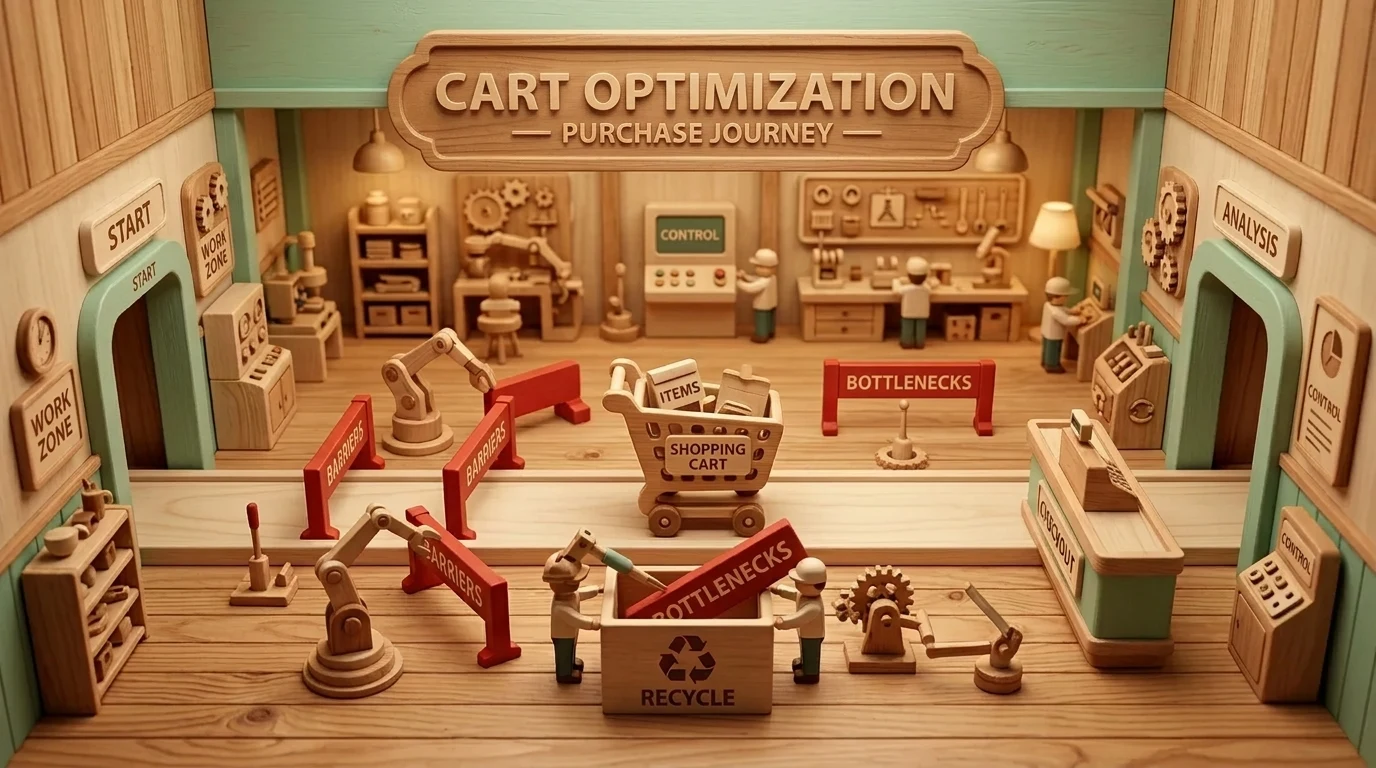
In 2026, ergonomic, low-friction pages win, offering decision-makers a clear next step with immediate micro-comfort. Learn more about our B2B Funnel and Landing Page Development.
Most carts are abandoned not due to high prices, but as a result of technical hurdles and cognitive friction: mandatory registration, slow checkout steps, unexpected delivery costs at the final step, and local payment failures. A transparent One-Page Checkout and micro-comfort elements can increase the number of completed purchases by 20-35%.
The average Cart Abandonment Rate in European and Latvian online stores ranges from 68% to as high as 75%. This means that for every 10 visitors who add an item to their cart, approximately 7 people leave the site without completing the purchase. Marketing specialists often blame "high prices" or "searching for discounts with competitors," but an in-depth code audit shows that in more than half of cases, purely technical and usability errors in the checkout process are to blame.
1. Mandatory Registration Before Purchase
The biggest conversion killer in e-commerce is complex processes, which professional e-commerce development and optimization fully resolve with guest checkout. A buyer wants to purchase an item in 60 seconds, not think of a new password with uppercase letters and special characters. Solution: Implement mandatory Guest Checkout as the default option.
2. Slow Parcel Locker List Loading (Omniva, DPD, Smartpost)
In Latvia, over 80% of e-store purchases are delivered via parcel lockers. In many stores, the parcel locker dropdown menu is loaded with heavy external API requests precisely when the user opens the cart. If the API response is delayed by 2-3 seconds, the buyer sees an empty field or a freeze and abandons the page. Solution: Local caching of the parcel locker list on the server with daily synchronization.
3. Unexpected Delivery Costs Only at the Final Step
If the product card shows a price of 25 EUR, but suddenly a 5.99 EUR delivery fee or an unexplained VAT surcharge appears at the final step, the buyer feels misled. The delivery cost threshold ("Free delivery from 40 EUR") and the base parcel locker price must be visible already on the product card and in the shopping cart.
4. Mobile Layout Errors and Keyboard Overlap
Over 70% of purchases occur on mobile devices, where website speed and code optimization are crucial: if the on-screen keyboard covers a button (for example, if the phone number field is not set to type="tel", forcing number input via the full text keyboard), unnecessary friction arises, and the purchase is postponed.

"The shopping cart is where marketing ends and pure engineering begins. If the payment window takes 4 seconds to load or the banking module doesn't open full-screen on a mobile phone, all the money you've invested in Google Ads simply burns away. In the cart, every millisecond and every unnecessary field has a direct monetary cost."
5. Overly Complex Multi-Step Checkout Process
Outdated 4-5 step checkouts (Step 1: Data : Step 2: Delivery : Step 3: Invoice : Step 4: Payment : Step 5: Confirmation) create unnecessary friction today. Every page reload is a risk of losing a buyer. The modern standard is a One-Page Checkout, where all fields are in one place with a clear summary.
6. Lack of Trust and Security Elements at Checkout
When a buyer needs to enter payment card details or select an internet bank, a caution mechanism is triggered. If recognizable bank logos (Swedbank, SEB, Citadele, Luminor), an SSL security icon, or an indication of secure data processing are missing near the payment button, some new buyers choose not to risk it.
7. Inconvenient Coupon or Discount Code Entry Location
If there's a large, prominent, and empty field "Enter discount code" in the cart, the buyer gets the feeling they are overpaying. As a result, they abandon the cart to search for "discount code" on Google, end up on coupon websites or with competitors, and never return. The coupon field should be discreet and expandable on demand.
8. Insufficient Clarity of Error Messages
To ensure no purchase information is lost even in case of errors, an independent Server-Side Tracking and Meta CAPI system ensures continuous data recording. The erroneous field should be highlighted in red with a precise and friendly explanation directly below it, preserving all other entered data.
Frequently Asked Questions About Preventing Cart Abandonment in E-commerce
Is mandatory profile registration still acceptable?
No, purchasing without registration (Guest Checkout) must be the default option. Buyers want to check out in a few seconds, not remember a new password.
How much impact does checkout step loading speed have on cart abandonment?
Every additional second in the checkout window reduces conversion by approximately 7%. If cart recalculation or delivery method selection slows down, the buyer becomes suspicious about payment security.
What micro-comfort elements should be placed near the payment button?
A secure payment icon (SSL, bank logos), a guarantee of free returns within 14 days, and a clear delivery time promise.
Want to increase the number of quality leads without raising your ad budget?
Book a 15-minute consultation. We'll transform your lead funnel, removing friction and shifting focus to a real value proposition.
Fixed budget. No hidden surcharges or forced services.