
The collaboration between Broad Match and Smart Bidding proved its potential in 2024. By 2026, advancements in language models allow Broad Match to accurately recognize even complex user queries, providing additional volume at a strictly controlled cost-per-click. Learn more in our Google Ads management services.
For years, the golden rule for Google Ads professionals was strict: use only Exact and Phrase match keywords, staying as far away from Broad Match as possible. In the past, Broad Match was notorious for wasting budgets on irrelevant searches. However, over the last two years, Google search technology has undergone tectonic shifts. With the integration of artificial intelligence and large language models, Broad Match has become an extremely precise tool - provided it is paired with Smart Bidding and rigorous human oversight.
Key Takeaways
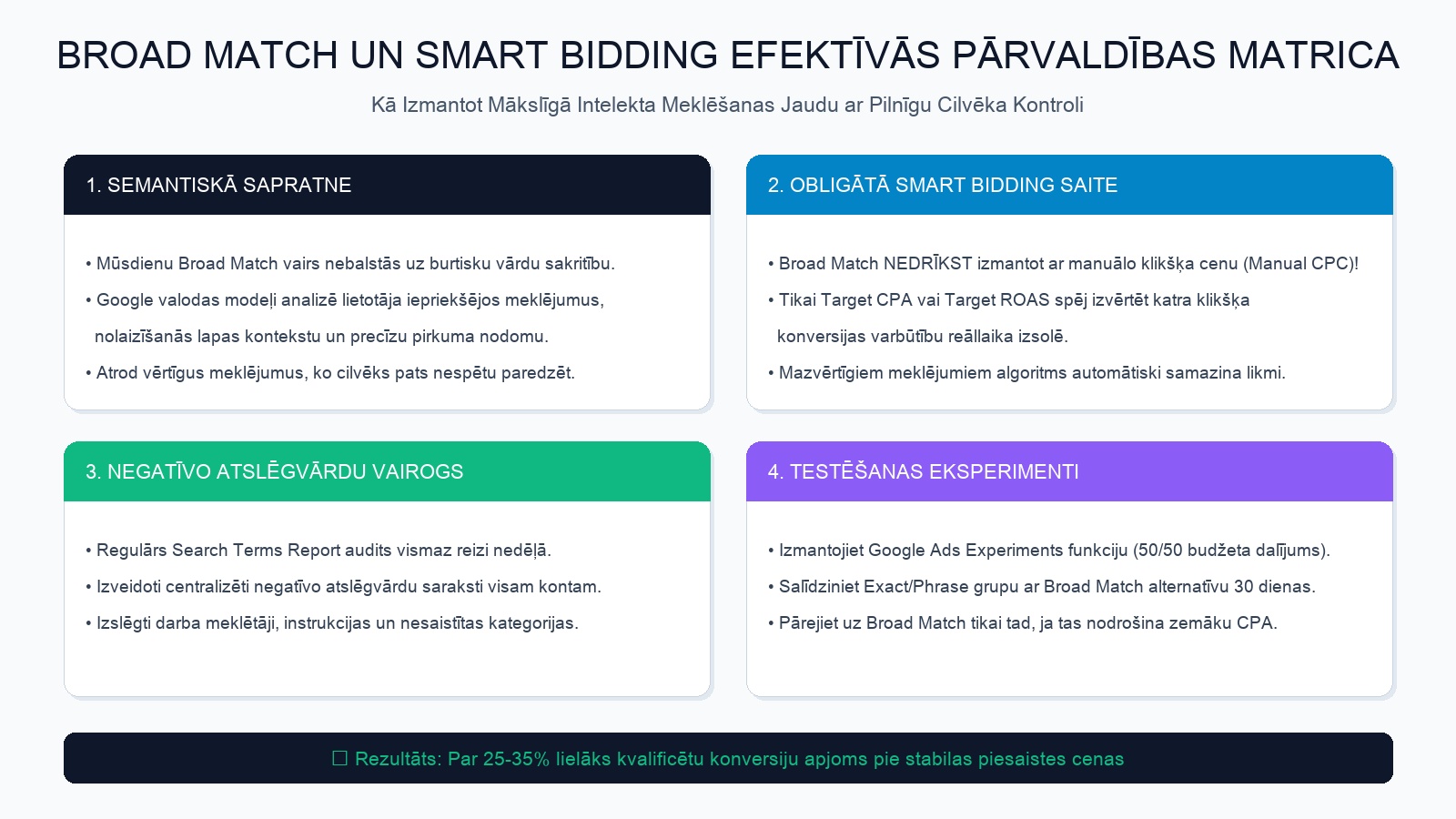
- Modern Broad Match is not what it was 5 years ago: Thanks to advanced natural language processing models, Broad Match analyzes the semantic context of a search rather than just literal word matches.
- Broad Match only works in tandem with Smart Bidding: Using Broad Match with manual CPC is dangerous for your budget - only Target CPA or Target ROAS can evaluate the purchase probability of each individual query.
- Negative keyword management is mandatory: Regular analysis of Search Terms Reports ensures that your budget is not spent on irrelevant or purely informational searches.
- Discovering new search queries: Approximately 15% of all daily searches on Google are completely new - Broad Match allows you to identify them and convert them before your competitors do.
How semantic models have changed the search auction
Traditional keyword matching was based on syntax - literal word comparison. Modern Google algorithms operate at a semantic level. This means the system understands the user's true intent, even if they haven't typed any of your campaign's keywords into their query.
When evaluating a user's query, Google considers a wide range of context: previous searches, the user's geographic location, landing page content, and other keywords in the relevant ad group. This allows you to find buyers who are simply impossible to predict with manually created keyword lists.
Prerequisites for safe Broad Match usage
For Broad Match to generate profit rather than losses, a business must follow three fundamental rules:
| Criterion | Requirement | Risk factor if ignored | Impact on campaign |
|---|---|---|---|
| Bidding strategy | Mandatory Target CPA or Target ROAS | Manual CPC will waste money on low-quality clicks | Algorithm bids only on converting queries |
| Conversion history | At least 30-50 conversions per month in the account | Algorithm will make flawed decisions without data | Stable and predictable optimization |
| Negative keyword list | Structured lists at account and campaign levels | Traffic from job searches, reviews, and competitors | Protected marketing budget |
| A/B testing | Google Ads Experiments feature | Sudden fluctuations in campaign performance | Safe comparison of the new approach vs. existing |
Successful campaign scaling requires regular monitoring. If your account has not been audited for a long time, an independent Google Ads audit can help clean it up, revealing budget leaks and efficiency reserves.
How to organize a test with Google Ads Experiments
Before switching entirely to Broad Match, it is recommended to use the experiments tool:
1. Create a campaign copy: Split the budget 50/50 between the base campaign (using Exact and Phrase) and the experimental campaign (where keywords are replaced with Broad Match).
2. Let the test run for 4 to 6 weeks: For the first two weeks, the algorithm will be in a learning phase. Evaluate results only after this period.
3. Compare total conversion count and CPA: If the experiment delivers more conversions at an equal or lower cost, the changes can be implemented in the main campaign.
This approach perfectly complements other strategies we analyzed in our article on how to properly build professional Google Ads. If you would like an in-depth assessment of your company's advertising strategy, contact us via the MarketMeNow team page.
Frequently Asked Questions
Should I completely delete Exact and Phrase match keywords?
No! It is recommended to keep your most valuable and profitable keywords, as they still serve as a precise anchor and ensure priority in the internal auction.
How often should I check the search terms report in Broad Match campaigns?
In the first month after launch, the report should be reviewed 2 to 3 times a week; later, one thorough audit per week is sufficient.
Is Broad Match suitable for companies with a very small budget?
If your monthly budget is limited (under 300-500 euros), it is safer to stick to narrower match types, as Broad Match requires a certain volume of data for accurate optimization.
Conclusion
The synergy of Broad Match and Smart Bidding is not about giving up control, but rather transitioning to a higher level of strategic management. By leveraging the power of machine learning alongside regular negative keyword audits, a business can significantly expand its market share at controllable costs.
Want to scale your Google Ads volume without the risk of irrelevant or low-quality searches?
Request a 15-minute consultation. We will discuss the proper combination of Broad Match and Smart Bidding for your industry.
Fixed budget. No hidden fees or forced services.