

Setting up conversion values correctly was a significant step in 2024 to move from simple lead counting to true profit tracking. By 2026, smart bidding algorithms can no longer function effectively without dynamic conversion values; integrating CRM data with Google Ads has become the daily standard. Learn more in our Google Ads optimization services.
Most companies managing Google Ads campaigns still rely on the 'Maximize Conversions' strategy. This approach makes a dangerous assumption: that all conversions are equally valuable. However, in real business, a 15 euro purchase is not comparable to a 500 euro order, and a simple price inquiry is not equivalent to a signed partnership agreement. By setting precise conversion values and shifting to Value-Based Bidding, a company can train Google's machine learning models to hunt for the exact clients who bring the highest profit.
Key Takeaways
- Shift from quantity to quality: Simple conversion count optimization forces the algorithm to seek the cheapest purchases or leads, ignoring their actual financial value.
- The power of Value-Based Bidding (VBB): By feeding Google Ads the exact amount of each transaction, the algorithm learns to bid more for users who place larger orders.
- Conversion Value Rules flexibility: Value rules allow you to adjust bidding aggressiveness based on device, geographic location, and previous customer history.
- Offline CRM data synchronization: B2B companies must feed back data on closed deals so that advertising optimizes for real clients rather than simple contact form submissions.
Why value-based bidding outperforms standard conversion counts
When an algorithm works on the 'Maximize Conversions with Target CPA' goal, its task is to find as many actions as possible at the lowest possible price. As a result, the system often attracts buyers who only purchase the cheapest sale items or fill out forms with a negligible budget.
In contrast, 'Maximize Conversion Value with Target ROAS' forces the algorithm to evaluate the predicted cart size of every click. If the system sees a user whose behavioral signals indicate a readiness to make a high-volume purchase, it is prepared to bid a higher price for that click because the expected return will be significantly greater.
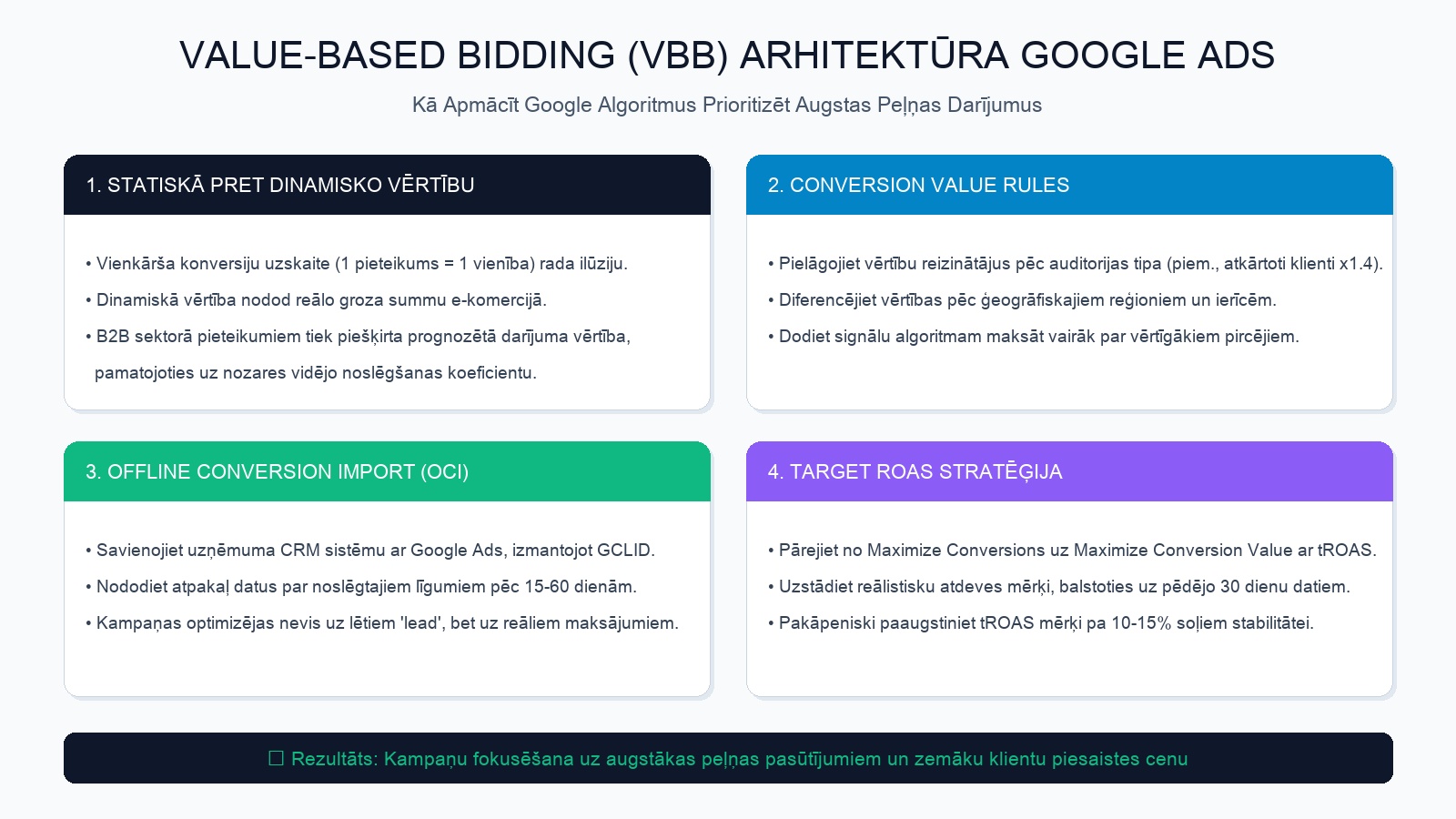
Three key steps to implementing a value system
To successfully configure value-based bidding, you need to go through three main stages:
| Configuration Step | Essence | How to implement | Business Benefit |
|---|---|---|---|
| 1. Dynamic value in e-commerce | Actual purchase amount excluding VAT and shipping | Set up purchase tag in Google Tag Manager | Precise real-time ROAS measurement |
| 2. Calculated value in B2B | Assign average deal value to leads | Calculate formula value based on closing % | Algorithm understands financial weight of leads |
| 3. Conversion Value Rules | Adjust value by audience or region | Add multiplier (e.g., x1.3) in Google Ads settings | More targeted bidding on priority segments |
| 4. Offline Conversion Import | Pass data from CRM after contract signing | Use GCLID parameter and regular data sync | Optimization for real profit, not just contacts |
Professional Google Ads campaign management relies on continuous analysis of this data. For values to be recorded accurately and without errors, reliable data analytics and measurement setup are critically important.
Human strategic control over Smart Bidding
Although Google algorithms are very powerful, they cannot predict company stock levels, logistics costs, or sudden margin changes. Therefore, the campaign manager must monitor results and regularly adjust Target ROAS goals.
As we explained in our previous study on Google Ads AI campaign capabilities and human control, artificial intelligence delivers excellent results only when a human provides it with the correct data and goals.
If you want to perform an audit of your ad account and shift to value-based bidding, contact us on the MarketMeNow consultation page.
Frequently Asked Questions
How many conversions are needed to enable Target ROAS?
It is recommended that the campaign has registered at least 20 to 30 conversions with values in the last 30 days so that the algorithm has enough data for model training.
What happens if the Target ROAS goal is set too high?
If the goal is disproportionately high (e.g., 1200% where the real rate is 400%), the algorithm will sharply reduce bids and the campaign's impression volume may drop to a minimum.
How to prevent canceled orders from affecting statistics?
By using a conversion adjustments file or synchronization with your CRM, you can cancel or reduce the value of previously registered purchases.
Conclusions
Implementing conversion values is a turning point in any company's digital marketing. It transforms ad spend from vague costs into a precisely predictable investment tool, where every invested euro brings maximum profit.
Want to teach the Google algorithm to attract the most valuable purchases and largest orders?
Book a 15-minute call. We will configure dynamic conversion values and tROAS smart bidding.
Fixed budget. No hidden extra fees or forced services.