
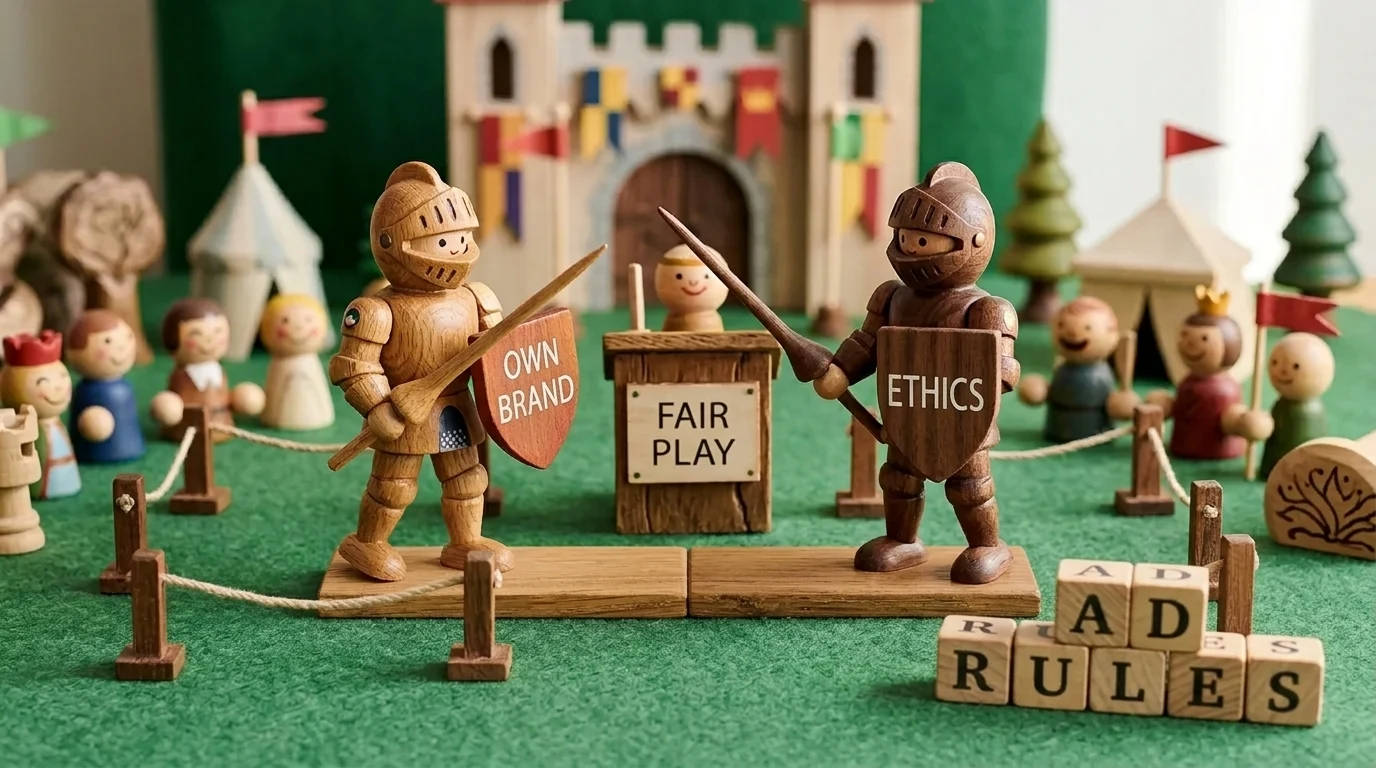
Competitor brand campaigns in Google Ads have become even more complex since 2024 due to rising costs. In 2026, the key to success for these campaigns lies in precise match keywords and a landing page that instantly and clearly demonstrates the advantages of your alternative. Learn more in our Google Ads services.
Every product or service has competitors, unless yours is so new and unique that it simply doesn't have any yet - but they will appear sooner or later. While you can seek ways to fight competitors, I believe it's far more productive to use them to your advantage, or at least strive to do so.
Key Takeaways
- Bidding on competitors is allowed: Google guidelines permit using competitor brands as search keywords in your campaigns.
- Trademark limits in ad copy: It is forbidden to include a registered competitor's brand in the ad headline or text itself, thereby misleading the buyer about affiliation.
- Lower Quality Score: Competitor keywords will always have lower relevance and a higher cost-per-click, so campaigns must be built with strict limits.
- Clear alternative offer: This strategy only works if your landing page instantly showcases compelling advantages (faster delivery, better support, fixed budget).
Google Ads and Competitors
In this specific situation, I will discuss using competitors in Google Ads within the Latvian context. While this situation might differ slightly in other countries, it's not relevant for our current discussion. So, the first and arguably most important question is - am I allowed to use my competitor's brand name in my advertising strategy? The simple answer is - yes, but with certain limitations. By definition, competitor brands can be used as keywords in your campaigns, meaning that when a user enters your competitor's keyword into Google Search, your ad can appear.
Can You Use Competitor Brands in Ad Copy?
The question isn't really "allowed" or "not allowed" here; it's more appropriate to ask - what is the best practice? It's crucial to remember that Google strongly dislikes user deception. If you include your competitor's name in your ad copy, it constitutes a form of consumer deception, which can displease both Google and your potential clients in the long run. Therefore, my recommendation is never to mislead your target audience and to create ads that are as transparent as possible from the planning stage.
The Purpose of Using Competitors
Okay, so don't use competitor names in ad copy. But then some readers might ask - why use competitor brands at all? The answer here is both simple and complex. For example, you've established your own business, let's say a beauty salon, and you want to start advertising online to attract new clients. One option is to create campaigns using service keywords available at your salon, but another option is to look at existing beauty salons in the immediate vicinity and use their names as your keywords.
Why? Because it's 100% certain that if someone is searching for one of your competitors, they are already consciously looking for the exact product or service that is also available at your salon. This way, you can offer this person to consider your salon as an alternative, as there will undoubtedly be people who want to check if they can find a better, cheaper, or more effective service. Subsequently, your ad and website must capture the potential client's attention and convince them to try your salon specifically.
Campaign Effectiveness
Such 'competitor campaigns' can be highly effective in terms of the quality of traffic delivered, but it's important to note that these campaigns won't be the cheapest. Long-standing experience shows that the average cost-per-click (CPC) for competitor keywords is quite high, as competitors often protect their own brands - I'll discuss this option in another article. Therefore, tracking results and data analysis will be of great importance here. You must monitor campaign profitability and their overall contribution. This strategy is often used for introducing new products to a market where competition already exists, and campaigns are only run for a specific period during the product's launch phase. Here, I'll revert to the old mantra - monitor your metrics, test results with and without competitor campaigns, to logically decide whether competitor campaigns are effective at a given moment.
In conclusion, what I can further recommend is - use these campaigns, but closely monitor their results. It can be an effective tool in the right hands. Each case is individual; you can plan extensively, but only by actually trying such campaigns will you understand if they can be profitable in your specific situation.
Want to ethically and effectively attract customers searching for your competitors?
Book a 15-minute consultation. We'll develop competitor conquest campaigns with high relevance and controlled costs.
Fixed budget. No hidden fees or forced services.