
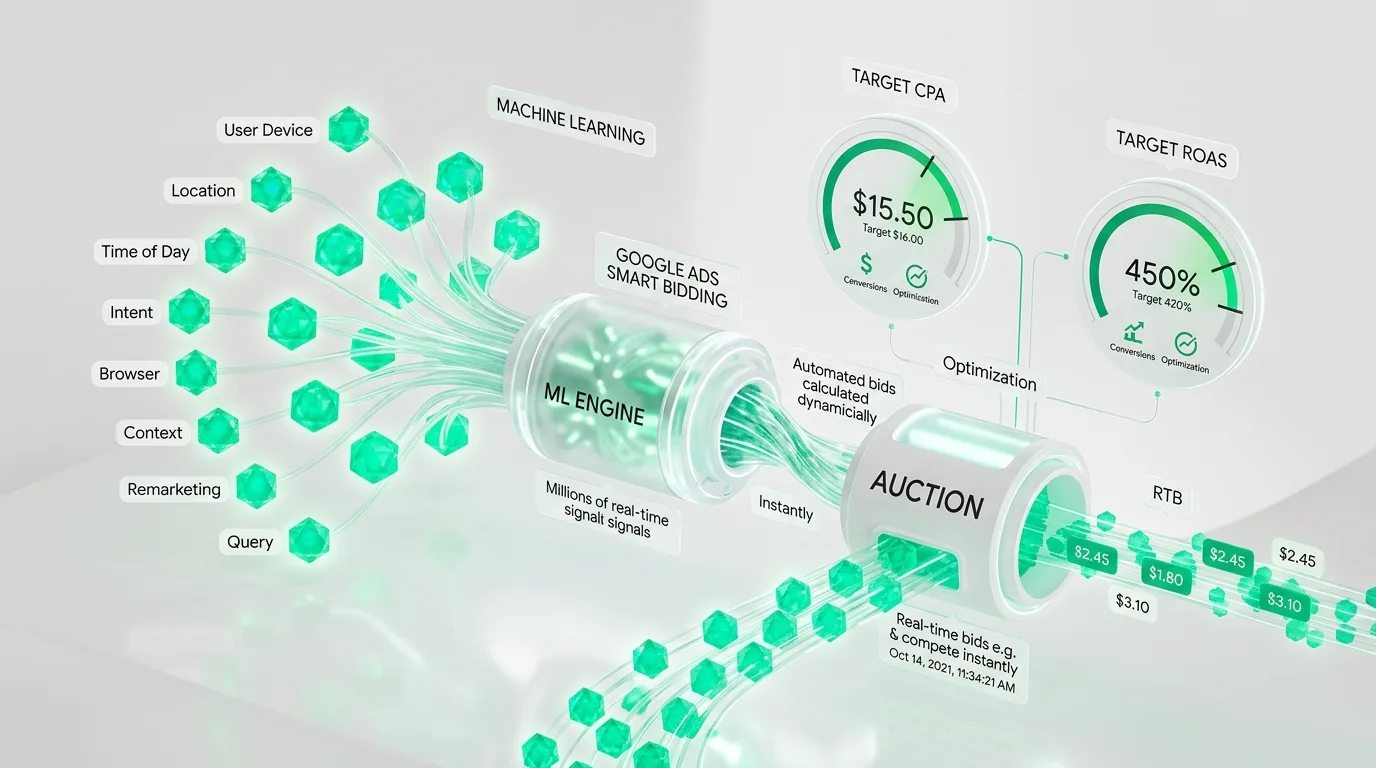
A historical analysis from 2021 on the breakthrough of Smart Bidding. Today, automated bidding works hand in hand with a value-based approach and purchase value optimization. Learn how we manage campaigns in our Google Ads service.
Key Takeaways
- Auction-Time Bidding Precision: Smart Bidding calculates bids for every search query in real-time, analyzing hundreds of unique signals that humans cannot capture manually.
- Strategy Consolidation: In 2021, Google simplified strategies where Target CPA and Target ROAS became target settings within Maximize Conversions and Maximize Conversion Value.
- Data Threshold: For smart bidding to work with maximum return, campaigns require a stable conversion history (at least 20-30 conversions per month).
- The New Specialist Role: Moving from a manual bid modifier to a strategist who provides systems with precise goals, audiences, and high-quality ad copy.
For many years, digital marketing specialists took pride in their ability to manually manage the cost-per-click (Manual CPC) for every single keyword, performing complex calculations and spending hours adjusting multipliers based on the time of day or city. However, in 2021, it is time to acknowledge the obvious: Google Ads Smart Bidding and machine learning algorithms have reached a level where humans lose in manual combat almost every single time.
Why is this the case? The answer lies not only in technological progress, but in the massive volume of data. In every single fraction of a second when a user enters a query, the Google system evaluates hundreds of contextual signals that are completely unavailable to a manual administrator. This is precisely where the power of automated bidding lies.
What is Auction-Time Bidding?
In the traditional manual model, you set a maximum cost-per-click (e.g., 0.85 EUR) and perhaps add a +20% mobile device multiplier. This bid remains unchanged for all users regardless of their purchase readiness.
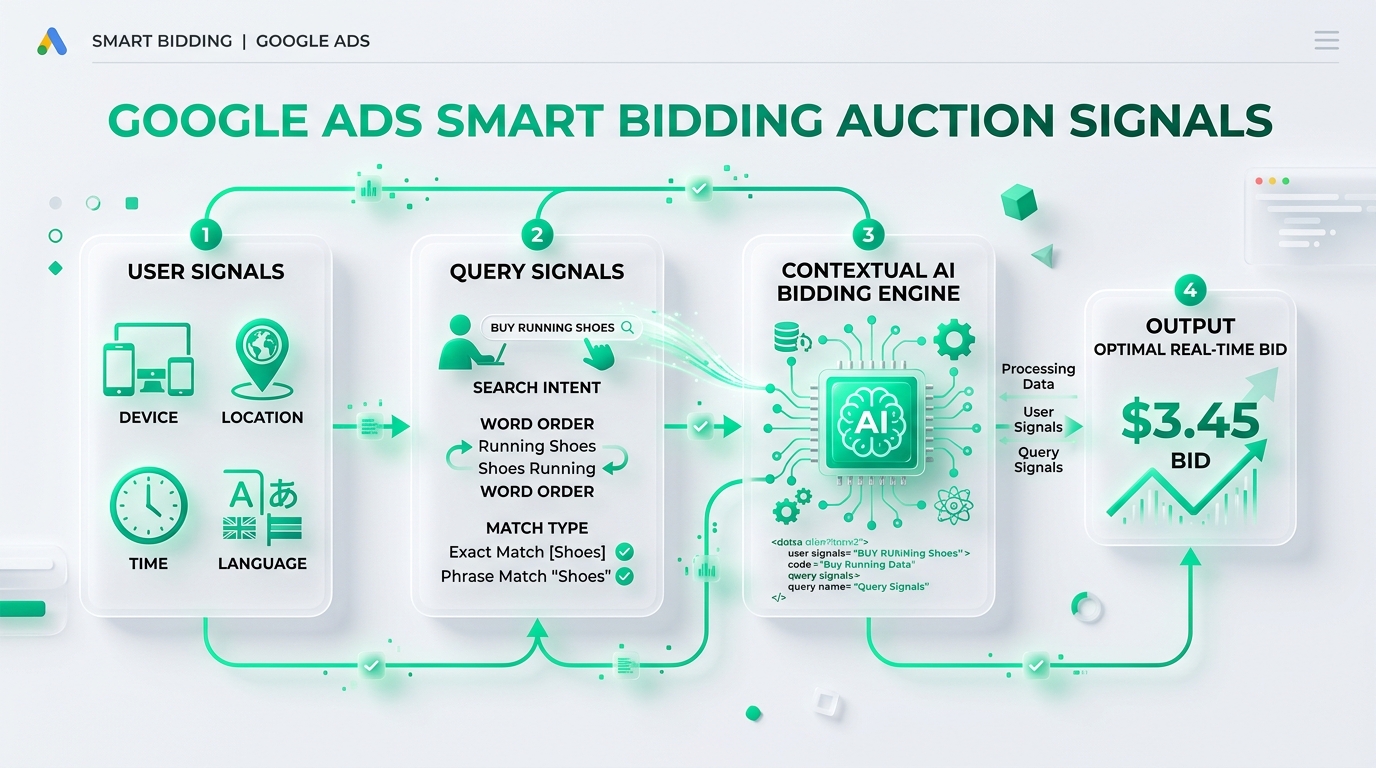
In contrast, Google Smart Bidding operates directly at the auction moment (Auction-Time):
- Real-Time Context Analysis: The system evaluates the user's specific device, operating system, precise geographic location, time of day, browser language, and even query syntax.
- Search Intent Depth: If a user has previously visited your site or performed searches similar to a purchase, the algorithm understands that the conversion probability is high and dynamically raises the bid to secure the top spot.
- Cost Savings on Low Signals: If a query is informational or the user is unlikely to make a purchase, the algorithm deliberately lowers the price or avoids participating in expensive auctions altogether, protecting your budget from waste.
Four Main Smart Bidding Strategies in 2021
Depending on your business goals and data volume, Google Ads offers four primary automation directions:
| Strategy | Best Suited Business | Goal | When to Use? |
|---|---|---|---|
| Maximize Conversions (with tCPA) | Service providers, B2B, lead generation | Get the maximum number of leads at a set cost (Target CPA) | When all conversions are of approximately equal value. |
| Maximize Conversion Value (with tROAS) | Online stores, e-commerce | Obtain maximum revenue return from advertising spend (Target ROAS) | When cart values differ significantly. |
| Maximize Clicks | Brand awareness, content portals | Attract the largest possible number of visitors within budget | At the initial stage of a campaign to quickly gather first data. |
| Target Impression Share | Brand protection, corporate clients | Ensure your ad appears at the very top of the page (Top of Page) | When 100% brand query coverage is a priority. |
Video Guide: How to Properly Set Up Smart Bidding in 2021
Watch an in-depth video analysis of the advantages of smart bidding and typical mistakes made by advertisers when transitioning from manual bidding:
Common Mistakes Why Smart Bidding Sometimes "Fails"
We often hear the opinion: "we turned on Target CPA, and the campaign stopped". Almost always, the reason is not in the algorithm, but in human error:
- Too Aggressive a Goal From Day One: If your historical cost per lead was 25 EUR, but you immediately set a Target CPA to 10 EUR, the algorithm concludes that reaching such a goal is impossible and simply stops participating in most auctions. Goals should be lowered gradually by 10-15% per week.
- Interrupting the Learning Phase: After turning on a strategy, the algorithm needs 7 to 14 days to calibrate its models. If budgets or ad copy are continuously changed during this time, the learning cycle starts over.
- Poor Quality or Missing Conversion Data: If the system does not record real purchases or simply counts page views, the algorithm will optimize for worthless actions. Therefore, professional Google Ads account monitoring and analytics setup are critical.
Strategic Conclusion
The transition to Smart Bidding does not mean human work in advertising becomes unnecessary. Quite the contrary, it frees up a specialist's time from mechanical clicking work, allowing them to focus on higher-level tasks: buyer psychology, developing strong value propositions, conversion rate optimization (CRO), and website usability. Only by combining intelligent algorithms with strong strategic management do advertising investments become a stable engine for business growth.
Frequently Asked Questions (FAQ)
How many conversions are needed to turn on Smart Bidding?
Although Google formally allows turning on Maximize Conversions even for new campaigns without history, for optimal results and accurate Target CPA/ROAS setup, it is recommended that the campaign or account has accumulated at least 15 to 30 conversions over the last 30 days.
Can Smart Bidding be combined with Broad Match?
Yes! In fact, in 2021, this is one of the most powerful synergies. While Broad Match was too risky with manual bidding, combined with Smart Bidding, the algorithm is able to filter queries in real-time and pay only for those searches that have a high conversion probability.
What to do if conversions have a long decision-making cycle (Conversion Delay)?
For more expensive services or B2B transactions, a client may think from the first click to a purchase for 14 or even 30 days. Check the "Days to Conversion" report in Google Ads and evaluate campaign efficiency with an appropriate time lag, rather than judging only by the last 3 days of results.
Do I still need to add negative keywords?
Unquestionably yes. Negative keywords are critically necessary to provide the algorithm with clear boundaries and prevent budget spending on queries that do not apply to your service or goods at all.
Want to make sure your Google ad smart bids are working with maximum return?
Schedule a 15-minute strategy call. We will review your campaign bidding strategies and conversion signal accuracy.
Fixed budget. No hidden extra charges or forced services.