
Smart Bidding (tCPA and tROAS) is only effective if your account has a sufficient volume of real conversions (at least 30-50 per month). If you activate tCPA too early in a new account without historical data, the algorithm gets stuck in the learning phase and misses out on your best customers. Learn more in our Google Ads strategy section.
Google Ads automated bidding systems - Smart Bidding - have reached a stage of maturity in 2026 where machine learning algorithms can largely outperform manual bid management. However, many businesses still experience a sharp drop in results the moment they enable one of these smart strategies. The reason is almost always poor timing, a lack of data, or incorrectly defined goals.
Key Takeaways
- Data Volume Threshold: Before activating Smart Bidding, a campaign needs at least 30 to 50 real conversions over the last 30 days to prevent the algorithm from making flawed decisions.
- Learning Period Patience: Do not touch the campaign for the first 7 to 14 days after launching a new bidding strategy, as the system is calibrating its bidding models.
- Target CPA vs. Target ROAS: Target CPA is more suitable for service-based businesses with uniform lead values, while e-commerce stores with varying cart sizes must use Target ROAS.
- Budget and Goal Correlation: An overly aggressive goal (e.g., an unrealistically low CPA) will "choke" ad delivery and reduce the total number of transactions.
How Smart Bidding works and how modern digital advertising uses it
Traditional manual bidding (Manual CPC) set a specific cost-per-click for all users searching for a particular keyword. In contrast, Smart Bidding uses "auction-time bidding," where the bid is dynamically calculated for every individual search query.
The Google algorithm analyzes hundreds of contextual signals in milliseconds: user device, physical location, time of day, browser language, operating system, previous browsing history, and even weather conditions in a specific region. If the system calculates a high probability of purchase, it increases the bid; if the probability is low, the bid is lowered or the ad is not shown at all.
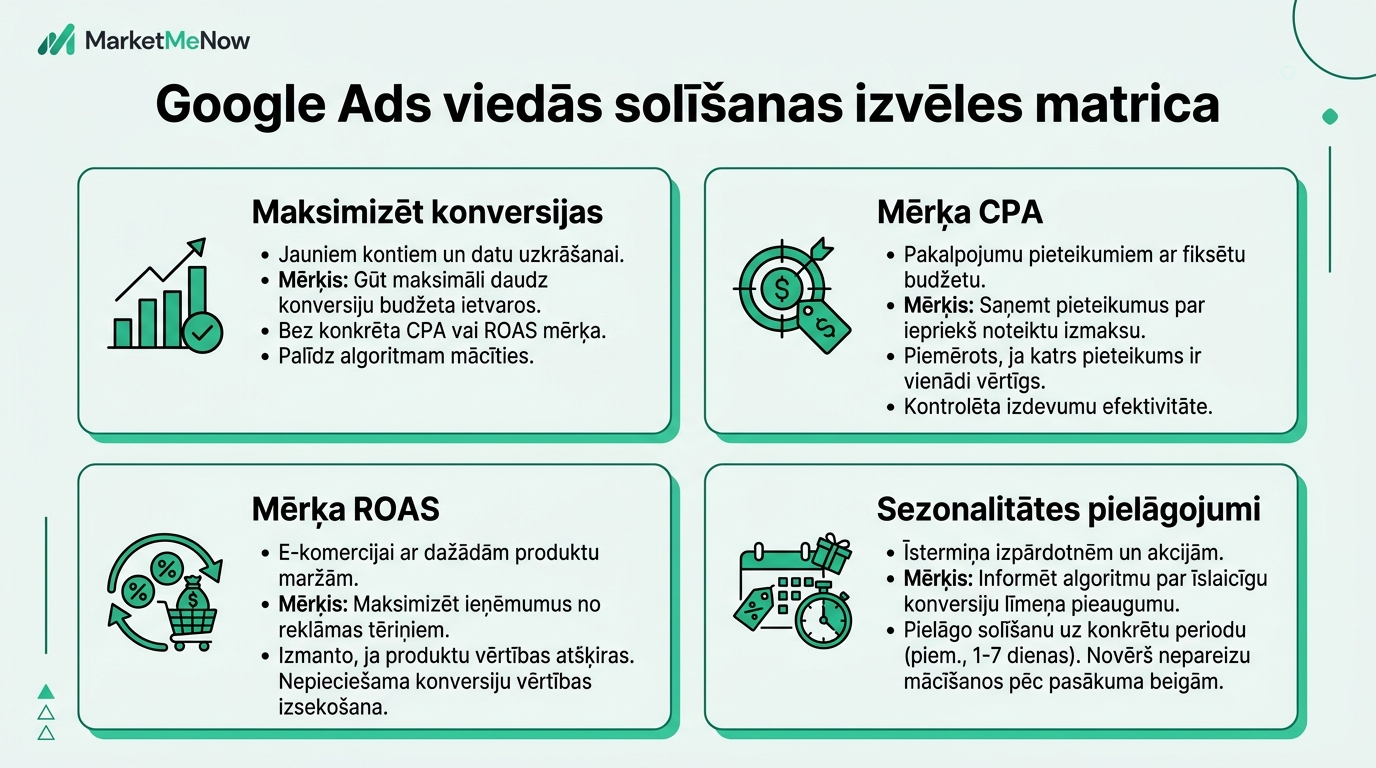
Comparison of the four main Smart Bidding strategies
Each strategy has its own mathematical goal and suitability for specific business models:
| Strategy | Primary Goal | Best Suited For | Critical Prerequisite |
|---|---|---|---|
| Maximize Conversions | Get the maximum number of leads within budget | New campaigns, service inquiries | Strict daily budget limit |
| Target CPA | Get conversions at a specific set price | B2B, legal services, lead forms | At least 30 conversions in the last month |
| Maximize Conversion Value | Generate the highest possible revenue from budget | E-stores with products of varying prices | Accurate tracking set up with Google Analytics 4 and GTM |
| Target ROAS | Ensure a specific return on ad spend percentage | E-commerce brands with known margins | At least 50 value-based conversions per month |
Why activating Smart Bidding too early destroys campaigns
The biggest mistake marketing specialists make is activating Target CPA or Target ROAS in a brand-new account without historical data. The machine learning algorithm cannot predict the future in a vacuum. If a campaign lacks sufficient conversion signals, the algorithm starts guessing and experimenting at the expense of your budget.
Recommended path for new accounts:
Phase 1 - Data Collection with Enhanced CPC or Maximize Clicks: In the first two to four weeks, the goal is to attract quality traffic and collect at least 30 to 50 conversions to build a profile of buyer behavior in the account.
Phase 2 - Transition to Maximize Conversions: Once baseline data is accumulated, switch the campaign to Maximize Conversions without a specific CPA cap, allowing the algorithm to determine the real market price.
Phase 3 - Setting Target CPA or Target ROAS: Only after the system consistently generates results should you set a Target CPA, basing it on the actual average CPA of the last 30 days, rather than an idealized wish.
Learning period rules and common management mistakes
During the learning period (which we have covered in more detail in our analysis of Smart Bidding efficiency vs. manual CPC), the system stabilizes bids. This period usually lasts 7 to 14 days. During this time, it is strictly forbidden to:
- Change the campaign's daily budget by more than 15 to 20 percent at a time.
- Add dozens of new keywords or change ad copy.
- Change conversion tracking settings or primary goals.
Any drastic intervention resets the machine learning cycle, forcing the algorithm to start over and prolonging the period of instability.
Frequently Asked Questions
Does Smart Bidding work with small budgets?
Yes, but with the condition that the budget is sufficient to get at least 1 to 2 conversions per day. If the budget only allows for one click per week, the algorithm cannot learn.
What should I do if impressions drop to zero after enabling Target CPA?
This means the set Target CPA is too low and does not reflect market reality. Increase the Target CPA by 30-40% and gradually lower it once impressions recover.
Are manual bids completely dead in 2026?
No, manual bidding is still useful in the first days of campaigns, as well as in very narrow B2B niches with microscopic search volumes where machine learning models lack sufficient data.
Conclusions and next steps
Smart Bidding is not a magic bullet that will fix errors in a poorly structured account or improve an uncompetitive offer. It is a powerful amplification system that works perfectly when based on clean data, accurate conversion tracking, and realistic business goals. Transition to automation gradually and give the algorithm time to prove its efficiency.
Want to choose the right bidding strategy for your Google Ads?
Book a 15-minute strategy call. We will evaluate your campaign conversion data and set the optimal tCPA or tROAS goal.
Fixed budget. No hidden fees or forced services.