
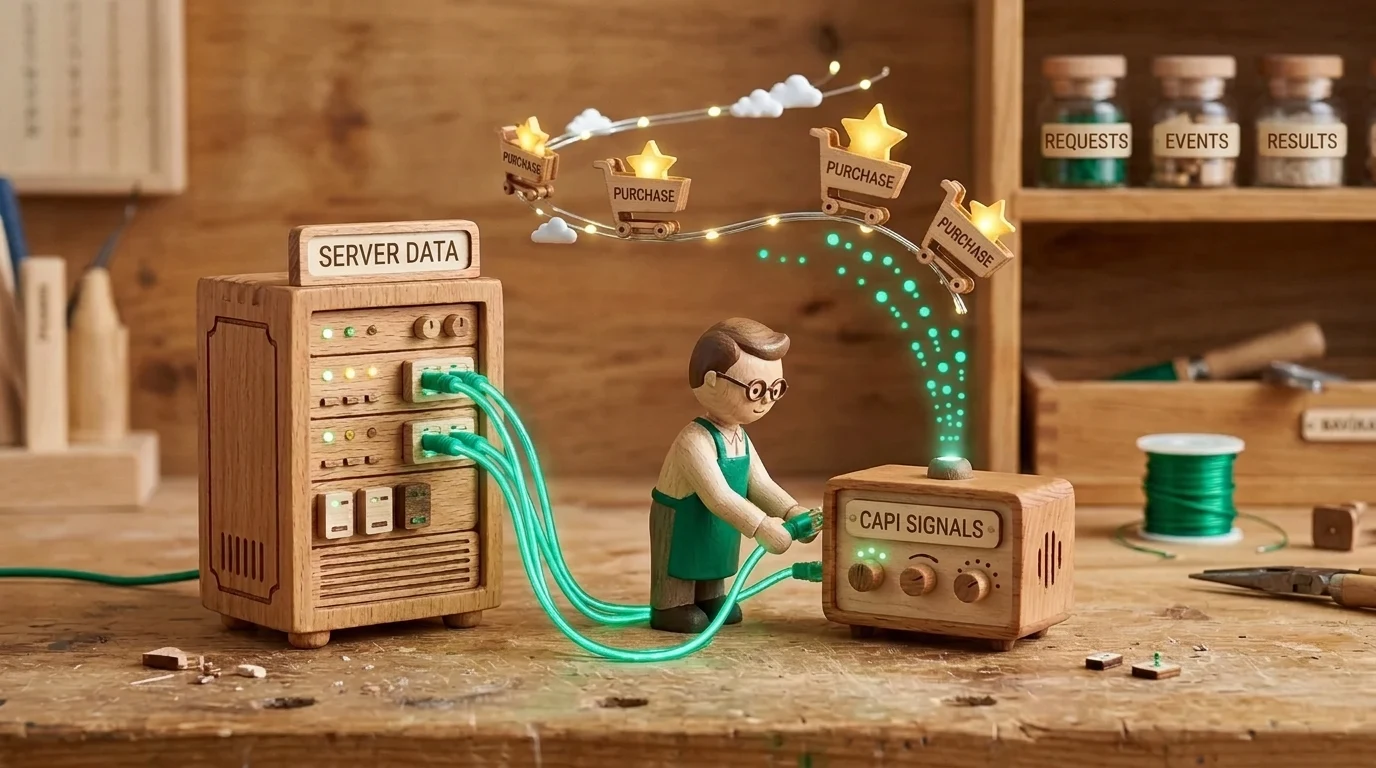
Implementing the Meta Conversions API in 2024 helped recover lost purchase signals. In 2026, a server-side CAPI connection with a high Event Quality Score (>8.5) is an indispensable foundation for the stable and predictable performance of Advantage+ campaigns. Learn more in our Meta Ads services.
In the e-commerce business, there is no greater frustration than seeing revenue hit your bank account while those transactions fail to appear in the Meta Ads Manager report. As a result, campaigns appear unprofitable, the algorithm lacks learning data, and marketing managers make the mistake of cutting budgets. The cause of this 'blind spot' is the weakness of the traditional Facebook Pixel in modern browsers. In this experience analysis, we will look at how implementing the Meta Conversions API (CAPI) in practice allows you to recover up to a quarter of lost conversion signals and significantly improve ad profitability.
Key Takeaways
- Loss of client browser signals: Browser privacy settings (Safari ITP, Firefox ETP) and ad blockers currently prevent the Meta Pixel from capturing 15% to 25% of all purchases.
- Server-to-Server connection stability: Meta Conversions API (CAPI) sends data directly from your cloud server to Meta's servers, bypassing any browser-based obstacles.
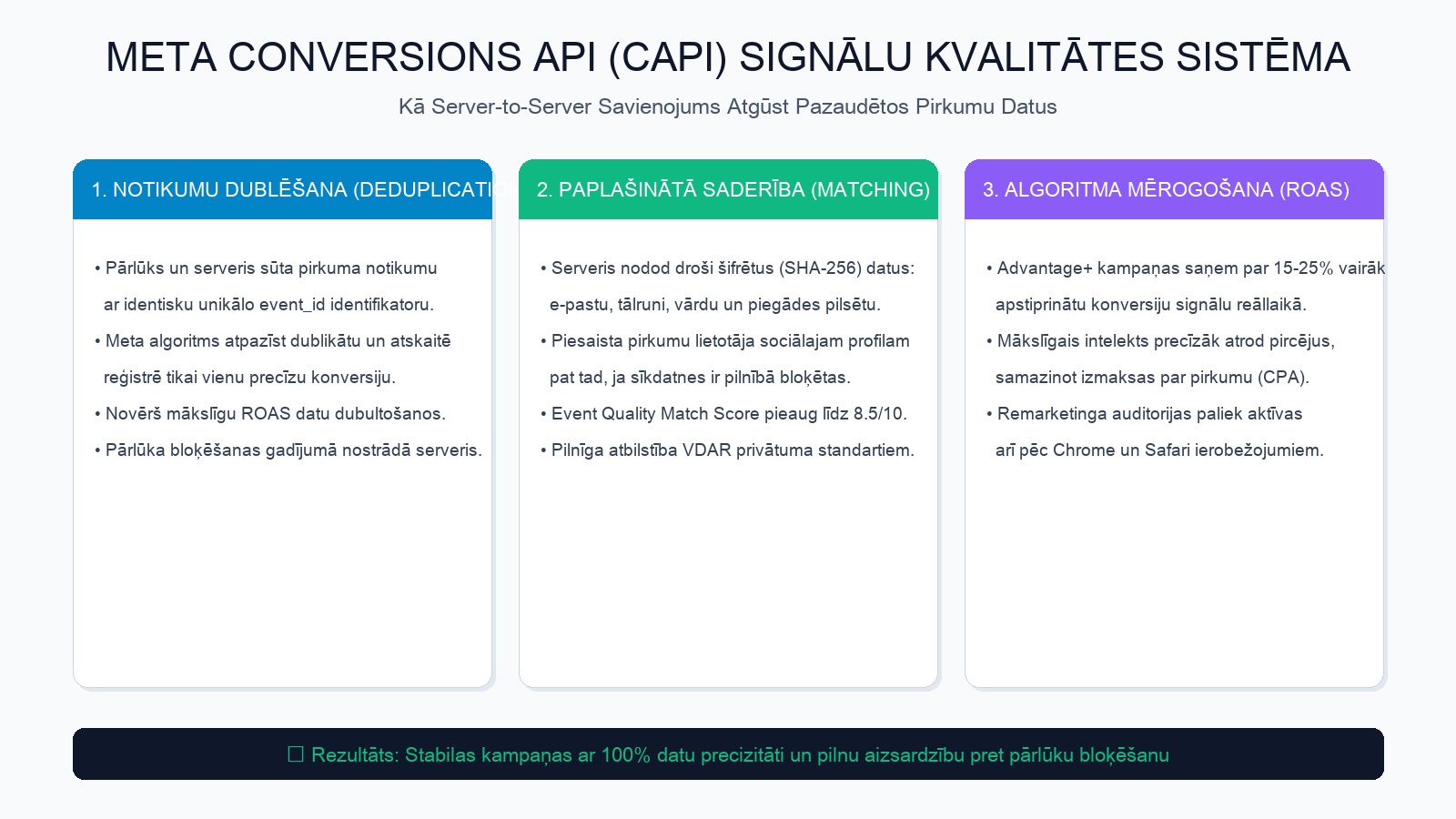
- Event Deduplication: By correctly configuring CAPI alongside the browser pixel using a unique event_id, the system records exactly one purchase, preventing data distortion.
- Increased Event Quality Match Score: By passing hashed first-party data (email, phone), the match rate increases to 8.5/10, allowing Advantage+ algorithms to reduce CPA.
Why the Standard Meta Pixel No Longer Delivers Results
The traditional Meta Pixel operates as a JavaScript snippet in the visitor's browser. When a user purchases a product, this script attempts to send a message to the Meta server. However, it faces a series of obstacles along the way:
• Apple Safari's ITP (Intelligent Tracking Prevention) deletes ad cookies after just 24 hours or 7 days.
• Ad and tracking blockers (AdBlock, uBlock, Brave browser) completely block requests to the connect.facebook.net domain.
• Network latency and slow mobile internet cause users to close the 'Thank You' page before the pixel can finish sending data.
As a result, Meta loses the link between the ad click and the actual purchase. This is exactly where the Server-Side CAPI solution comes to the rescue.
Four Steps to CAPI Implementation with Maximum Quality Scores
For CAPI to provide a real return, simply installing a plugin is not enough - it requires the correct data architecture:
| Implementation Phase | How It Works | What to Watch For | Business Benefit |
|---|---|---|---|
| 1. Server Container Setup | Server GTM is linked to the company's subdomain | Use a 1st-party domain (e.g., data.mystore.com) | Bypasses browser blockers |
| 2. Event Deduplication | Browser and server events are assigned an identical event_id | Ensure the ID is generated before tags are fired | Prevents duplicate purchase reporting |
| 3. Advanced Matching | The server reads customer data and hashes it with SHA-256 | Emails must be converted to lowercase before hashing | Match Quality rises above 8.0/10 |
| 4. Offline Conversions Import | Post-payment and invoice confirmations are sent from CRM | Sync data at least once every 24 hours | Campaigns optimize for actual paid orders |
This approach ensures that your Meta Ads advertising campaigns receive the most complete signals, allowing Advantage+ models to work at maximum capacity.
How the Match Quality Score Affects CPC and CPA
In the Meta Events Manager panel, each CAPI event is assigned an 'Event Quality Match Score' on a scale of 1 to 10. This shows what percentage of purchases Meta can link to real user profiles:
Low Score (below 5.0/10): Meta only receives the IP address and user agent. The purchase is recorded, but the algorithm cannot understand exactly which user made it, so future optimization is weak.
High Score (8.0 - 9.5/10): Hashed email, phone, name, and city are transmitted. Meta connects the purchase to the user account with 95% accuracy. As a result, the algorithm finds similar buyers faster, and the cost per conversion (CPA) decreases by 15-20%.
High-quality tracking requires an integrated approach where business data analytics works in tandem with advertising budgets.
As we explained in our review of how Meta Advantage+ Shopping campaign automation works, high-quality data is the only fuel the machine learning engine needs.
Frequently Asked Questions
Should the standard pixel be turned off after implementing CAPI?
Categorically no! Meta's official recommendation is a 'Redundant Setup' - running both in parallel with proper deduplication. The browser pixel provides lightning-fast signals, while CAPI serves as a reliable safety net.
Does implementing CAPI slow down website loading?
Quite the opposite! If CAPI is implemented via Server-Side GTM, heavy third-party scripts no longer need to run on the website, which reduces CPU load.
How long does it take to see an increase in efficiency?
The first recovered conversions appear in reports within 24-48 hours, while the algorithmic CPA reduction becomes pronounced after 2 to 3 weeks once the system has been trained with the new data.
Conclusion
In 2024, the Meta Conversions API is no longer a technological experiment but a mandatory survival tool for every e-shop. By preventing signal loss and increasing data matching, your advertising campaigns become stable, predictable, and significantly more profitable.
Want to recover lost Meta Ads purchase signals with a stable CAPI integration?
Book a 15-minute call. We will set up the server-side Conversions API for maximum ad audience accuracy.
Fixed budget. No hidden fees or forced upsells.