
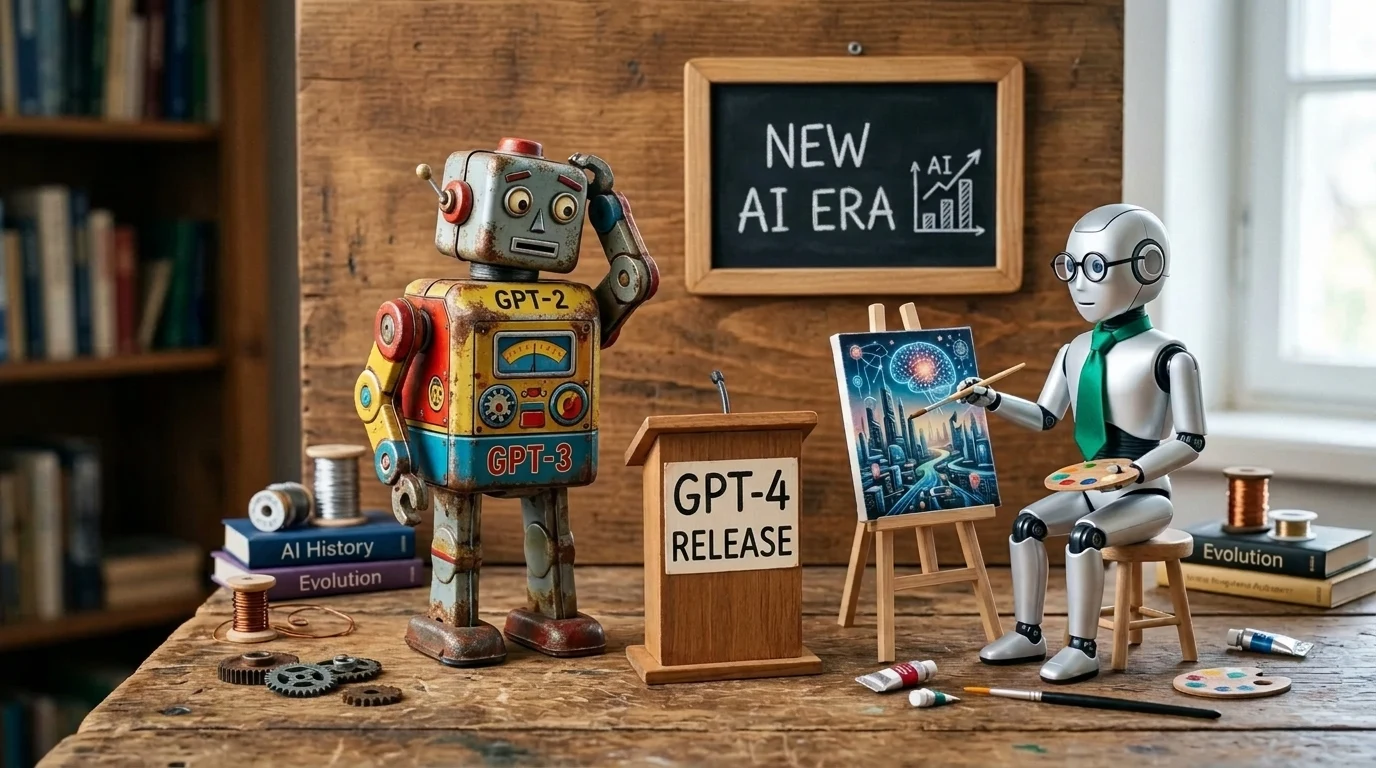
The March 2023 release of GPT-4 marked the beginning of the multimodal era. In 2026, we work with models like GPT-4o, Claude 3.5 Sonnet, and Google Gemini, which not only analyze text and images but also independently execute business workflows through API integrations. Learn more in our business automation section.
On March 14, 2023, OpenAI made a long-awaited announcement by officially launching its next-generation artificial intelligence model - GPT-4. While the previous GPT-3.5 model was revolutionary in text generation and conversational understanding, GPT-4 marks a transition into an entirely different category. It is a multimodal model capable of analyzing not just text but also images, demonstrating human-level performance in complex professional and academic exams. This milestone significantly expands the boundaries of enterprise automation.
Key Takeaways
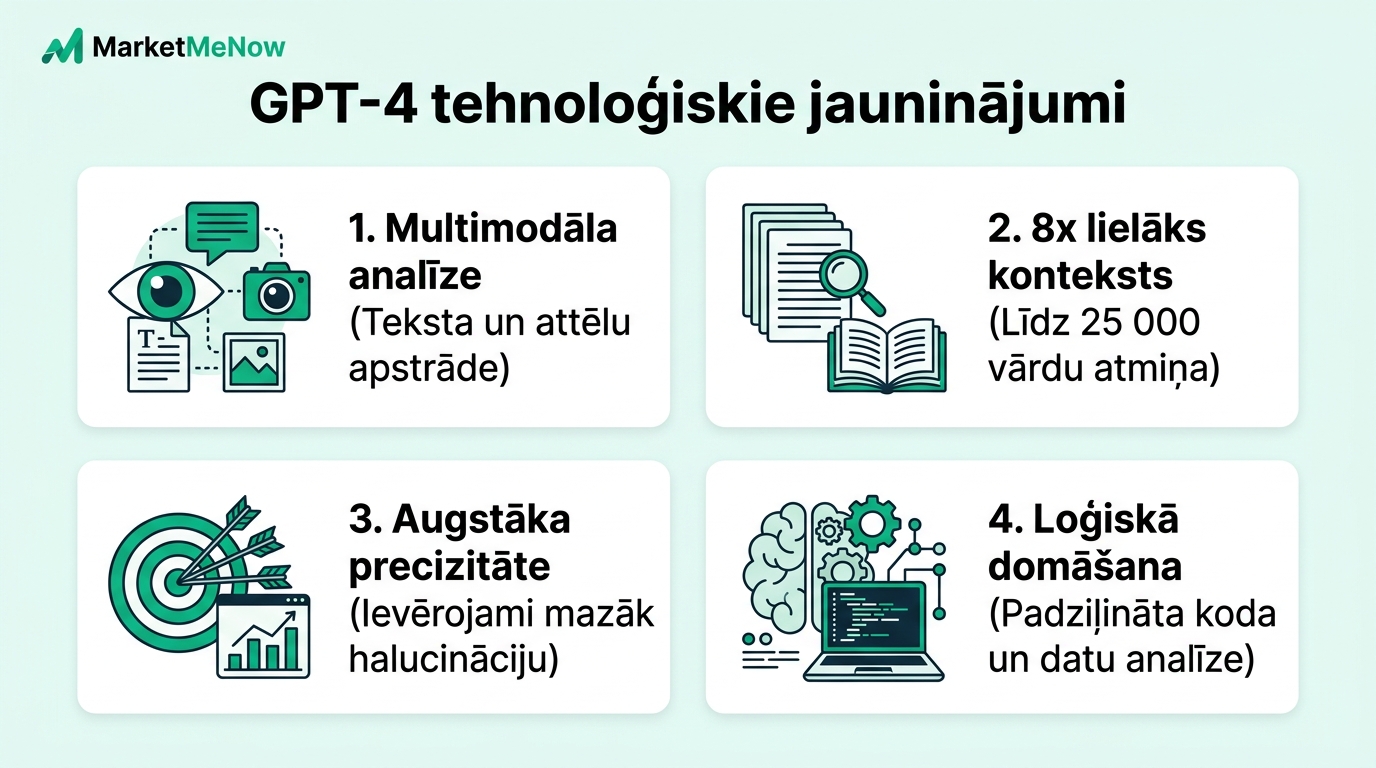
- Multimodal Capabilities: The model accepts both text and image inputs, analyzing charts, sketches, tables, and screenshots.
- Massive Context Window: GPT-4 supports processing up to 25,000 words in a single query (roughly a 50-page document analysis).
- Factual Accuracy Leap: Compared to GPT-3.5, hallucinations and factual errors have been reduced by 40-60%.
- Higher Logical Reasoning: The model successfully passed the US Uniform Bar Exam scoring in the top 10% of test-takers, whereas the previous version fell into the bottom 10%.
Technological Innovations of GPT-4 Compared to the Previous Generation
Although the interface for ChatGPT Plus users may appear similar on the surface, the underlying logic and architecture of the model have undergone massive development. The main differences can be divided into four core areas:
Practical Business Applications Available Today
For companies seeking practical value to improve their everyday processes, GPT-4 opens entirely new doors:
1. Analysis of Complex Financial and Data Reports. Thanks to the large context window, businesses can feed the model full annual reports, competitor audit data, or balance sheets and ask it to identify trends and anomalies.
2. Programming Code Auditing and Development. GPT-4 demonstrates impressive capabilities in debugging code, scripting API integrations, and architecting complex website feature logic.
3. Converting Visual Sketches Into Code. During the live presentation, OpenAI demonstrated how GPT-4 wrote fully functional HTML and JavaScript code within seconds based on a hand-drawn website sketch on a napkin.
4. Customer Support Automation with Deep Context. The model understands multi-step customer requests, factoring in internal company policies and previous communication history without relying on stereotypical robotic responses.
Official OpenAI GPT-4 Developer Video
Watch the official demonstration by OpenAI co-founder Greg Brockman from the live GPT-4 presentation:
Conclusions and Preparation for the New AI Era
The release of GPT-4 confirms that artificial intelligence is rapidly becoming a foundational technology, much like the internet or mobile phones once did. Companies that learn to integrate these tools into their marketing, data analysis, and customer service today will gain a massive speed and cost-efficiency advantage over their competitors.
If your business wants to implement smart digital solutions and combine the power of artificial intelligence with a well-crafted marketing strategy, reach out to our team via the contact page or learn more about our digital services.
Frequently Asked Questions About GPT-4
How can I gain access to the GPT-4 model?
Why does GPT-4 run slower than GPT-3.5?
Can GPT-4 completely replace programmers and lawyers?
Want to integrate next-generation AI models and automation into your daily business operations?
Book a 15-minute strategy call. Let us discuss practical AI solutions for your team productivity.
Fixed budget. No hidden fees or forced add-on services.