

In 2024, the industry was preparing for the complete phase-out of third-party cookies in Chrome. Although Google later adapted its strategy toward a user choice model, the winners in 2026 are those companies that proactively transitioned to an independent first-party sGTM infrastructure and full data control on their own servers. Learn more in our server-side data analytics services.
On January 4, 2024, Google took a step that the digital marketing industry had been discussing for years: it officially began disabling third-party cookies for 1% of Chrome browser users worldwide. Although Apple Safari and Mozilla Firefox have blocked these cookies for years, Chrome - with its market share exceeding 60% - was the last major stronghold. This means digital advertising and analytics are entering a new era where traditional browser pixels can no longer deliver reliable data.
Key Takeaways
- Chrome 1% test from January 2024: Google officially started phasing out third-party cookies for 1% of Chrome users worldwide (approximately 30 million devices), preparing for a full transition.
- Strategic value of First-Party Data: Direct business-to-customer contact (emails, phone numbers, registrations, purchase history) becomes the primary competitive edge in the digital landscape.
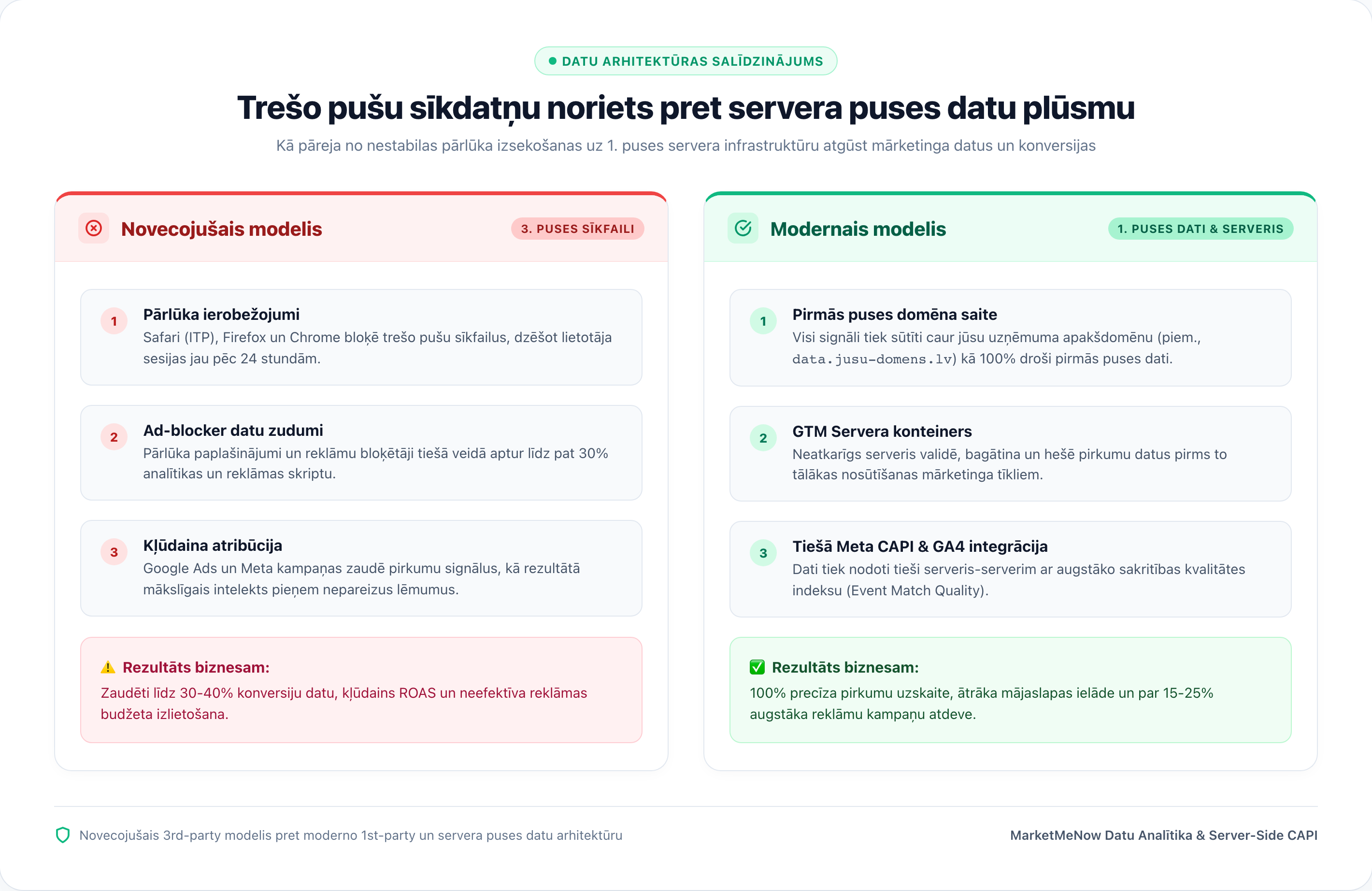
- Importance of Server-Side tracking: Moving from browser pixels to server-side data containers (Server-Side GTM) allows businesses to bypass browser restrictions and maintain measurement stability.
- Google Privacy Sandbox alternatives: The Topics API replaces traditional interest tracking by delivering privacy-preserving ad selection directly at the browser level.
Why Third-Party Cookies Are Dying and What Replaces Them
Third-party cookies were a mechanism that enabled ad networks to track user actions across different websites to build detailed profiles. With growing privacy demands from society and regulators, this model has become unsustainable.
Google's alternative is the 'Privacy Sandbox' initiative. Its goal is to protect user anonymity while providing advertisers with tools to measure performance. Instead of a website receiving a unique user ID, the browser itself categorizes user interests into groups (Topics API) and passes them to the ad auction without disclosing personal data.
How This Impacts Business and Marketing Campaigns
The sunset of third-party cookies impacts several everyday areas of digital marketing:
| Marketing Element | Legacy Approach (3rd-Party) | New Reality (1st-Party & AI) | Required Action |
|---|---|---|---|
| Remarketing | Track users across websites via browser pixels | Audience modeling and direct customer lists (Customer Match) | Collect emails and consents in your CRM |
| Conversion Attribution | Direct last-click attribution via cookies | Blended model with Enhanced Conversions and modeling | Enable Enhanced Conversions |
| Data Integrity | Browser scripts blocked by ad blockers and browsers | Data flow through the company's own server subdomain | Implement Server-Side GTM and CAPI |
| User Tracking | Cross-domain third-party identifiers | First-party unique identifiers and session stitching | Strengthen internal website analytics |
For businesses whose strategy relied on running simple ads without organized analytics, campaign ROI will plummet rapidly. This is why modern business data analytics is becoming a core competitive advantage.
Three Key Steps to Achieve Independence and Data Stability
To prepare your website for the complete loss of third-party cookies, take the following steps:
1. Transition to Server-Side data collection: Traditional browser pixels send data directly from the visitor's device to Meta or Google. By using Server-Side CAPI and server containers, data first reaches your own server. There, it is hashed, cleaned, and securely passed to advertising platforms via a server-to-server protocol.
2. Implement Google Enhanced Conversions and Meta CAPI: These tools leverage first-party hashed data (such as a customer's email address entered during checkout) to connect an ad view with an actual conversion even when cookies are blocked.
3. Invest in First-Party Data collection: Offer visitors tangible value in exchange for registration: educational resources, first-order discounts, or expert guides. A clean, consented email database is an asset no browser update can take away. These changes are also supported by a modern Meta Ads campaign structure, where Advantage+ models thrive on high-quality signals.
Similar to what we explained in our historical breakdown of how Apple's iOS 14.5 privacy revolution changed digital advertising, tech limitations always reward those who invest early in their infrastructure.
Frequently Asked Questions
Will Google Analytics 4 (GA4) stop working after third-party cookies are disabled?
No. GA4 primarily uses first-party cookies (_ga), which are not blocked because they belong to the site's own domain. However, cross-campaign linking and attribution will become less accurate without additional tools like Consent Mode v2 and Enhanced Conversions.
Does my company need to build its own server for data collection?
There is no need to purchase a physical server. Flexible cloud services (such as Google Cloud Platform or Hetzner) are used instead, costing only a few dozen euros per month while handling millions of events.
When is 100% third-party cookie blocking expected in Chrome?
Google's initial plan anticipated a phase-out throughout 2024, reaching full deprecation in the second half of the year following regulatory approvals.
Conclusion
The era of third-party cookies has come to an end, but this does not mean the end of digital marketing. It marks a shift toward a fairer, more secure, and technologically mature ecosystem where companies equipped with robust first-party data architecture win.
Is your marketing analytics ready for privacy changes and cookie restrictions?
Book a 15-minute call. We will help you transition to a first-party sGTM data infrastructure and maintain accurate conversion tracking.
Fixed budget. No hidden fees or forced upsells.