

Budget burning remains a major issue in Google Ads auctions, but in 2026 it is further amplified by automated campaigns (Performance Max and Broad Match keywords paired with Smart Bidding) if strict negative keyword lists and brand exclusion filters are not applied. Explore our Google Ads management and audit services.
The Google Ads advertising system has become extremely automated in recent years, and at first glance, it might seem that clicking a few buttons is enough to make a campaign profitable. However, in reality, every unconsidered checkmark and default setting can become an expensive leak in company marketing budget. In our practice auditing new advertising accounts, we regularly find that 30% to as much as 60% of monthly spending goes toward completely useless, non-converting clicks. Here are ten of the most dangerous mistakes that must be fixed immediately.
Key Takeaways
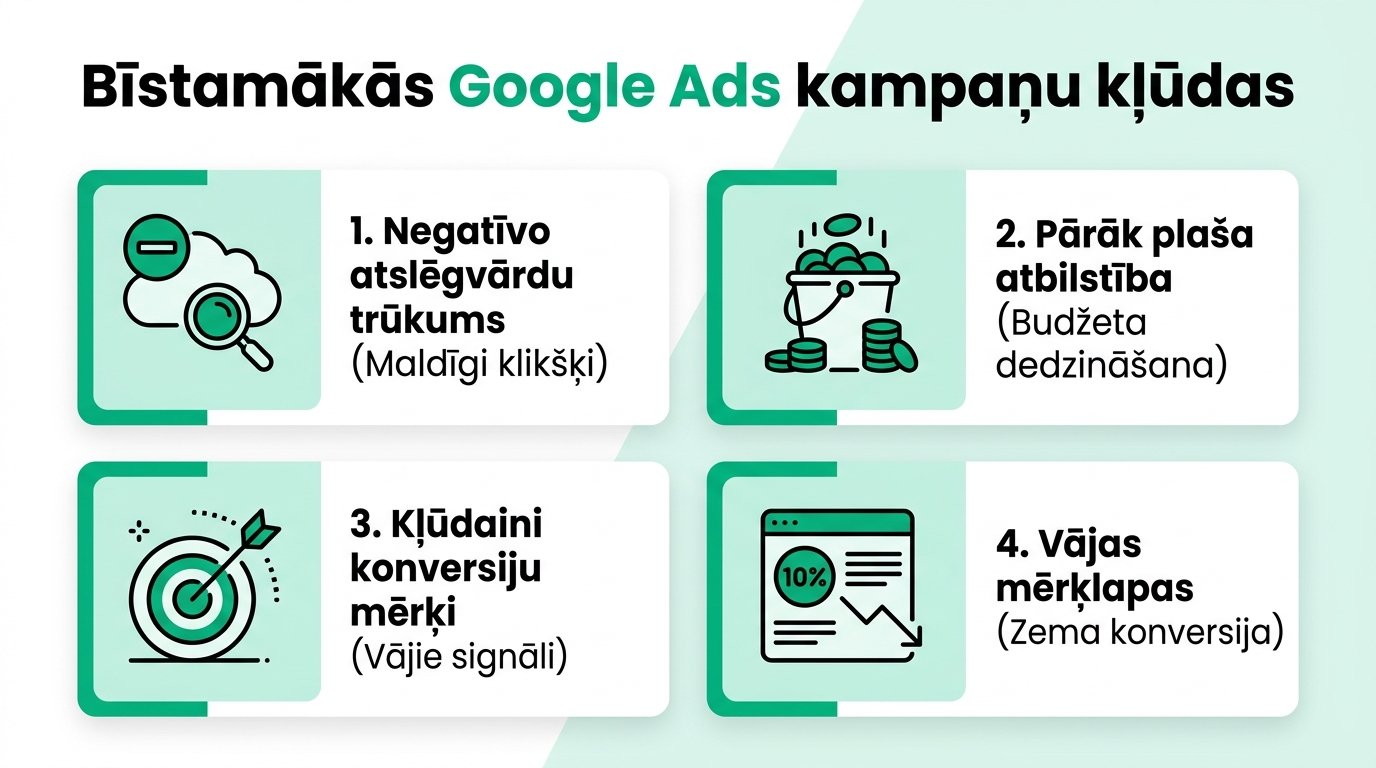
- Lack of negative keywords: Without regular search term audits, up to half of the budget is spent on irrelevant queries (e.g., "free", "job openings", "manual").
- Mixing Search and Display networks: Leaving search campaigns enabled on the Google Display Network generates thousands of accidental clicks in games and mobile apps.
- Faulty conversion signals: If a simple page view is measured as a conversion, the smart bidding algorithm will optimize for empty clicks rather than actual purchases.
- Lack of relevant landing pages: Sending visitors from a specific product ad to a general homepage means guaranteed conversion loss.
The Most Dangerous Google Ads Campaign Mistakes
To understand where advertising returns disappear, let us look at a detailed list of mistakes commonly faced by businesses in Latvia and the Baltics:
1. Ignoring negative keyword lists. If you sell high-end office furniture but have not added negative words like "used", "repair", "DIY", or "rental", you will pay for hundreds of clicks from people who will never become your buyers.
2. Overly aggressive use of Broad Match. Broad Match keywords without clear Smart Bidding conversion data force the system to display ads for distantly related topics, wasting money in idle mode.
3. Combining Search and Display Network into a single campaign. Search ads are designed to capture high purchase intent, whereas the display network is for passive attention. They must not live in the same campaign with a single budget.
4. Incorrect geographic targeting. By default, Google shows ads to people who are in your selected location OR show interest in it. If this is not switched to "People regularly in your targeted locations", you can receive expensive clicks from all over the world.
Structural and Measurement Failures That Reduce ROAS
5. Absence or duplication of conversion tracking. If purchase or inquiry tracking is not properly set up in the account, the Smart Bidding algorithm is blind. Equally dangerous is dual measurement, which artificially inflates reports and misleads management.
6. Sending ads to the website homepage. A user searching for "heat pump installation in Riga" expects to immediately see prices and an inquiry form for heat pumps, rather than having to search for the service on a general homepage.
7. Not using ad assets and extensions. An ad without sitelinks, call buttons, and structured snippets takes up half as much space on the screen, resulting in a lower CTR and a worse Quality Score.
8. Mixing brand and generic queries into one pot. Brand searches show very low cost-per-click and high returns. If they are mixed with generic keywords, you cannot see the true customer acquisition cost.
9. Leaving campaigns on autopilot without regular audits. Even the best campaign ages over time, competitors change bids, and new search queries appear. The account requires regular weekly audits.
10. Drawing conclusions too early during the learning phase. Drastic budget or bidding strategy changes in the first two weeks throw the algorithm back to square one, preventing stable efficiency.
Expert Video on Typical Google Ads Mistakes
Watch this detailed video review by Mike Mancini regarding the most dangerous mistakes and their practical solutions:
How to Regain Control Over Your Advertising Budget
To ensure that every euro invested brings a real return, it is recommended to introduce a regular campaign review procedure: at least once a week, review the search terms report, update negative keyword lists, and compare ad performance against actual purchase numbers in accounting.
If you want a professional outside perspective and a precise audit of your existing campaigns, explore our advertising management and audit services or contact our specialists.
Frequently Asked Questions About Google Ads Mistakes
How often should a negative keyword audit be performed?
Why does my campaign spend the entire daily budget early in the morning?
Is a company brand campaign necessary if we are in first place organically?
Suspect that your Google Ads budget is being wasted on irrelevant clicks?
Book a 15-minute account audit consultation. We will check your search queries and eliminate unnecessary costs.
Fixed budget. No hidden extra fees or pushed services.