

Mistake #1 in advertising budget planning remains relying on a single channel and miscalculating CAC (Customer Acquisition Cost). Channel synergy (Google Ads + SEO + email funnels) and real server-side data tracking allow you to invest only in directions that drive profit. Explore our advertising budget management services.
The end of the year is traditionally the time when marketing managers and business owners sit down at Excel tables to plan how next year's digital advertising and budget allocation will be managed. Unfortunately, most of these plans are built on outdated assumptions or 'last year's figures plus 10 percent'. The result is expensive clicks, wasted potential, and dissatisfaction with marketing returns. In this article, we will examine ten of the most common budget planning traps and the right approach to preventing them.
Key Takeaways
- 70-20-10 budget allocation model: 70% of the advertising budget should be invested in proven, stable channels, 20% in scaling campaigns, and 10% in innovative experiments.
- Ignoring seasonality and bid spikes: Planning a flat budget across all 12 months is a mistake; costs and demand can vary two to three times over the course of the year.
- First-party data budget: Without investments in analytics (where GA4 and Google Tag Manager setup is the foundation), email lists, and CRM systems, advertising efficiency decreases every year due to privacy restrictions.
- Disregarding Customer Lifetime Value (LTV): Evaluating advertising solely on first-purchase profitability often leads companies to abandon profitable campaigns that generate repeat long-term purchases.
Top 10 Most Expensive Mistakes in Digital Advertising Budget Planning
After analyzing campaign reports across various industries for years, we have compiled ten critical stumbling blocks:
1. All eggs in one basket: Investing 100% of the budget solely in Google Ads or only in Meta Ads exposes the business to huge risks the moment platform prices rise or algorithms change.
2. A static budget across all 12 months (ignoring fluctuations, as discussed in our analysis on CAC and ROAS in December auctions): Spending exactly 1,000 euros a month in both quiet January and hot November is a waste of money. The budget must dynamically follow the market demand curve.
3. Misalignment between Customer Acquisition Cost (CAC) and margins: Advertisers often set a goal to 'sell at any cost', forgetting to deduct cost of goods sold, logistics, and taxes.
4. Zero budget for producing new creative assets: Thousands are allocated for ad placements, but nothing is left for creating visuals and videos, forcing months of displaying worn-out banners.
5. Ignoring experiments and testing: If the budget lacks a separate reserve for testing new channels (such as TikTok or LinkedIn), the company loses competitiveness.
6. Focusing only on the bottom of the funnel (Bottom-of-Funnel): Spending exclusively on search ads and remarketing eventually dries up the flow of new buyers, and clicks become increasingly expensive.
7. Prematurely stopping campaigns: Fear of the first two weeks of volatility leads to shutting down a campaign right when the algorithm has almost finished learning.
8. Overlooking GA4 analytics and conversion tracking errors: Decisions are made based on inaccurate data where some transactions are not recorded at all.
9. Ignoring LTV (Customer Lifetime Value): Failing to evaluate how much a client will spend over a year or two prevents competing more aggressively for market share.
10. Lack of an action plan for crisis or breakout moments: If a single campaign starts showing phenomenal results, the company often lacks additional budget reserves for immediate scaling.
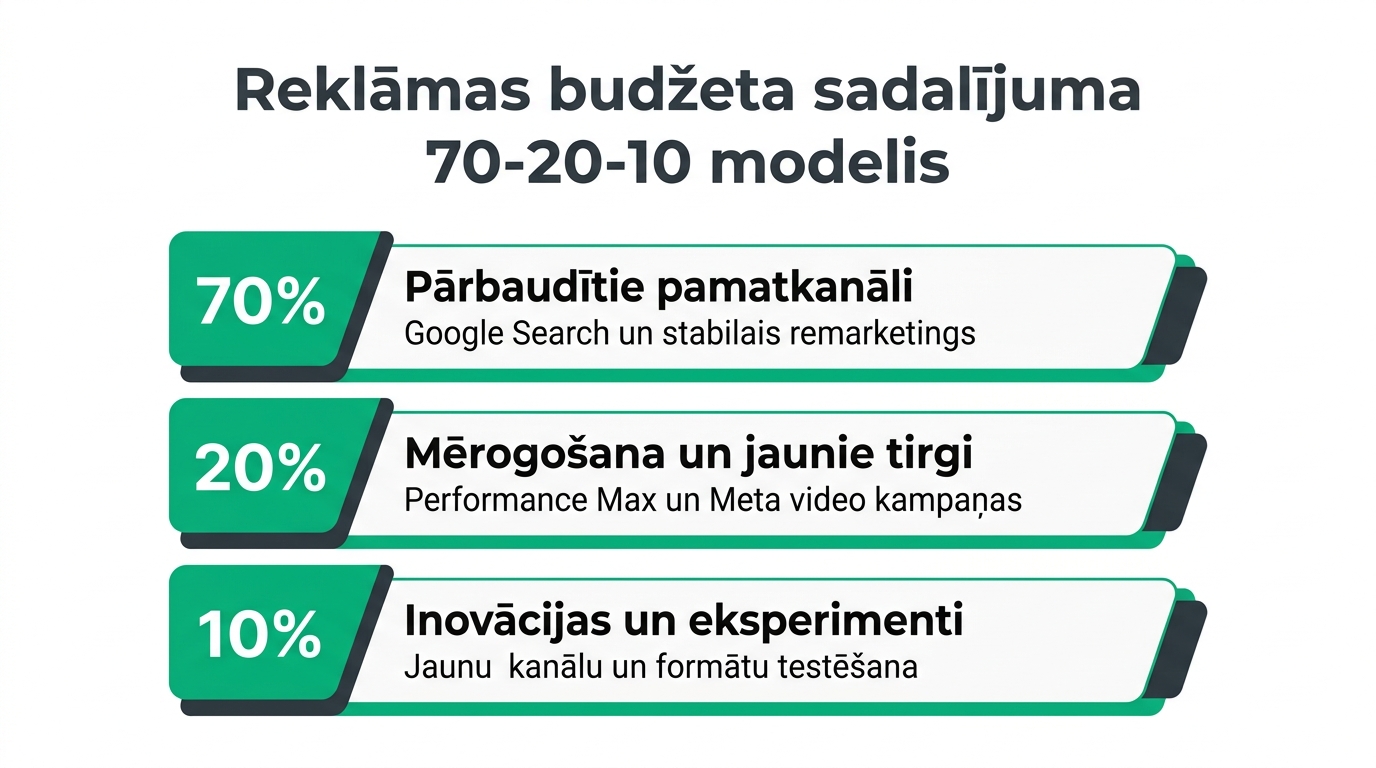
The 70-20-10 Budget Allocation Model in Practice
To ensure both stable profit today and growth tomorrow, use the industry-recognized allocation:
| Share | Percentage | Campaign Types and Goals | Expected Return |
|---|---|---|---|
| Proven core channels | 70% | Google Search with high purchase intent, precise remarketing | Predictable, stable ROAS with minimal risk |
| Scaling and new markets | 20% | Performance Max, Meta Advantage+ video campaigns, new regions | Medium risk, high potential for new customer acquisition |
| Experiments and innovations | 10% | New formats, influencer partnerships, new platforms | High risk, opportunity to discover the next big business breakthrough |
How to Calculate Permissible CAC (Customer Acquisition Cost)
Before setting your annual advertising budget, perform a simple calculation:
Suppose your average order value is 60 euros and your gross profit margin is 40% (24 euros). If you want the advertising to be profitable on the very first purchase while retaining a 50% profit margin, your maximum allowable CAC is 12 euros. Knowing this limit and your desired monthly order volume (e.g., 500 purchases), the required advertising budget is 6,000 euros per month.
Frequently Asked Questions
How large should the experiment budget reserve be?
For small and medium-sized businesses, 10% is the ideal balance. If your monthly budget is 2,000 euros, allocate 200 euros for new visual or platform tests.
Should the budget for next year be split by quarters or months?
The best practice is quarterly budget planning with monthly flexibility. This allows you to reallocate unspent funds to months with higher demand.
What to do if advertising prices in your industry suddenly rise by 30%?
Optimize your landing page conversion rate (CRO). If page conversion increases from 1% to 1.5%, it fully compensates for a 30% increase in cost per click.
Conclusions and Next Steps
Advertising budget planning is not a one-time administrative duty, but a living strategic tool. Apply the 70-20-10 model, calculate real margins, and remember that the best marketing investment is a balanced system that attracts new buyers and retains existing ones.
Planning your advertising budget and want a clear, data-driven return calculation?
Book a 15-minute budget planning call. We will develop the optimal marketing channel allocation for your business.
Fixed budget. No hidden fees or forced services.