

A historical announcement from March 2022 when Google officially announced the Universal Analytics shutdown deadline. Today, Universal Analytics is no longer functional, and GA4 is the sole standard. If you need to organize or audit your measurements, see our data and analytics services and Google Ads management.
March 16, 2022 marked the end of an era in analytics, where correct Google Analytics 4 and GTM implementation became mandatory. Google made an official and uncompromising announcement: the standard Universal Analytics (UA) tool would stop processing new data on July 1, 2023. The platform that served as the primary web traffic measurement tool worldwide for over a decade is being completely replaced by Google Analytics 4 (GA4). Businesses that wait until the last minute risk losing historical comparison data entirely.
Key Takeaways
- Fixed deadline: Starting July 1, 2023, standard UA properties no longer record any visits, and historical data will eventually be deleted as well.
- Year-over-Year (YoY) comparison risk: To compare results with the previous year in July 2023, GA4 needed to run in parallel well before July 1, 2022.
- Radical data model shift: The transition from sessions and pageviews to a unified event-driven architecture.
- Free BigQuery integration: GA4 provides direct raw data export to the Google cloud, previously available only in the expensive Analytics 360 version.
Why the UA shutdown changes the rules of the game and how data analytics is evolving
Universal Analytics was built in 2005 (based on Urchin technology) when an internet user typically sat down at a desktop computer, opened a browser, and completed an order within a single continuous session. Modern users behave completely differently: they open a link in a smartphone app in the morning, browse offers on a tablet at lunch, and place an order on a computer in the evening.
UA treated this single user as three different people and three separate sessions. Furthermore, privacy restrictions (Safari ITP, Firefox ETP, ad blockers) distorted session duration and bounce rate metrics. GA4 is built from the ground up, combining web and app data into a unified whole.
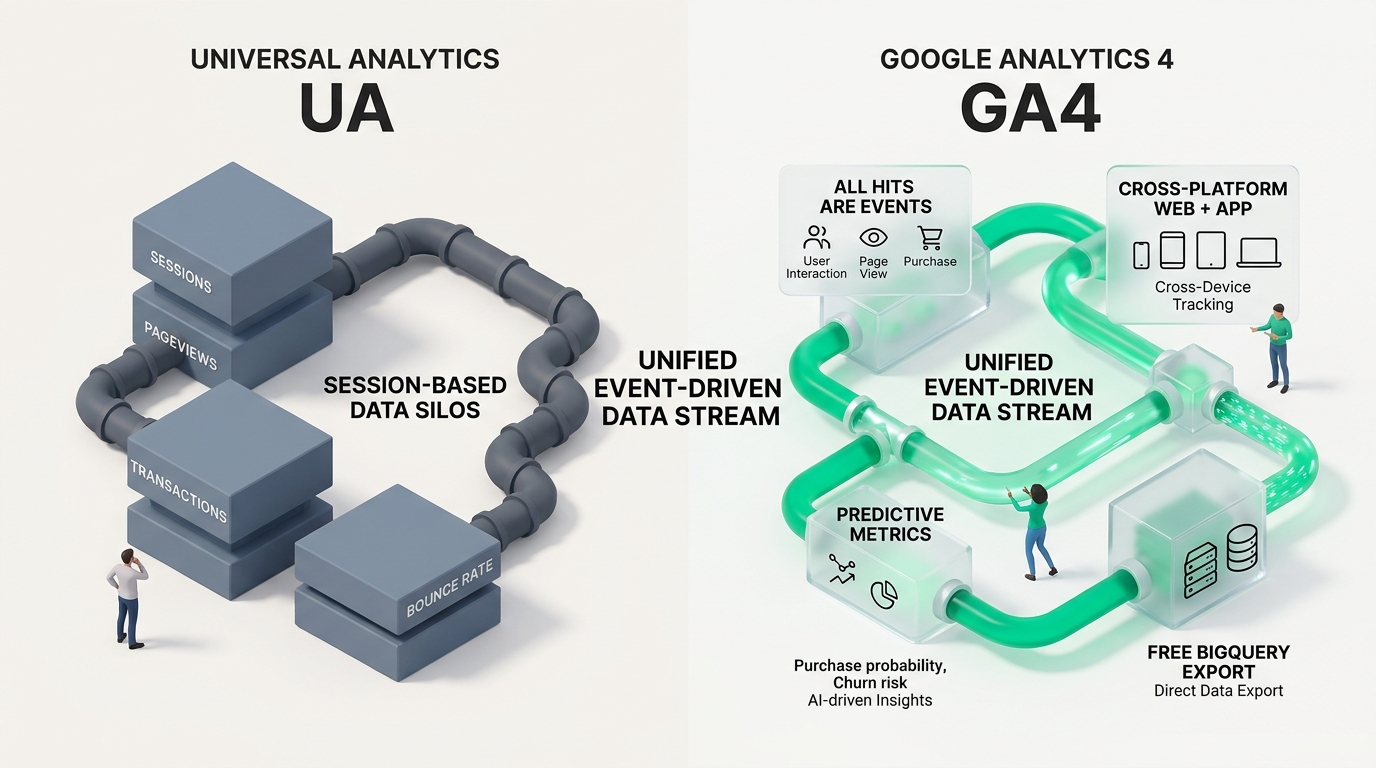
Key differences: GA4 and server-side measurement architecture
- Everything is an event: GA4 no longer has separate hit types like pageview, event, social interaction, or e-commerce. Any action - a page load, click, video view, or purchase - is an event with its own parameters.
- Engagement Rate replaces Bounce Rate: Instead of the outdated bounce rate, GA4 measures engaged sessions (longer than 10 seconds, with 2+ pageviews, or a conversion).
- Predictive metrics: Using machine learning, GA4 can predict purchase probability in the next 7 days and user churn risk.
- Free connection to BigQuery: Every business now has the opportunity to export raw data to its own data warehouse, eliminating data sampling limitations.
Practical Loves Data video guide on GA4 capabilities
Watch an in-depth Loves Data video course on how to master the GA4 environment step by step, set up basic events, and compare the new interface with familiar Universal Analytics:
Frequently Asked Questions about the Universal Analytics Shutdown
Will my historical UA data automatically transfer to my new GA4 account?
No. Because GA4 and Universal Analytics use fundamentally different data models (events versus sessions), historical data cannot be directly imported into GA4. That is why GA4 should be launched in parallel immediately to start accumulating its own history in the new system.
Should I delete the old UA code from my website right after launching GA4?
No, the best practice is Dual Tagging. Keep both codes running simultaneously until July 2023 - UA will ensure the continuity of familiar daily reports while GA4 accumulates data for the future in parallel.
How long after July 2023 will old UA data remain available?
Data protection and modeling (which we covered in detail in our analysis on conversion modeling and first-party data): UA will be accessible in the interface for at least six months after the shutdown date. After this period, old data will be permanently deleted, so it is recommended to export essential historical reports in time.
Need a professional GA4 and conversion measurement audit for your website?
Book a 15-minute call. We will help check event tracking, purchase values, and ensure accurate data for your advertising campaigns.
Fixed budget. No hidden fees or forced services.