
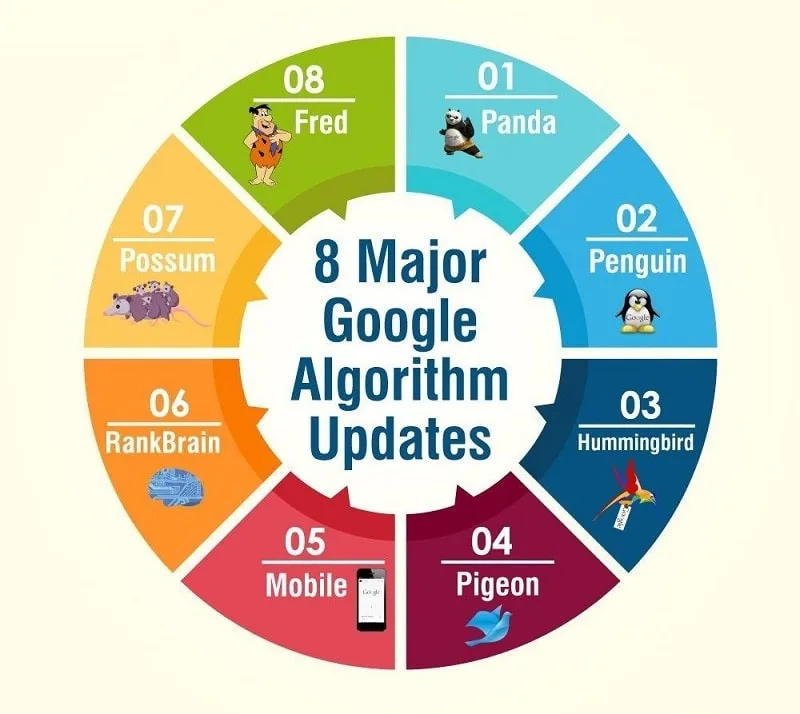
A historical guide to Google algorithms from 2020. Since the days of Panda and Penguin, the core principle has remained unchanged: technical cleanliness, internal linking architecture, and solving real user problems outperform any algorithm fluctuations. For modern search requirements, read our research on Google Core Updates and the impact of AI content or request a Website SEO Audit.

May 2020 began with a new movement in the Search Engine Optimization (SEO) industry. Google is rolling out another major update, shifting the order of results and rankings in the search engine. This is the time when SEO specialists crawl out from every corner, and the long-awaited online buzz begins. Businesses and clients alike are reminded of the importance of Google optimization. In short: it is an SEO carnival!
Google algorithm updates (Panda, Penguin, Core Updates) are aimed at one primary goal: clearing search results of low-quality, manipulated content and highlighting sites with genuine user value. Long-term protection against ranking drops relies on three pillars: technically flawless website code, a well-organized internal link structure, and authentic industry expertise.
Why does Google do this?

Google still generates most of its revenue from paid advertisements that appear in its search engine. These ads are also visible on many websites within the Google partner network, YouTube, and Gmail, but the vast majority still come directly from Google Search.
As we know, in addition to paid ads, Google Search also provides organic results (oh yes, thanks for the reminder, Aigars!). While these are gradually being "eaten away" by various new features, they still exist, and people use them. This is primarily why visitors use Google in the first place. No matter how you look at it, Google must maintain order in these organic results. If they become a mess, people will stop using the search engine, and Google's advertising revenue will drop significantly.
And then there is a huge crowd of people who manipulate these results, trying to attract as many visitors as possible to their website, even though the quality and relevance of the site to the searched keyword are often questionable.
That is Google's main goal: to get rid of these irrelevant results, improve them, and make the user experience better and better.
History of Updates
Google was launched back in 1997. Results were displayed under the influence of the legendary PageRank algorithm. After 5 years of operation, the first publicly known update was performed in 2002. It is believed that this is when PageRank ceased to be the only Google algorithm. From this moment on, Google updates became a daily part of the SEO industry, a kind of competition to see who could outsmart competitors in predicting the next changes, ensuring their website would be a winner rather than a loser.
2003-2009: Small but important

In 2003, there were 6 (!) deliberate updates - Boston, Cassandra, Dominic, Esmeralda, Fritz, and Florida. They were primarily aimed at link spam, hidden text, keyword stuffing, and link schemes.
The 2004 Brandy update introduced LSI (Latent Semantic Indexing) - it assigned value to link anchor text and how links were labeled ("click here," "read more," "Company X," etc.).
Another significant turning point occurred in early 2005 when Google introduced the nofollow attribute, which is now used by countless news portals and beyond. This attribute indicates that the search engine should not follow the link (essentially telling it to ignore the link). Thus, Google and all other search engines began the fight against link spam.
Back then, Google even had its own "SEO guy" (until 2015), the head of the webspam team, Matt Cutts, whose every move was followed by the entire SEO world. Every word Matt said at the time was like a divine sign; you just had to interpret it correctly.
2010-2011: The arrival of Panda

The next significant update occurred in 2010 - Caffeine. Until then, larger or smaller updates affecting spam techniques were carried out almost every year, but this time the website indexing order was changed, and new pages were added to Google almost in real-time.
In 2010, along with other updates, Google also began penalizing pages with thin content, as well as those that provided a poor user experience.
Quite quietly, in that same 2010, Google also announced that signals from social networks like Facebook and Twitter would henceforth be taken into account for websites. We also conducted several experiments at the time, which proved that social signals have a significant impact on results.
The 2011 Attribution update paid more attention to stolen, already published content.
In the same year, the massive Panda update arrived, affecting about 1/5 of all internet pages. It was aimed at spam, content farms, stolen/copied content, and pages with an excessively high ad-to-content ratio. The original Panda was followed by many other versions until Google eventually incorporated it into the core algorithm as a permanent component.
At the end of 2011, in the shadow of Panda, another significant update arrived - Freshness. From this point on, Google began assigning more value to new content, pushing websites with outdated content lower in the results.
2012: The Penguin enters

The Penguin update is one of the largest anti-spam efforts in Google's history. An open war was declared against those using prohibited techniques - external link manipulation and link schemes were the main targets.
The Penguin update, much like Panda, had many improved versions until...
In 2016, Google announced that Penguin was becoming a core component of the Google algorithm, meaning it is used when indexing a page (rather than just penalizing for past actions).
By the way, in that same now-distant 2012, Google also introduced the EMD (Exact Match Domain) update, which significantly reduced the value of domain names that matched keywords.
2013-2014: Hummingbird and Pigeon take flight

The Hummingbird update essentially put an end to keyword spam in website content. No, it is not that including keywords in content no longer had meaning, but content quality and context became more important than the number of keywords. This update also gave much greater importance to the deeper content of a page.
2014 is interesting for the Payday Loans update - an update essentially aimed at one specific industry, which in Latvia we know as "quick loans," which were taking over the world at the time. Of course, Google positioned it as just another update aimed at link buying, low-quality external links, and over-optimization. The update affected more than just sites dedicated to quick loans.
In 2014, the next big update arrived - Pigeon. This update is historic because it was aimed at improving local results. For businesses in the US, it meant changes measured in millions, while in Latvia, it practically meant that an Ogre hair salon should appear higher for the search "hair salon" than a competitor in Riga. Thus, the feature we cannot live without today in the smartphone era was activated - high-quality local search.
2015-2017: RankBrain and Mobile-First

In 2015, the RankBrain algorithm was implemented, which officially introduced the third most important component to the Google algorithm alongside external links and content: machine learning. The goal is simple: taking into account the massive volume of data controlled by Google, provide the user with the highest quality result for their search. Google is literally trying to guess what a person is looking for. Essentially, this means that since 2015, manipulating the Google algorithm has become even more difficult.
In 2015, the Mobilegeddon update was the first signal that developers needed to pay more attention to mobile versions of websites. This update did not yet affect desktop searches, but in the mobile environment, preference was already given to mobile-friendly pages. In 2016, this signal was even stronger, and today we can certainly state that responsive, mobile-friendly pages are given priority in all searches.
Recent Years
To keep life interesting, SEO specialists are constantly catching known fluctuations in Google results, sometimes artificially assigning them names (e.g., the Fred update), but in reality, Google now performs updates daily; the algorithm works at a level where it updates itself without manual intervention. Google does not package updates in beautiful names and does not speak much about them publicly.
In any case, one thing is clear: improvements are constantly being made, and much is being done for the mobile environment, as the use of Google Search on mobile devices has grown dramatically over these years.
The Latest May Update

The current update, which is not implemented in a single day but is a long process that has been ongoing for a month, is also not officially named by Google; it is just another update. However, many have noticed significant changes in the results, so it is clear that something larger is happening in the Google algorithm than usual.
Later today, we are releasing a broad core algorithm update, as we do several times per year. It is called the May 2020 Core Update. Our guidance about such updates remains as we’ve covered before. Please see this blog post for more about that:https://t.co/e5ZQUAlt0G
- Google SearchLiaison (@searchliaison) May 4, 2020
Experts share various observations:
- websites with negative link dynamics are suffering - lost links outnumber gained ones
- pandemic impact - websites that are no longer relevant currently are losing weight, replaced by results more appropriate to the search
- AI impact - human search habits have changed so drastically that it is a surprise even to Google's artificial intelligence, which is trying to adapt
- among the biggest winners are content-rich pages; losers include business websites with weak content
Neil Patel, in his blog post, shares interesting observations that the biggest winners are websites with regular new content additions, while losers are those with irregular and weak existing content.
What exactly should I do?

You need to add up all the factors and take the sum. Every major update remains in Google's core algorithm. The more you know, the better you navigate SEO factors - what can be done, what is better not to do, where you can take risks, and where it is better not to.
That is exactly why this blog post is so long and has a strong historical touch. As you might guess, the May update is big, but compared to those that have already happened, it seems it could be just another one.
You must take into account everything that has happened before, start with an analysis of all major updates, apply the influencing factors to your website, and make the necessary changes if a risk factor is identified. Only then can you be sure that no major shocks await you in the future.
Key things:
- pay close attention to the technical state of the website, design, speed, and user experience
- start creating content, do not let the website "die" - write news, blog posts
- create rich, valuable content, the kind that people like; do not think about whether the search engine algorithm likes it, solve problems, answer questions
- make the website friendly to all devices and browsers!
- use internal links to tell the search engine which pages are the most important on your site
- ask partners, friends, related projects, and organizations to link to your website
- do not buy questionable quality links that will "instantly improve website positions and cost only 50 EUR"
- if you are not sure, do not take the risk
Frequently Asked Questions about Google algorithm updates
What should I do if my website's rankings suddenly drop after a Google algorithm update?
The first golden rule is not to make chaotic decisions and not to change everything at once. Wait 2-3 weeks for the algorithm rollout to conclude, and conduct a technical and content audit to determine the real reasons.
Why are internal links so important for Google Search?
Internal links pass authority and help the search bot understand which pages are your primary pillar pages. A well-organized cluster link network significantly speeds up the indexing and ranking of your most important services.
What is the difference between Google Panda and Penguin algorithms?
Panda historically penalized low-quality, short, and duplicate content (thin content), while Penguin targeted artificial, purchased, and spammy backlinks. Today, both are integrated into the core search engine.
Want to protect your website from algorithm fluctuations and improve rankings?
Request a professional SEO audit. We will evaluate your website's technical health, content relevance, and prepare concrete steps for stable growth.
Fixed budget. No hidden fees or forced services.