
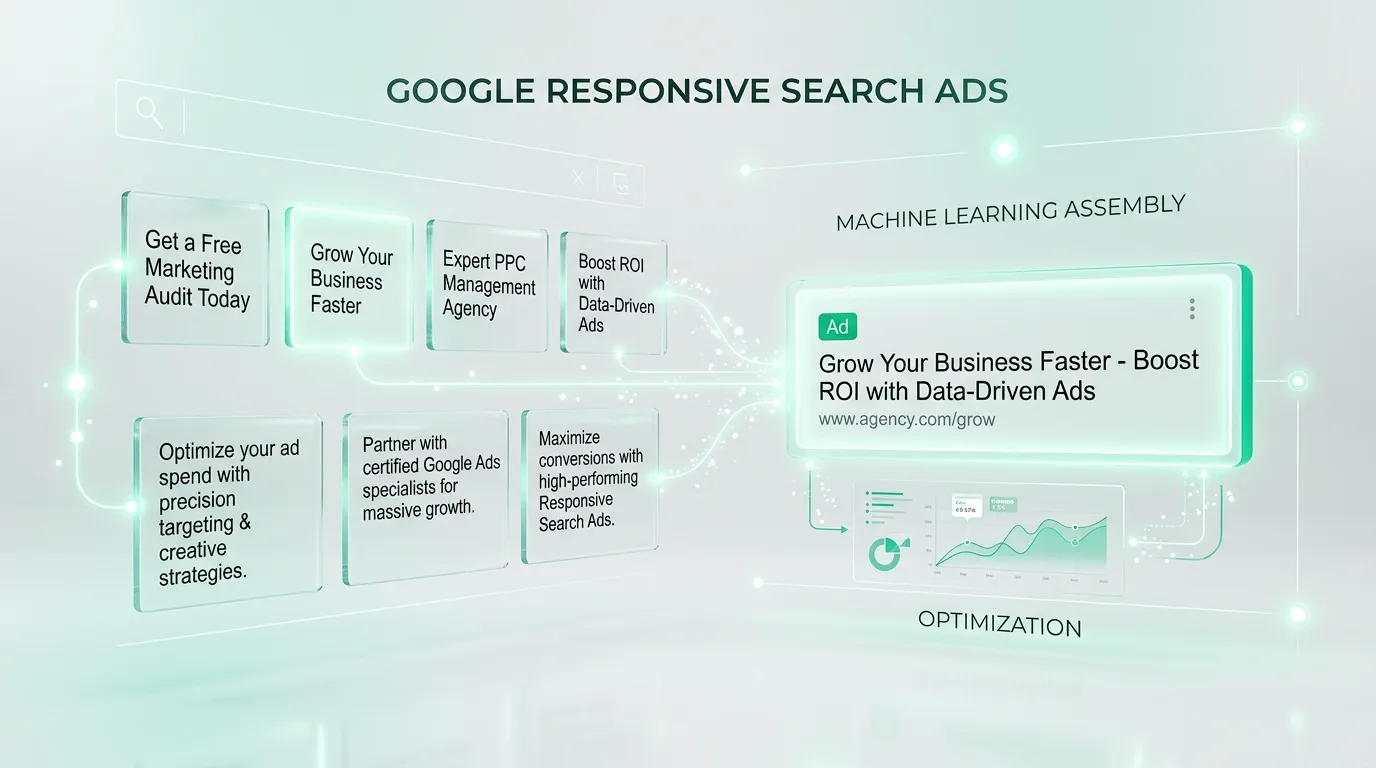
Historical analysis regarding the discontinuation of Expanded Text Ads in the summer of 2022. Today, Responsive Search Ads (RSA) combined with Performance Max serve as the standard, focusing primarily on the qualitative value of headlines and descriptions. Learn more about our Google Ads campaign management.
The official announcement by Google Ads regarding the retirement of the ETA format on June 30, 2022, marks one of the biggest milestones in the history of search advertising. For years, digital marketing specialists manually polished every letter across three fixed headlines and two descriptions. Now, this static approach is becoming a thing of the past. It is replaced by Responsive Search Ads (RSA) - a machine learning system that combines the most relevant message for each specific searcher in real time during every individual auction.
Key Takeaways
- End of the static era: Starting June 30, 2022, new ETAs can no longer be created or edited, making RSA the primary format for search ads.
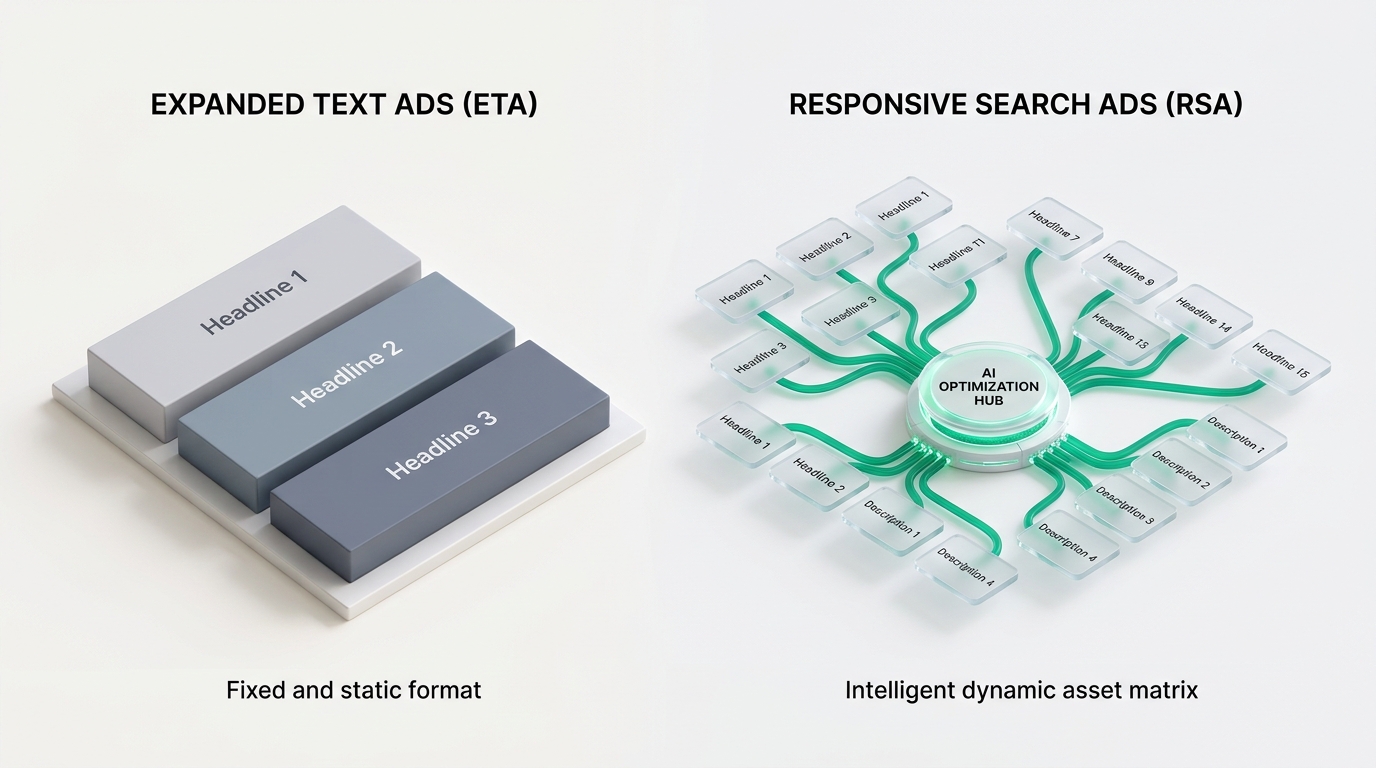
- Asset matrix principle: Instead of one fixed text, you now need to prepare up to 15 different headlines and 4 descriptions, ensuring maximum thematic diversity.
- Pinning risks: Excessive pinning of headlines to specific positions limits algorithmic flexibility and often lowers the campaign Ad Strength score.
- Higher auction returns: Properly structured RSA ads cover 10-15% more relevant queries and deliver a lower average cost-per-click.
Why the old ETA format can no longer compete with machine learning
The classic Expanded Text Ads format was born at a time when user queries in search engines were short and predictable. However, today approximately 15% of all searches entered into Google every day are completely new queries that the system has never seen before. People no longer search for just two keywords - they ask complex questions, compare solutions, and specify conditions.
With a fixed three-line headline structure, it is impossible to precisely answer all these nuances of user intent. Responsive Search Ads solve this problem by allowing the algorithm to test thousands of possible combinations and select the exact message that best matches the user location, device, and search history at any given moment.
Text preparation: high-converting ad copy and content creation
The most common mistake when transitioning to RSA is entering 15 nearly identical headlines with minimal word variations. The algorithm requires real semantic diversity. Here is a proven matrix structure for high-converting ads:
- Keyword headlines (3-4 variants): Direct match with the searched service or product to engage the user and ensure a high Quality Score.
- Value propositions and benefits (3-4 variants): Why choose you - delivery speed, industry experience, warranties, or official representative status.
- Calls to action or CTAs (2-3 variants): A clear next step, such as calculate costs, apply for a consultation, or order online.
- Brand and social proof (2-3 variants): Company name, number of satisfied clients, or industry awards.
Achieving goals: digital advertising and pinning logic: When to fix a position and when to let the algorithm decide
The Google Ads interface provides the option to pin any headline to position 1, 2, or 3. If legal requirements or industry specifics dictate that the company name or disclaimer must be visible, pinning is necessary. However, if you pin every position with a single variant, you essentially turn your RSA back into the old ETA and lose all the advantages of machine learning.
A best practice is flexible pinning: if you want a keyword to always appear in position 1, pin at least 3 different keyword variations to position 1. This way, Google can still test the best variant while maintaining your preferred structure.
Official Google Ads video guide on Responsive Search Ads
Watch the official Google Ads team training video on how to correctly prepare effective Responsive Search Ads assets and achieve the best campaign returns:
Frequently Asked Questions about transitioning to RSA
What will happen to my existing Expanded Text Ads after June 30?
Auctions will continue (as we discussed in detail in our article on Google Ads Phrase Match changes and the retirement of BMM), and historical data will remain available for them. However, you will no longer be able to edit them or add new ETA texts, making it mandatory to base new campaign structures on RSA.
How many Responsive Search Ads should be placed in one ad group?
Google recommends maintaining at least one well-configured RSA with an Ad Strength rating of "Good" or "Excellent" per ad group, alongside all relevant ad extensions or assets (Sitelinks, Callouts, Structured Snippets).
Does a low Ad Strength rating directly stop an ad from showing?
No, Ad Strength is solely a diagnostic tool and not a direct auction ranking factor. However, it indicates that your texts lack diversity or keyword relevance, which drives up click costs and reduces ad impression frequency in the long run.
Want to modernize and optimize your company Google search ads?
Book a 15-minute strategy call. We will review campaign texts and assets, and improve click performance.
Fixed budget. No hidden fees or forced services.